


Page 1218 - Clinical Immunology_ Principles and Practice ( PDFDrive )
P. 1218
1182         Part tEN  Prevention and Therapy of Immunological Diseases


            KEY CONCEPt                                                        Imiquimod
         Cyclosporine: Mechanism of Action                                                NH
                                                                                      N     2
          Association with cyclophilin
          Formation of cyclosporine–cyclophilin complex
          Binds calcineurin
          Inactivates calcineurin                                                           N
          Regulatory proteins unable to translocate into nucleus
          Transcription of proinflammatory genes affected                                   CH 2
                                                                                            CH
        Adverse Effects                                                                 CH 3   CH 3
        The most common side effects of cyclosporine are hypertension,   FIG 87.10  Imiquimod—chemical structure.
        hyperkalemia, hypomagnesemia, and hyperlipidemia. More
        importantly, cyclosporine has well-documented short-term and
                                            15
        long-term adverse effects on kidney function.  These data come
        from patients who had received solid organ transplants, most   SIROLIMUS
        notably renal transplants. In such patients, initial doses of
        15–25 mg/kg/day led to a reduction in the glomerular filtration   Sirolimus is a macrolide that binds the cytosolic protein FK-binding
        rate (GFR) and rise in serum creatinine in a percentage of patients,   protein 12 (FKBP12). In contrast to the tacrolimus–FKBP12
                                            16
        as well as histologically proven nephropathy.  The pathogenic   complex, which inhibits calcineurin, the sirolimus–FKBP12
        mechanism of kidney damage is poorly understood but is believed   complex directly binds the mammalian target of rapamycin
                           17
        to consist of two phases.  The first is a period of partial ischemia   (mTOR) complex1 (mTORC1), thereby inhibiting the mTOR
        secondary to vascular contraction, which is reversible with dose   pathway. Thus it inhibits the response to IL-2, blocking activa-
        reduction or drug discontinuation. The later, irreversible phase   tion of T and B cells. It has shown promise in the treatment
                                                                                                                19
        results from chronic scarring of the glomeruli. Treatment recom-  for systemic lupus erythematosus (SLE); Sjögren syndrome ;
                                                                  20
        mendations for some diseases, such as psoriasis, have therefore   RA ; psoriasis; genetic disorders, such as tuberous sclerosis;
                                                                                                        21
        been targeted at much lower maximum daily doses of 5 mg/kg/  and neoplastic disorders, such as Kaposi sarcoma.  The main
        day, with a reduced dose if creatinine rises 30% above baseline.   advantage of sirolimus over tacrolimus or cyclosporine is reduced
        Otherwise healthy patients treated at these dosage levels have   renal toxicity.
        been successfully managed for many years on cyclosporine with
                          18
        no impact on the GFR.  Nephrotoxicity has also been a concern   IMIQUIMOD
        during tacrolimus therapy. Other adverse effects include increased
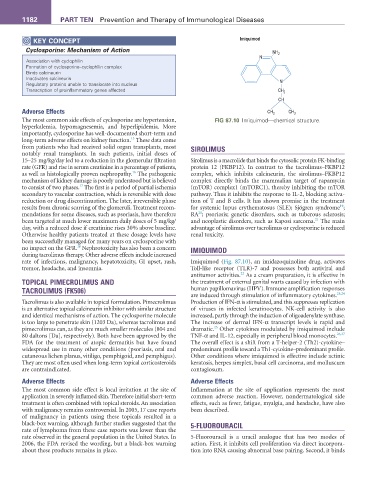
        rate  of  infections,  malignancy,  hepatotoxicity,  GI  upset,  rash,   Imiquimod (Fig. 87.10), an imidazoquinoline drug, activates
        tremor, headache, and insomnia.                        Toll-like receptor (TLR)-7  and possesses both antiviral  and
                                                                                22
                                                               antitumor activities.  As a cream preparation, it is effective in
        TOPICAL PIMECROLIMUS AND                               the treatment of external genital warts caused by infection with
        TACROLIMUS (FK506)                                     human papillomavirus (HPV). Immune amplification responses
                                                               are induced through stimulation of inflammatory cytokines. 23,24
        Tacrolimus is also available in topical formulation. Pimecrolimus   Production of IFN-α is stimulated, and this suppresses replication
        is an alternative topical calcineurin inhibitor with similar structure   of viruses in infected keratinocytes. NK-cell activity is also
        and identical mechanisms of action. The cyclosporine molecule   increased, partly through the induction of oligoadenylate synthase.
        is too large to penetrate skin (1203 Da), whereas tacrolimus and   The  increase  of  dermal  IFN-α  transcript  levels  is  rapid  and
                                                                       25
        pimecrolimus can, as they are much smaller molecules (804 and   dramatic.  Other cytokines modulated by imiquimod include
        80 daltons [Da], respectively). Both have been approved by the   TNF-α and IL-12, especially in peripheral blood monocytes. 26,27
        FDA for the treatment of atopic dermatitis but have found   The overall effect is a shift from a T-helper-2 (Th2)-cytokine–
        widespread use in many other conditions (psoriasis, oral and   predominant profile toward a Th1-cytokine–predominant profile.
        cutaneous lichen planus, vitiligo, pemphigoid, and pemphigus).   Other conditions where imiquimod is effective include actinic
        They are most often used when long-term topical corticosteroids   keratosis, herpes simplex, basal cell carcinoma, and molluscum
        are contraindicated.                                   contagiosum.
        Adverse Effects                                        Adverse Effects
        The most common side effect is local irritation at the site of   Inflammation at the site of application represents the most
        application in severely inflamed skin. Therefore initial short-term   common adverse reaction. However, nondermatological side
        treatment is often combined with topical steroids. An association   effects, such as fever, fatigue, myalgia, and headache, have also
        with malignancy remains controversial. In 2005, 17 case reports   been described.
        of malignancy in patients using these topicals resulted in a
        black-box warning, although further studies suggested that the   5-FLUOROURACIL
        rate of lymphoma from these case reports was lower than the
        rate observed in the general population in the United States. In   5-Fluorouracil is a uracil analogue that has two modes of
        2006, the FDA revised the wording, but a black-box warning   action. First, it inhibits cell proliferation via direct incorpora-
        about these products remains in place.                 tion into RNA causing abnormal base pairing. Second, it binds

