


Page 1284 - Clinical Immunology_ Principles and Practice ( PDFDrive )
P. 1284
1246         Part ElEvEn  Diagnostic Immunology


           Flow cytometry can be used to test for the presence or absence   CD62L, and CXCR7 and memory T cells that express the alterna-
        of a specific cell surface antigen. An example of this type of   tive CD45 isoform, CD45RO (and varied CD62L, or CXCR7,
        application is in the evaluation of a patient with a history of   depending on whether the cells are central or effector memory
                                                                    35
        recurrent skin infections, delayed wound healing, and persistent   cells).  In addition, memory B cells can be detected by the
        granulocytosis, which suggests a diagnosis of leukocyte adhesion   expression of CD27 and can be further divided into isotype-
        deficiency type 1 (LAD-1). 28,32  This disorder results from a defect   switched and isotype-nonswitched memory cells on the basis
        in the gene encoding CD18, preventing the expression of three   of their pattern of surface immunoglobulin expression. 29,36
        different heterodimeric adhesion molecules (β 2  integrins) each   Defects associated with familial lymphohistiocytosis (FLH)
        containing CD18 (Chapter 22). This disorder can usually be   are generally associated with abnormal NK cell function. Many
        diagnosed by studying granulocytes (and lymphocytes) for the   of the FHL-causing defects can be determined by flow cytometry.
        expression of CD18 (as well as the three isoforms of CD11).   For example, signaling lymphocyte activation molecule (SLAM)
        Patients often have decreased rather than absent CD18 expression   associated protein (SAP) and X-linked inhibitor of apoptosis
        and  confirmation  of  the  diagnosis  can  be  accomplished  by   (XIAP) intracellular staining can be used to evaluate for X-linked
        demonstrating failure of CD18 (and CD11a, 11b, 11c) upregula-  lymphoproliferative (XLP) disorders types 1 and 2, respectively.
        tion following granulocyte activation. 28              Likewise, lack of intracellular perforin expression in NK cells
           Immunophenotyping can also help address questions regarding   would be indicative of hemophagocytic lymphohistiocytosis
        the level of cell differentiation. Antibodies specific to proteins   (HLH) type 2. Additionally, the evaluation of CD107a surface
        expressed by early (precursor) cells represent one approach and   expression, which is normally expressed on cytoplasmic granules
        would include evaluating for the thymocyte marker CD1 or the   and upon incubation with specific target cells (e.g., K562 cells)
        pre-B-cell marker CD10 (CALLA), to cite a few. However, defining   gets expressed on the surface of NK cells, is useful in determining
        the developmental level of a particular cell population or sub-  the underlying genetic defect causing FHL. 37,38  Specifically, lack
        population is best accomplished by using a panel of reagents   of CD107a upregulation is suggestive of syntaxin-11  or
        that span the natural history of the cell lineage. This approach   MUNC-13.4 defects.
        represents the standard for testing leukemias and lymphomas.
        In addition to defining the presence or absence of specific antigens,   INTRACELLULAR EVALUATION
        evaluating their level of expression is also valuable, which may
        be altered in abnormal cells. Malignant cells may also express   Cellular Activation
        antigens associated with different lineages and have altered FSC
        and SSC characteristics, as well as diminished or absent CD45    ClInICal rElEvanCE
        expression, requiring modified gating approaches.
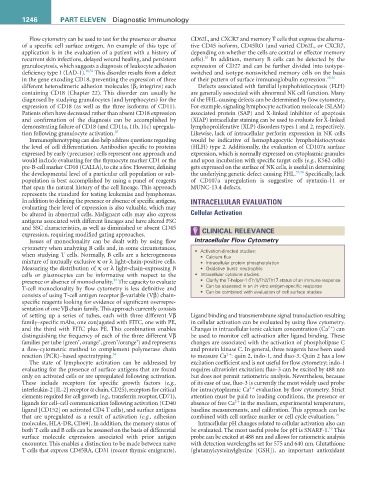
           Issues of monoclonality can be dealt with by using flow   Intracellular Flow Cytometry
        cytometry when analyzing B cells and, in some circumstances,   •  Activation-directed studies:
        when studying T cells. Normally, B cells are a heterogeneous   •  Calcium flux
        mixture of mutually exclusive κ or λ light-chain-positive cells.   •  Intracellular protein phosphorylation
        Measuring the distribution of κ or λ light-chain-expressing B   •  Oxidative burst: neutrophils
        cells or plasmocytes can be informative with respect to the   •  Intracellular cytokine studies:
                                      33
        presence or absence of monoclonality.  The capacity to evaluate   •  Clarify the T-helper-1 (Th1)/Th2/Th17 status of an immune response
        T-cell monoclonality by flow cytometry is less definitive and   •  Can be assessed in an in vitro antigen-specific response
        consists of using T-cell antigen receptor β-variable (Vβ) chain-  •  Can be combined with evaluation of cell surface studies
        specific reagents looking for evidence of significant overrepre-
        sentation of one Vβ chain family. This approach currently consists
        of setting up  a series  of tubes, each with  three different Vβ   Ligand binding and transmembrane signal transduction resulting
        family–specific mAbs, one conjugated with FITC, one with PE,   in cellular activation can be evaluated by using flow cytometry.
                                                                                                            2 +
        and  the third with FITC plus  PE. This  combination enables   Changes in intracellular ionic calcium concentration (Ca ) can
        distinguishing the frequency of each of the three different Vβ   be used to monitor cell activation after ligand binding. These
                                       +
                                              +
                                 +
                          +
        families per tube (green , orange , green /orange ) and represents   changes are associated with the activation of phospholipase C
        a  flow-cytometric method to  complement polymerase chain   and protein kinase C. In general, three reagents have been used
                                                                           2 +
        reaction (PCR)–based spectratyping. 34                 to measure Ca : quin 2, indo-1, and fluo-3. Quin 2 has a low
           The state of lymphocyte activation can be addressed by   excitation coefficient and is not useful for flow cytometry; indo-1
        evaluating for the presence of surface antigens that are found   requires ultraviolet excitation; fluo-3 can be excited by 488 nm
        only on activated cells or are upregulated following activation.   but does not permit ratiometric analysis. Nevertheless, because
        These include receptors for specific growth factors (e.g.,   of its ease of use, fluo-3 is currently the most widely used probe
                                                                                   2 +
        interleukin-2 [IL-2] receptor α chain, CD25), receptors for critical   for intracytoplasmic Ca  evaluation by flow cytometry. Strict
        elements required for cell growth (e.g., transferrin receptor, CD71),   attention must be paid to loading conditions, the presence or
                                                                              2 +
        ligands for cell–cell communication following activation (CD40   absence of free Ca  in the medium, experimental temperature,
        ligand [CD152] on activated CD4 T cells), and surface antigens   baseline measurements, and calibration. This approach can be
        that are upregulated as a result of activation (e.g., adhesion   combined with cell surface marker or cell cycle evaluation. 10
        molecules, HLA-DR, CD69). In addition, the memory status of   Intracellular pH changes related to cellular activation also can
                                                                                                             10
        both T cells and B cells can be assessed on the basis of differential   be evaluated. The most useful probe for pH is SNARF-1.  This
        surface  molecule  expression associated  with  prior antigen   probe can be excited at 488 nm and allows for ratiometric analysis
        encounter. This enables a distinction to be made between naïve   with detection wavelengths set for 575 and 640 nm. Glutathione
        T cells that express CD45RA, CD31 (recent thymic emigrants),   (glutamylcysteinylglycine [GSH]), an important antioxidant

