


Page 138 - Clinical Immunology_ Principles and Practice ( PDFDrive )
P. 138
120          ParT ONE  Principles of Immune Response


        or CD8 coreceptor. This is accompanied by the movement of                                            CD4
        these cells into the medulla of the thymus. Once in the medullary                                     SP
        region, interactions with mTECs support negative selection of
        the maturing T cells, ensuring the deletion of autoreactive T                                        CD4+
                                                                                                             CD8–
        cells from the repertoire. Surviving single-positive (SP) thymocytes   HSC  ETP    DN        DP
        exit the thymus as mature T cells.
                                                                                          CD4–      CD4+
                                                                                          CD8–      CD8+     CD8
                                                                                                              SP
        LINEAGE COMMITMENT                                                                                   CD4–
        T-cell lineage commitment is the result of a stepwise develop-        THYMUS   HUMAN                 CD8+
                                                    4,5
        mental program that starts with HSCs in bone marrow.  These                DN1  DN2
        HSCs are already endowed with the potential to differentiate               CD34+ CD34+
        into T cells when directly transplanted into the thymus. However,          CD38– CD38+
        these HSCs do not fulfill this fate because they lack the ability          CD1A– CD1A–    T lineage commitment
        to migrate to the thymus. Hence, further differentiation is              MOUSE
        necessary.
                                                                                   DN1  DN2  DN3  DN4
        THE COMMON LYMPHOID PROGENITOR                                             CD25– CD25+ CD25+  CD25–
                                                                                   CD44+ CD44+ CD44 low CD44–
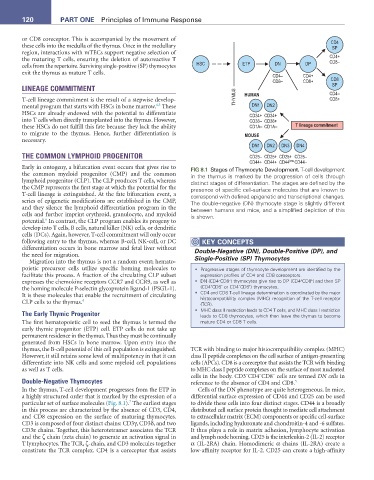
        Early in ontogeny, a bifurcation event occurs that gives rise to   FIG 8.1  Stages of Thymocyte Development. T-cell development
        the common myeloid progenitor (CMP) and the common     in the thymus is marked by the progression of cells through
        lymphoid progenitor (CLP). The CLP produces T cells, whereas   distinct stages of differentiation. The stages are defined by the
        the CMP represents the first stage at which the potential for the   presence of specific cell-surface molecules that are known to
        T-cell lineage is extinguished. At the fate bifurcation event, a   correspond with defined epigenetic and transcriptional changes.
        series of epigenetic modifications are established in the CMP,   The double-negative (DN) thymocyte stage is slightly different
        and they silence the lymphoid differentiation program in the   between humans and mice, and a simplified depiction of this
        cells and further imprint erythroid, granulocyte, and myeloid   is shown.
                6
        potential.  In contrast, the CLP program enables its progeny to
        develop into T cells, B cells, natural killer (NK) cells, or dendritic
        cells (DCs). Again, however, T-cell commitment will only occur
        following entry to the thymus, whereas B-cell, NK-cell, or DC    KEY CONCEPTS
        differentiation occurs in bone marrow and fetal liver without   Double-Negative (DN), Double-Positive (DP), and
        the need for migration.                                  Single-Positive (SP) Thymocytes
           Migration into the thymus is not a random event; hemato-
        poietic precursor cells utilize specific homing molecules to   •  Progressive stages of thymocyte development are identified by the
        facilitate this process. A fraction of the circulating CLP subset   expression profiles of CD4 and CD8 coreceptors.
                                                                            −
                                                                                                   +
                                                                                                       +
                                                                         −
        expresses the chemokine receptors CCR7 and CCR9, as well as   •  DN (CD4 CD8 ) thymocytes give rise to DP (CD4 CD8 ) and then SP
                                                                      +
                                                                         −
                                                                               −
                                                                                   +
        the homing molecule P-selectin glycoprotein ligand-1 (PSGL-1).   (CD4 CD8  or CD4 CD8 ) thymocytes.
        It is these molecules that enable the recruitment of circulating   •  CD4 and CD8 T-cell lineage determination is coordinated by the major
                                                                   histocompatibility complex (MHC) recognition of the T-cell receptor
        CLP cells to the thymus. 4                                 (TCR).
        The Early Thymic Progenitor                              •  MHC class II restriction leads to CD4 T cells, and MHC class I restriction
                                                                   leads to CD8 thymocytes, which then leave the thymus to become
        The first hematopoietic cell to seed the thymus is termed the   mature CD4 or CD8 T cells.
        early thymic progenitor (ETP) cell. ETP cells do not take up
        permanent residence in the thymus. Thus they must be continually
        generated from HSCs in bone marrow. Upon entry into the
        thymus, the B-cell potential of this cell population is extinguished.   TCR with binding to major histocompatibility complex (MHC)
        However, it still retains some level of multipotency in that it can   class II peptide complexes on the cell surface of antigen-presenting
        differentiate into NK cells and some myeloid cell populations   cells (APCs). CD8 is a coreceptor that assists the TCR with binding
        as well as T cells.                                    to MHC class I peptide complexes on the surface of most nucleated
                                                                                 −
                                                                                      −
                                                                                          −
                                                               cells in the body. CD3 CD4 CD8  cells are termed DN cells in
        Double-Negative Thymocytes                             reference to the absence of CD4 and CD8. 5
        In the thymus, T-cell development progresses from the ETP in   Cells of the DN phenotype are quite heterogeneous. In mice,
        a highly structured order that is marked by the expression of a   differential surface expression of CD44 and CD25 can be used
                                           7
        particular set of surface molecules (Fig. 8.1).  The earliest stages   to divide these cells into four distinct stages. CD44 is a broadly
        in this process are characterized by the absence of CD3, CD4,   distributed cell surface protein thought to mediate cell attachment
        and CD8 expression on the surface of maturing thymocytes.   to extracellular matrix (ECM) components or specific cell-surface
        CD3 is composed of four distinct chains: CD3γ, CD3δ, and two   ligands, including hyaluronate and chondroitin-4 and -6 sulfates.
        CD3ε chains. Together, this heterotetramer associates the TCR   It thus plays a role in matrix adhesion, lymphocyte activation
        and the ζ chain (zeta chain) to generate an activation signal in   and lymph node homing. CD25 is the interleukin-2 (IL-2) receptor
        T lymphocytes. The TCR, ζ-chain, and CD3 molecules together   α  (IL-2RA)  chain.  Homodimeric  α  chains  (IL-2RA)  create  a
        constitute the TCR complex. CD4 is a coreceptor that assists   low-affinity receptor for IL-2. CD25 can create a high-affinity

