


Page 134 - Clinical Immunology_ Principles and Practice ( PDFDrive )
P. 134
CHaPTEr 7  B-Cell Development and Differentiation              117


             Both mechanisms, SHM and CSR, need to be tightly controlled,   on survival factors, such as APRIL and IL-6. Eosinophils have
           since the introduction of double-strand breaks into the DNA can   been shown to be the main providers of these cytokines, and
           not only pose a risk to the longevity of the B cell but also permit   when they are depleted, plasma cells rapidly go into apoptosis. 35
                                                 31
           translocations involving and activating oncogenes.  For example,   By continuously secreting antibodies, long-lived plasma cells
           for Burkitt lymphoma cells and for plasma cell–derived myeloma   provide the individual with long-term humoral protection.
           cells, the translocation and ectopic expression of the  c-MYC
           gene is an apparent consequence of abnormal SHM and CSR.   CLINICaL rELEVaNCE
                                                                   Abnormal B-Cell Development and Diseases of
           B-CELL MEMORY                                           Immune Function
           One of the key features of the immune system is immunological   •  Failure to generate B cells or a normal repertoire of antibodies leads
           memory for antigens encountered in the past. In humoral immune   to humoral immune deficiency, which is commonly marked by recurrent
           responses, there are two layers of memory, long-lived B memory   sinopulmonary infections.
           cells and B effector cells (i.e., plasma cells). The generation of   •  Failure to prevent the formation of antibodies with high avidity or high
           these long-lived cells is dependent on antigen activation of B   affinity to self antigens can lead to autoimmune diseases.
           cells in the presence of T helper cells and thus the induction of   •  The process of antibody repertoire diversification lends itself to the
                                                                     creation of mutations that can activate and modify oncogenes as well,
           germinal centers.                                         leading to leukemia or lymphoma. Mechanisms include:
           Memory B Cells                                            •  Recombinase activating gene (RAG)1/2-catalyzed juxtaposition of
                                                                       an oncogene to an immunoglobulin promoter or enhancer, activating
           Although long-term protection of the organism is provided by   the oncogene.
           both memory B and plasma cells, their contribution varies; some   •  Activation-induced cytidine deaminase (AID)–induced DNA double-
           individuals are protected mainly by memory B cells, whereas   strand breaks and chromosome alterations.
                                                32
           others are primarily protected by plasma cells.  This can be of   •  AID-induced somatic hypermutation (SHM) of oncogene, altering
                                                                       its function.
           vital importance in special situations, such as transplantation,
           where activation of the immune system should be avoided. For
           example, treatment of transplant recipients with rituximab, an   ECTOPIC LYMPHOID TISSUE AND
           mAb specific for CD20, depletes memory B cells but has no   B-CELL DEVELOPMENT
           effect on long-living plasma cells secreting transplant-specific
           antibodies.                                            In autoimmune diseases, in infection, and in tumors (cancer),
             After a lag-phase of 1–2 days, primary B-cell responses start   ectopic lymphoid tissue can develop in the affected tissue or
           with secreted low-affinity IgM antibodies. High-affinity antibodies   organ. Inflammatory cytokines and the presence of B cells can
           of other Ig classes require the passage of time to be generated.   support the development of additional lymphoid tissue. 32
           In contrast, a second encounter with antigen induces a rapid   The growth of ectopic lymphoid tissue in the rheumatoid
           development of memory B cells into new plasma cells, secreting   synovium (Chapter 52) offers an excellent example of this disease-
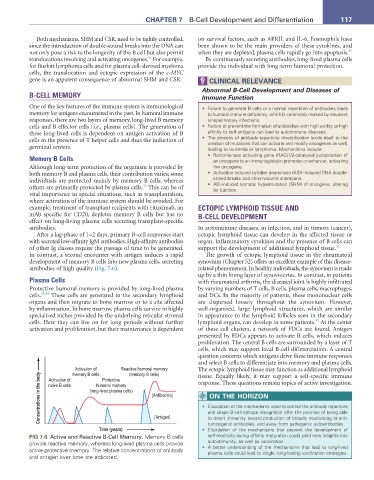
           antibodies of high quality (Fig. 7.6).                 related phenomenon. In healthy individuals, the synovium is made
                                                                  up by a thin lining layer of synoviocytes. In contrast, in patients
           Plasma Cells                                           with rheumatoid arthritis, the diseased joint is highly infiltrated
           Protective humoral memory is provided by long-lived plasma   by varying numbers of T cells, B cells, plasma cells, macrophages,
           cells. 33,34  These cells are generated in the secondary lymphoid   and DCs. In the majority of patients, these mononuclear cells
           organs and then migrate to bone marrow or to a site affected   are dispersed loosely throughout the synovium. However,
           by inflammation. In bone marrow, plasma cells survive in highly   well-organized, large lymphoid structures, which are similar
           specialized niches provided by the underlying reticular stromal   in appearance to the lymphoid follicles seen in the secondary
                                                                                                        32
           cells. Here they can live on for long periods without further   lymphoid organs, can develop in some patients.  At the center
           activation and proliferation, but their maintenance is dependent   of these cell clusters, a network of FDCs are found. Antigen
                                                                  presented by FDCs appears to activate B cells, which induces
                                                                  proliferation. The central B cells are surrounded by a layer of T
                                                                  cells, which may support local B-cell differentiation. A central
                                                                  question concerns which antigens drive these immune responses
                                                                  and select B cells to differentiate into memory and plasma cells.
                         Activation of  Protective Reactive humoral memory  The ectopic lymphoid tissue may function as additional lymphoid
                                           (memory B cells)
                         memory B cells
              Concentrations in the body  naive B cells  (long-lived plasma cells)  [Antibodies]  •  Elucidation of the mechanisms used to control the antibody repertoire
                                                                  tissue. Equally likely, it may support a self-specific immune
                 Activation of
                                                                  response. These questions remain topics of active investigation.
                                humoral memory
                                                                      ON THE HOrIZON
                                                                     and shape B-cell epitope recognition offer the promise of being able
                                                                     to direct immunity toward production of broadly neutralizing or anti-
                                                                     tumorigenic antibodies, and away from pathogenic autoantibodies.
                                 Time (years)       [Antigen]      •  Elucidation of the mechanisms that prevent the development of
           FIG 7.6  Active and Reactive B-Cell Memory. Memory B cells   self-reactivity during affinity maturation could yield new insights into
           provide reactive memory, whereas long-lived plasma cells provide   autoimmunity, as well as vaccination.
           active protective memory. The relative concentrations of antibody   •  A better understanding of the mechanisms that lead to long-lived
                                                                     plasma cells could lead to single, long-lasting vaccination strategies.
           and antigen over time are indicated.

