


Page 133 - Clinical Immunology_ Principles and Practice ( PDFDrive )
P. 133
116          ParT ONE  Principles of Immune Response


                                          IgM antibody
                           Protein
                                          µ antibody heavy chain
                            RNA
                                                                 Interferon-γ     Interleukin-4
                           Gene                                                       Switch transcripts

                            5'                                                                 3'
                                  VDJ Sµ Cµ     Recombination  Sγ2      Cγ2    Sγ4      Cγ4
                             Promoter
                                    5'                                             3'  Gene
                           Transcription
                                                                                       RNA
                            Translation                                                Protein
                                                        Cγ4 antibody heavy chain

                                                        IgG4 antibody
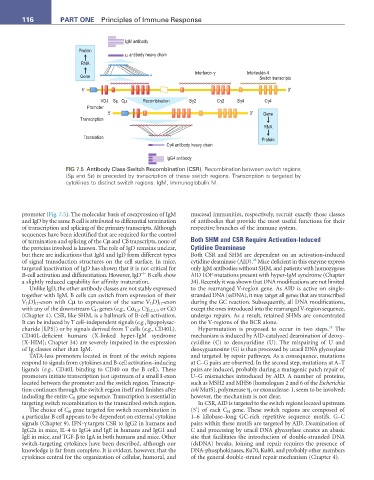
                       FIG 7.5  Antibody Class-Switch Recombination (CSR). Recombination between switch regions
                       (Sµ and Sε) is preceded by transcription of these switch regions. Transcription is targeted by
                       cytokines to distinct switch regions. IgM, Immunoglobulin M.


        promoter (Fig. 7.5). The molecular basis of coexpression of IgM   mucosal immunities, respectively, recruit exactly those classes
        and IgD by the same B cell is attributed to differential termination   of antibodies that provide the most useful functions for their
        of transcription and splicing of the primary transcripts. Although   respective branches of the immune system.
        sequences have been identified that are required for the control
        of termination and splicing of the Cµ and Cδ transcripts, none of   Both SHM and CSR Require Activation-Induced
        the proteins involved is known. The role of IgD remains unclear,   Cytidine Deaminase
        but there are indications that IgM and IgD form different types   Both CSR and SHM are dependent on an activation-induced
                                                                                    28
        of signal transduction structures on the cell surface. In mice,   cytidine deaminase (AID).  Mice deficient in this enzyme express
        targeted inactivation of IgD has shown that it is not critical for   only IgM antibodies without SHM, and patients with homozygous
                                               −/−
        B-cell activation and differentiation. However, IgD  B cells show   AID LOF mutations present with hyper-IgM syndrome (Chapter
        a slightly reduced capability for affinity maturation.  34). Recently it was shown that DNA modifications are not limited
           Unlike IgD, the other antibody classes are not stably expressed   to the rearranged V-region gene. As AID is active on single-
        together with IgM. B cells can switch from expression of their   stranded DNA (ssDNA), it may target all genes that are transcribed
        V H DJ H -exon with Cµ to expression of the same V H DJ H -exon   during the GC reaction. Subsequently, all DNA modifications,
        with any of the downstream C H  genes (e.g., Cα 1,2 , Cγ 1,2,3,4 , or Cε)   except the ones introduced into the rearranged V-region sequence,
        (Chapter 4). CSR, like SHM, is a hallmark of B-cell activation.   undergo repairs. As a result, retained SHMs are concentrated
        It can be induced by T cell–independent signals (e.g., lipopolysac-  on the V-regions of the BCR alone.
                                                                                                             28
        charide [LPS]) or by signals derived from T cells (e.g., CD40L).   Hypermutation is proposed to occur in two steps.  The
        CD40L-deficient humans (X-linked hyper-IgM syndrome    mechanism is induced by AID-catalyzed deamination of deoxy-
        [X-HIM]; Chapter 34) are severely impaired in the expression   cytidine (C) to deoxyuridine (U). The mispairing of U and
        of Ig classes other than IgM.                          deoxyguanosine (G) is than processed by uracil DNA glycosylase
           TATA-less promoters located in front of the switch regions   and targeted by repair pathways. As a consequence, mutations
        respond to signals from cytokines and B-cell activation–inducing   at C–G pairs are observed. In the second step, mutations at A–T
        ligands (e.g., CD40L binding to CD40 on the B cell). These   pairs are induced, probably during a mutagenic patch repair of
        promoters initiate transcription just upstream of a small Ι-exon   U–G mismatches introduced by AID. A number of proteins,
        located between the promoter and the switch region. Transcrip-  such as MSH2 and MHS6 (homologues 2 and 6 of the Escherichia
        tion continues through the switch region itself and finishes after   coli MutS), polymerase η, or exonuclease-1, seem to be involved;
        including the entire C H  gene sequence. Transcription is essential in   however, the mechanism is not clear.
        targeting switch recombination to the transcribed switch region.  In CSR, AID is targeted to the switch regions located upstream
           The choice of C H  gene targeted for switch recombination in   (5’) of each C H  gene. These switch regions are composed of
        a particular B cell appears to be dependent on external cytokine   1–6 kilobase–long GC-rich repetitive sequence motifs. G–C
        signals (Chapter 9). IFN-γ targets CSR to IgG2 in humans and   pairs within these motifs are targeted by AID. Deamination of
        IgG2a in mice, IL-4 to IgG4 and IgE in humans and IgG1 and   C and processing by uracil DNA glycosylase creates an abasic
        IgE in mice, and TGF-β to IgA in both humans and mice. Other   site that facilitates the introduction of double-stranded DNA
        switch-targeting cytokines have been described, although our   (dsDNA) breaks. Joining and repair requires the presence of
        knowledge is far from complete. It is evident, however, that the   DNA-phosphokinases, Ku70, Ku80, and probably other members
        cytokines central for the organization of cellular, humoral, and   of the general double-strand repair mechanism (Chapter 4).

