


Page 141 - Clinical Immunology_ Principles and Practice ( PDFDrive )
P. 141
CHaPTEr 8  T-Cell Development              123


                Normal MHC     Defective MHC I  Normal MHC I                 Male-specific TCR transgene; MHC I  restricted
                                                                                                  a
                 expression    Normal MHC II   Defective MHC II
                                                                         FEMALE         FEMALE           MALE
                                                                          MHC a          MHC b           MHC a
                   DP              DP              DP
                                                                          DP              DP              DP


               CD4    CD8      CD4    CD8      CD4    CD8
               SP     SP       SP     SP       SP     SP               CD4    CD8     CD4    CD8      CD4    CD8
                                                                       SP     SP       SP     SP      SP     SP
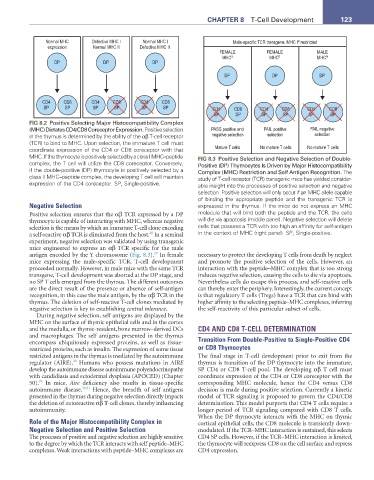
           FIG 8.2  Positive Selecting Major Histocompatibility Complex
           (MHC) Dictates CD4/CD8 Coreceptor Expression. Positive selection   PASS positive and  FAIL positive  FAIL negative
           in the thymus is determined by the ability of the αβ T-cell receptor   negative selection  selection  selection
           (TCR) to bind to MHC. Upon selection, the immature T cell must
           coordinate expression of the CD4 or CD8 coreceptor with that   Mature T cells   No mature T cells   No mature T cells
           MHC. If the thymocyte is positively selected by a class I MHC–peptide   FIG 8.3  Positive Selection and Negative Selection of Double-
           complex, the T cell will utilize the CD8 coreceptor. Conversely,   Positive (DP) Thymocytes Is Driven by Major Histocompatibility
           if the double-positive (DP) thymocyte is positively selected by a   Complex (MHC) Restriction and Self Antigen Recognition. The
           class II MHC–peptide complex, the developing T cell will maintain   study of T-cell receptor (TCR) transgenic mice has yielded consider-
           expression of the CD4 coreceptor. SP, Single-positive.   able insight into the processes of positive selection and negative
                                                                  selection. Positive selection will only occur if an MHC allele capable
                                                                  of binding the appropriate peptide and  the transgenic TCR is
           Negative Selection                                     expressed in the thymus. If the mice do not express an MHC
           Positive selection ensures that the αβ TCR expressed by a DP   molecule that will bind both the peptide and the TCR, the cells
           thymocyte is capable of interacting with MHC, whereas negative   will die via apoptosis (middle panel). Negative selection will delete
           selection is the means by which an immature T-cell clone encoding   cells that possess a TCR with too high an affinity for self-antigen
                                                  20
           a self-reactive αβ TCR is eliminated from the host.  In a seminal   in the context of MHC (right panel). SP, Single-positive.
           experiment, negative selection was validated by using transgenic
           mice engineered to express an  αβ TCR specific for the male
                                                   27
           antigen encoded by the Y chromosome (Fig. 8.3).  In female   necessary to protect the developing T cells from death by neglect
           mice expressing the male-specific TCR, T-cell development   and promote the positive selection of the cells. However, an
           proceeded normally. However, in male mice with the same TCR   interaction with the peptide–MHC complex that is too strong
           transgene, T-cell development was aborted at the DP stage, and   induces negative selection, causing the cells to die via apoptosis.
           no SP T cells emerged from the thymus. The different outcomes   Nevertheless cells do escape this process, and self-reactive cells
           are the direct result of the presence or absence of self-antigen   can thereby enter the periphery. Interestingly, the current concept
           recognition, in this case the male antigen, by the αβ TCR in the   is that regulatory T cells (Tregs) have a TCR that can bind with
           thymus. The deletion of self-reactive T-cell clones mediated by   higher affinity to the selecting peptide–MHC complexes, inferring
           negative selection is key to establishing central tolerance.  the self-reactivity of this particular subset of cells.
             During negative selection, self antigens are displayed by the
           MHC on the surface of thymic epithelial cells and in the cortex
           and the medulla, or thymic-resident, bone marrow–derived DCs   CD4 AND CD8 T-CELL DETERMINATION
           and macrophages. The self antigens presented in the thymus
           encompass ubiquitously expressed proteins, as well as tissue-  Transition From Double-Positive to Single-Positive CD4
           restricted proteins, such as insulin. The expression of some tissue   or CD8 Thymocytes
           restricted antigens in the thymus is mediated by the autoimmune   The final stage in T-cell development prior to exit from the
                         28
           regulator (AIRE).  Humans who possess mutations in  AIRE   thymus is transition of the DP thymocyte into the immature,
           develop the autoimmune disease autoimmune polyendocrinopathy   SP CD4 or CD8 T-cell pool. The developing αβ T cell must
           with candidiasis and ectodermal dysplasia (APOCED) (Chapter   coordinate expression of the CD4 or CD8 coreceptor with the
              29
           50).  In mice,  Aire deficiency also results in tissue-specific   corresponding MHC molecule, hence the CD4 versus CD8
           autoimmune disease. 30,31  Hence, the breadth of self antigens   decision is made during positive selection. Currently a kinetic
           presented in the thymus during negative selection directly impacts   model of TCR signaling is proposed to govern the CD4/CD8
           the deletion of autoreactive αβ T-cell clones, thereby influencing   determination. This model purports that CD4 T cells require a
           autoimmunity.                                          longer period of TCR signaling compared with  CD8 T cells.
                                                                  When the DP thymocyte interacts with the MHC on thymic
           Role of the Major Histocompatibility Complex in        cortical epithelial cells, the CD8 molecule is transiently down-
           Negative Selection and Positive Selection              modulated. If the TCR–MHC interaction is sustained, this selects
           The processes of positive and negative selection are highly sensitive   CD4 SP cells. However, if the TCR–MHC interaction is limited,
           to the degree by which the TCR interacts with self peptide–MHC   the thymocyte will reexpress CD8 on the cell surface and repress
           complexes. Weak interactions with peptide–MHC complexes are   CD4 expression.

