


Page 178 - Clinical Immunology_ Principles and Practice ( PDFDrive )
P. 178
160          ParT ONE  Principles of Immune Response


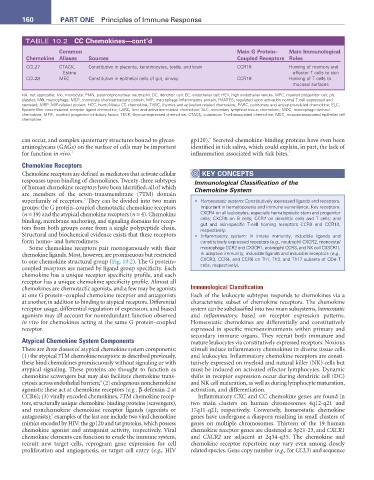
         TABLE 10.2  CC Chemokines—cont’d
                    Common                                                     Main G Protein–  Main Immunological
          Chemokine aliases   Sources                                          Coupled receptors roles
          CCL27     CTACK,    Constitutive in placenta, keratinocytes, testis, and brain  CCR10  Homing of memory and
                      Eskine                                                                     effector T cells to skin
          CCL28     MEC       Constitutive in epithelial cells of gut, airway  CCR10            Homing of T cells to
                                                                                                 mucosal surfaces
        NA, not applicable; Mo, monocyte; PMN, polymorphonuclear neutrophil; DC, dendritic cell; EC, endothelial cell; HEV, high endothelial venule; MPC, myeloid progenitor cell; plt,
        platelet; MΦ, macrophage; MCP, monocyte chemoattractant protein; MIP, macrophage inflammatory protein; RANTES, regulated upon activation normal T cell expressed and
        secreted; MRP, MIP-related protein; HCC, hemofiltrate CC chemokine; TARC, thymus and activation-related chemokine; PARC, pulmonary and activation-related chemokine; ELC,
        Epstein-Barr virus-induced receptor ligand chemokine; LARC, liver and activation-related chemokine; SLC, secondary lymphoid tissue chemokine; MDC, macrophage-derived
        chemokine; MPIF, myeloid progenitor inhibitory factor; TECK, thymus-expressed chemokine; CTACK, cutaneous T-cell-associated chemokine; MEC, mucosa-associated epithelial cell
        chemokine.


                                                                      6
        can occur, and complex quaternary structures bound to glycos-  gp120).  Secreted chemokine-binding proteins have even been
        aminoglycans (GAGs) on the surface of cells may be important   identified in tick saliva, which could explain, in part, the lack of
        for function in vivo. 1                                inflammation associated with tick bites. 7
        Chemokine Receptors
        Chemokine receptors are defined as mediators that activate cellular    KEY CONCEPTS
        responses upon binding of chemokines. Twenty-three subtypes   Immunological Classification of the
        of human chemokine receptors have been identified, all of which   Chemokine System
        are members of the seven-transmembrane (7TM) domain
                            3
        superfamily of receptors.  They can be divided into two main   •  Homeostatic system: Constitutively expressed ligands and receptors.
        groups: the G protein–coupled chemotactic chemokine receptors   Important in hematopoiesis and immune surveillance. Key receptors:
        (n = 19) and the atypical chemokine receptors (n = 4). Chemokine   CXCR4 on all leukocytes, especially hematopoietic stem and progenitor
        binding, membrane anchoring, and signaling domains for recep-  cells; CXCR5 on B cells; CCR7 on dendritic cells and T cells; and
                                                                   gut and skin-specific T-cell homing receptors CCR9 and CCR10,
        tors from both groups come from a single polypeptide chain.   respectively.
        Structural and biochemical evidence exists that these receptors   •  Inflammatory system: In innate immunity, inducible ligands and
        form homo- and heterodimers.                               constitutively expressed receptors (e.g., neutrophil CXCR2, monocyte/
           Some chemokine receptors pair monogamously with their   macrophage CCR2 and CX3CR1, eosinophil CCR3, and NK cell CX3CR1).
        chemokine ligands. Most, however, are promiscuous but restricted   In adaptive immunity, inducible ligands and inducible receptors (e.g.,
        to one chemokine structural group (Fig. 10.2). The G protein–  CXCR3, CCR4, and CCR6 on Th1, Th2, and Th17 subsets of CD4 T
        coupled receptors are named by ligand group specificity. Each   cells, respectively).
        chemokine has a unique receptor specificity profile, and each
        receptor has a unique chemokine specificity profile. Almost all
        chemokines are chemotactic agonists, and a few may be agonists   Immunological Classification
        at one G protein–coupled chemokine receptor and antagonists   Each of the leukocyte subtypes responds to chemokines via a
        at another, in addition to binding to atypical receptors. Differential   characteristic subset of chemokine receptors. The chemokine
        receptor usage, differential regulation of expression, and biased   system can be subclassified into two main subsystems, homeostatic
        agonism may all account for nonredundant function observed   and  inflammatory, based on receptor expression patterns.
        in vivo for chemokines acting at the same G protein–coupled   Homeostatic chemokines are differentially and constitutively
        receptor.                                              expressed in specific microenvironments within primary and
                                                               secondary immune organs. They recruit both immature and
        Atypical Chemokine System Components                   mature leukocytes via constitutively expressed receptors. Noxious
        There are three classes of atypical chemokine system components:   stimuli induce inflammatory chemokines in diverse tissue cells
        (1) the atypical 7TM chemokine receptors: as described previously,   and leukocytes. Inflammatory chemokine receptors are consti-
        these bind chemokines promiscuously without signaling or with   tutively expressed on myeloid and natural killer (NK) cells but
        atypical signaling. These proteins are thought to function as   must be induced on activated effector lymphocytes. Dynamic
        chemokine scavengers but may also facilitate chemokine trans-  shifts in receptor expression occur during dendritic cell (DC)
                                  4
        cytosis across endothelial barriers;  (2) endogenous nonchemokine   and NK cell maturation, as well as during lymphocyte maturation,
        agonists: these act at chemokine receptors (e.g., β-defensin-2 at   activation, and differentiation.
        CCR6); (3) virally encoded chemokines, 7TM chemokine recep-  Inflammatory CXC and CC chemokine genes are found in
        tors, structurally unique chemokine-binding proteins (scavengers),   two main clusters on human chromosomes 4q12-q21 and
        and nonchemokine chemokine receptor ligands (agonists or   17q11-q21, respectively. Conversely, homeostatic chemokine
                  5
        antagonists);  examples of the last one include two viral chemokine   genes have undergone a diaspora resulting in small clusters of
        mimics encoded by HIV: the gp120 and tat proteins, which possess   genes on multiple chromosomes. Thirteen of the 19 human
        chemokine  agonist and  antagonist  activity, respectively. Viral   chemokine receptor genes are clustered at 3p21-23, and CXCR1
        chemokine elements can function to evade the immune system,   and  CXCR2 are adjacent at 2q34-q35. The chemokine and
        recruit  new  target cells, reprogram  gene expression  for  cell   chemokine  receptor  repertoire  may  vary  even  among  closely
        proliferation  and  angiogenesis,  or target  cell entry (e.g.,  HIV   related species. Gene copy number (e.g., for CCL3) and sequence

