


Page 197 - Clinical Immunology_ Principles and Practice ( PDFDrive )
P. 197
178          ParT ONE  Principles of Immune Response


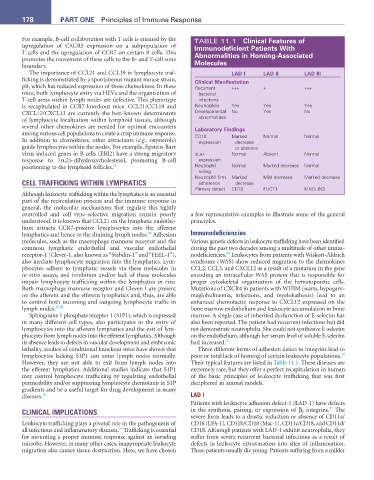
        For example, B-cell collaboration with T cells is ensured by the   TABLE 11.1  Clinical Features of
        upregulation of CXCR5 expression on a subpopulation of     Immunodeficient Patients With
        T cells and the upregulation of CCR7 on certain B cells. This   abnormalities in Homing-associated
        promotes the movement of these cells to the B- and T-cell zone
        boundary.                                                Molecules
           The importance of CCL21 and CCL19 in lymphocyte traf-             LaD I     LaD II        LaD III
        ficking is demonstrated by a spontaneous mutant mouse strain,   Clinical Manifestation
        plt, which has reduced expression of these chemokines. In these   Recurrent   +++  +         +++
        mice, both lymphocyte entry via HEVs and the organization of   bacterial
        T-cell areas within lymph nodes are defective. This phenotype   infections
        is  recapitulated  in CCR7-knockout  mice. CCL21/CCL19  and   Neutrophilia  Yes  Yes         Yes
        CXCL12/CXCL13 are currently the best-known determinants   Developmental  No    Yes           No
        of lymphocyte localization within lymphoid tissues, although   abnormalities
        several other chemokines are needed for optimal encounters   Laboratory Findings
        among various cell populations to create a crisp immune response.   CD18   Marked   Normal   Normal
        In addition to chemokines, other attractants (e.g., oxysterols)   expression  decrease
        guide lymphocytes within the nodes. For example, Epstein-Barr         or absence
        virus induced genes in B cells (EBI2) have a strong migratory   sLex   Normal  Absent        Normal
        response to 7α,25-dihydroxycholesterol, promoting B-cell   expression
        positioning to the lymphoid follicles. 25                Neutrophil   Normal   Marked decrease  Normal
                                                                  rolling
                                                                 Neutrophil firm  Marked   Mild decrease  Marked decrease
        CELL TRAFFICKING WITHIN LYMPHATICS                        adherence   decrease
                                                                 Primary detect  CD18  FUCT1         KINDLIN3
        Although leukocyte trafficking within the lymphatics is an essential
        part of the recirculation process and the immune response in
        general, the molecular mechanisms that regulate this tightly
        controlled and cell type–selective migration remain poorly   a few representative examples to illustrate some of the general
        understood. It is known that CCL21 on the lymphatic endothe-  principles.
        lium attracts CCR7-positive lymphocytes into the afferent
                                                 26
        lymphatics and hence to the draining lymph nodes.  Adhesion   Immunodeficiencies
        molecules, such as the macrophage mannose receptor and the   Various genetic defects in leukocyte trafficking have been identified
        common lymphatic endothelial and vascular endothelial   during the past two decades among a multitude of other immu-
                                                                           30
        receptor-1 (Clever-1, also known as “Stabilin-1” and “FEEL-1”),   nodeficiencies.  Leukocytes from patients with Wiskott-Aldrich
        also mediate lymphocyte migration into the lymphatics. Lym-  syndrome (WAS) show reduced migration to the chemokines
        phocytes adhere to lymphatic vessels via these molecules in     CCL2, CCL3, and CXCL12 as a result of a mutation in the gene
        in vitro assays, and inhibition and/or lack of these molecules   encoding an intracellular WAS protein that is responsible for
        impair lymphocyte trafficking within the lymphatics  in vivo.   proper cytoskeletal  organization of  the  hematopoietic  cells.
        Both macrophage mannose receptor and Clever-1 are present   Mutations of CXCR4 in patients with WHIM (warts, hypogam-
        on the afferent and the efferent lymphatics and, thus, are able   maglobulinemia, infections, and myelokathexis) lead to an
        to control both incoming and outgoing lymphocyte traffic in   enhanced chemotactic response to CXCL12 expressed on the
        lymph nodes. 27,28                                     bone marrow endothelium and leukocyte accumulation in bone
           Sphingosine 1 phosphate receptor 1 (S1P1), which is expressed   marrow. A single case of inherited dysfunction of E-selectin has
        in many different cell types, also participates in the entry of   also been reported. The patient had recurrent infections but did
        lymphocytes into the afferent lymphatics and the exit of lym-  not demonstrate neutrophilia. She could not synthesize E-selectin
        phocytes from lymph nodes into the efferent lymphatics. Although   on the endothelium, although her serum level of soluble E-selectin
        its absence leads to defects in vascular development and embryonic   had increased. 31
        lethality, studies of conditional knockout mice have shown that   Three different forms of adhesion defect in integrins lead to
                                                                                                                 32
        lymphocytes  lacking S1P1 can enter lymph nodes normally.   poor or total lack of homing of certain leukocyte populations.
        However, they are not able to exit from lymph nodes into     Their typical features are listed in Table 11.1. These diseases are
        the efferent lymphatics. Additional studies indicate that S1P1   extremely rare, but they offer a perfect recapitulation in human
        may  control lymphocyte trafficking  by  regulating  endothelial   of  the  basic  principles  of  leukocyte  trafficking  that  was  first
        permeability and/or suppressing lymphocyte chemotaxis in S1P   deciphered in animal models.
        gradients and be a useful target for drug development in many
        diseases. 29                                           LAD I
                                                               Patients with leukocyte adhesion defect-1 (LAD-1) have defects
                                                                                                             33
        CLINICAL IMPLICATIONS                                  in  the  synthesis,  pairing,  or  expression  of  β 2   integrins.   The
                                                               severe form leads to a drastic reduction or absence of CD11a/
        Leukocyte trafficking plays a pivotal role in the pathogenesis of   CD18 (LFA-1), CD11b/CD18 (Mac-1), CD11c/CD18, and CD11d/
                                        16
        all infectious and inflammatory diseases.  Trafficking is essential   CD18. Although patients with LAD-1 exhibit neutrophilia, they
        for mounting a proper immune response against an invading   suffer from severe recurrent bacterial infections as a result of
        microbe. However, in many other cases, inappropriate leukocyte   defects in leukocyte extravasation into sites of inflammation.
        migration also causes tissue destruction. Here, we have chosen   These patients usually die young. Patients suffering from a milder

