


Page 194 - Clinical Immunology_ Principles and Practice ( PDFDrive )
P. 194
CHaPTEr 11  Lymphocyte Adhesion and Trafficking                175


                                              Molecule  PNAd  P-selectin  E-selectin  CD73  VAP-1  Hyaluronan  CCL21/19  CCL 25  CCL 17/22  CXCL 12  CXCL 13  MAdCAM-1  VCAM-1  ICAM-1/2  CD31  JAM-A  JAM-B  JAM-C  CD99
                                           Endothelial cell


                                              Family  Sialomucin  Selectin  Ectoenzymes  GAG  Chemokine  Ig family  member  Unique


                               Leukocyte
                           Molecule  Family
                           L-selectin  Selectin
                           PSGL-1  Sialomucin
                           ESL-1
                           CD38    Ectoenzyme
                           CD44    Proteoglycan
                           CCR7
                           CCR9
                           CCR4    Chemokine
                                   receptor
                           CXCR 4
                           CXCR 5
                           α4β7
                           α4β1    Integrin
                           LFA-1
                           Mac-1
                           CD31
                           JAM-A   Ig family
                                   member
                           JAM-C
                           CD99    Unique
                           Siglec 9/10  Lectin
                             ?
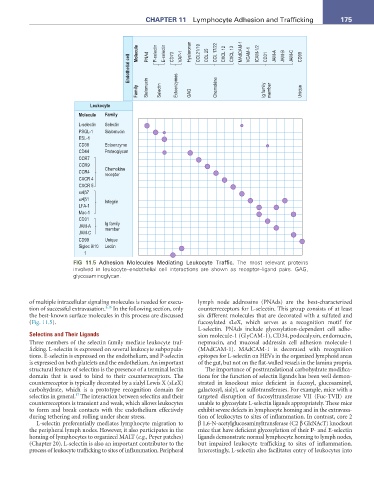
                         FIG 11.5  Adhesion Molecules Mediating Leukocyte Traffic. The most relevant proteins
                         involved in leukocyte–endothelial cell interactions are shown as receptor–ligand pairs. GAG,
                         glycosaminoglycan.


           of multiple intracellular signaling molecules is needed for execu-  lymph node addressins (PNAds) are the best-characterized
                                    2,16
           tion of successful extravasation.  In the following section, only   counterreceptors for L-selectin. This group consists of at least
           the best-known surface molecules in this process are discussed   six different molecules that are decorated with a sulfated and
           (Fig. 11.5).                                           fucosylated sLeX, which serves as a recognition motif for
                                                                  L-selectin. PNAds include glycosylation-dependent cell adhe-
           Selectins and Their Ligands                            sion molecule-1 (GlyCAM-1), CD34, podocalyxin, endomucin,
           Three members of the selectin family mediate leukocyte traf-  nepmucin, and mucosal addressin cell adhesion molecule-1
           ficking. L-selectin is expressed on several leukocyte subpopula-  (MAdCAM-1). MAdCAM-1 is decorated with recognition
           tions. E-selectin is expressed on the endothelium, and P-selectin   epitopes for L-selectin on HEVs in the organized lymphoid areas
           is expressed on both platelets and the endothelium. An important   of the gut, but not on the flat-walled vessels in the lamina propria.
           structural feature of selectins is the presence of a terminal lectin   The importance of posttranslational carbohydrate modifica-
           domain that is used to bind to their counterreceptors. The   tions for the function of selectin ligands has been well demon-
           counterreceptor is typically decorated by a sialyl Lewis X (sLeX)   strated in knockout mice deficient in fucosyl, glucosaminyl,
           carbohydrate,  which  is  a  prototype  recognition  domain  for   galactosyl, sialyl, or sulfotransferases. For example, mice with a
                          17
           selectins in general.  The interaction between selectins and their   targeted disruption of fucosyltransferase  VII (Fuc-TVII) are
           counterreceptors is transient and weak, which allows leukocytes   unable to glycosylate L-selectin ligands appropriately. These mice
           to form and break contacts with the endothelium effectively   exhibit severe defects in lymphocyte homing and in the extravasa-
           during tethering and rolling under shear stress.       tion of leukocytes to sites of inflammation. In contrast, core 2
             L-selectin preferentially mediates lymphocyte migration to   β 1,6-N-acetylglucosaminyltransferase (C2 β GlcNAcT) knockout
           the peripheral lymph nodes. However, it also participates in the   mice that have deficient glycosylation of their P- and E-selectin
           homing of lymphocytes to organized MALT (e.g., Peyer patches)   ligands demonstrate normal lymphocyte homing to lymph nodes,
           (Chapter 20). L-selectin is also an important contributor to the   but impaired leukocyte trafficking to sites of inflammation.
           process of leukocyte trafficking to sites of inflammation. Peripheral   Interestingly, L-selectin also facilitates entry of leukocytes into

