


Page 21 - Clinical Immunology_ Principles and Practice ( PDFDrive )
P. 21
CHaPter 1  The Human Immune Response                      7


           foreign  antigen. These  molecules  are  Igs,  TCRs,  and  MHC   with its unique antigen receptor. The variable domain of the
           molecules (see Fig. 1.1) (Chapters 4, 5). All are products of a   mature receptor is created by the rearrangement of two or three
           very large family of ancestrally related genes, the immunoglobulin   separate gene segments. These are designated V (variable) and
           superfamily, which includes many other molecules essential to   J (joining), for IgL chains and TCR α and γ chains, and V, D
           induction and regulation of immune responses. 15,16  Members of   (diversity) and J, for IgH and TCR β and δ chains. In addition
           the Ig superfamily exhibit characteristic structural features. The   to rearrangement, N-nucleotide addition also contributes sub-
           most notable of these is organization into homologous domains   stantially to receptor diversity. N-nucleotide addition results in
           of approximately 110 amino acids that are usually encoded by   the insertion, at the time of rearrangement, of one or more
           a single exon with an intradomain disulfide bond, characteristically   nongenomic nucleotides at the junctions between V, D, and J
           configured as antiparallel strands, forming two opposing β-pleated   segments  through the  action of  terminal  deoxynucleotidyl
                                                                                 17
           sheets.                                                transferase (TdT).  This permits receptor diversity to extend
                                                                  beyond germline constraints. Analysis of the linear sequences
           Immunoglobulins and T-Cell Receptors                   of many Ig V regions domains has shown that they contain three
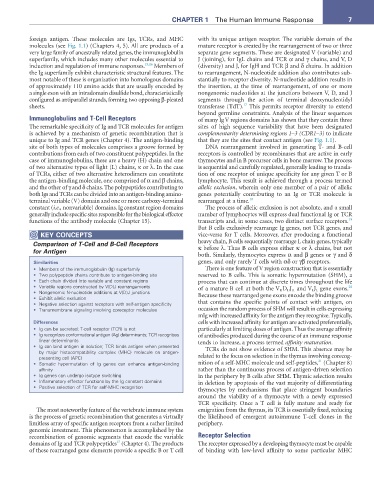
           The remarkable specificity of Ig and TCR molecules for antigen   sites  of high sequence  variability  that  have  been designated
           is achieved by a mechanism of genetic recombination that is   complementarity determining regions 1–3 (CDR1–3) to indicate
           unique to Ig and TCR genes (Chapter 4). The antigen-binding   that they are the sites that contact antigen (see Fig. 1.1).
           site of both types of molecules comprises a groove formed by   DNA rearrangement involved in generating T- and B-cell
           contributions from each of two constituent polypeptides. In the   receptors is controlled by recombinases that are active in early
           case of immunoglobulins, these are a heavy (H) chain and one   thymocytes and in B precursor cells in bone marrow. The process
           of two alternative types of light (L) chains, κ or λ. In the case   is sequential and carefully regulated, generally leading to transla-
           of TCRs, either of two alternative heterodimers can constitute   tion of one receptor of unique specificity for any given T or B
           the antigen-binding molecule, one comprised of α and β chains,   lymphocyte. This result is achieved through a process termed
           and the other of γ and δ chains. The polypeptides contributing to   allelic exclusion, wherein only one member of a pair of allelic
           both Igs and TCRs can be divided into an antigen-binding amino-  genes potentially contributing to an Ig or TCR molecule is
           terminal variable (V) domain and one or more carboxy-terminal   rearranged at a time. 18
           constant (i.e., nonvariable) domains. Ig constant region domains   The process of allelic exclusion is not absolute, and a small
           generally include specific sites responsible for the biological effector   number of lymphocytes will express dual functional Ig or TCR
                                                                                                                   19
           functions of the antibody molecule (Chapter 15).       transcripts and, in some cases, two distinct surface receptors.
                                                                  But B cells exclusively rearrange Ig genes, not TCR genes, and
               KeY ConCePtS                                       vice-versa for T cells. Moreover, after producing a functional
            Comparison of T-Cell and B-Cell Receptors             heavy chain, B cells sequentially rearrange L chain genes, typically
            for Antigen                                           κ before λ. Thus B cells express either κ or λ chains, but not
                                                                  both. Similarly, thymocytes express α and β genes or γ and δ
            Similarities                                          genes, and only rarely T cells with αδ or γβ receptors.
            •  Members of the immunoglobulin (Ig) superfamily       There is one feature of V region construction that is essentially
            •  Two polypeptide chains contribute to antigen-binding site  reserved to B cells. This is somatic hypermutation (SHM), a
            •  Each chain divided into variable and constant regions  process that can continue at discrete times throughout the life
            •  Variable regions constructed by V(D)J rearrangements  of a mature B cell at both the V H D H J H  and V L J L  gene exons.
                                                                                                                   20
            •  Nongenomic N-nucleotide additions at V(D)J junctions  Because these rearranged gene exons encode the binding groove
            •  Exhibit allelic exclusion
            •  Negative selection against receptors with self-antigen specificity  that  contains  the  specific  points  of  contact  with  antigen,  on
            •  Transmembrane signaling involving coreceptor molecules  occasion the random process of SHM will result in cells expressing
                                                                  mIg with increased affinity for the antigen they recognize. Typically,
            Differences                                           cells with increased affinity for antigen are activated preferentially,
            •  Ig can be secreted; T-cell receptor (TCR) is not   particularly at limiting doses of antigen. Thus the average affinity
            •  Ig recognizes conformational antigen (Ag) determinants; TCR recognizes   of antibodies produced during the course of an immune response
              linear determinants                                 tends to increase, a process termed affinity maturation.
            •  Ig can bind antigen in solution; TCR binds antigen when presented   TCRs do not show evidence of SHM. This absence may be
              by major histocompatibility complex (MHC) molecule on antigen-
              presenting cell (APC)                               related to the focus on selection in the thymus involving corecog-
                                                                                                         21
            •  Somatic hypermutation of Ig genes can enhance antigen-binding   nition of a self-MHC molecule and self-peptides,  (Chapter 8)
              affinity                                            rather than the continuous process of antigen-driven selection
            •  Ig genes can undergo isotype switching             in the periphery by B cells after SHM. Thymic selection results
            •  Inflammatory effector functions by the Ig constant domains  in deletion by apoptosis of the vast majority of differentiating
            •  Positive selection of TCR for self-MHC recognition
                                                                  thymocytes by mechanisms that place stringent boundaries
                                                                  around the viability of a thymocyte with a newly expressed
                                                                  TCR specificity. Once a T cell is fully mature and ready for
             The most noteworthy feature of the vertebrate immune system   emigration from the thymus, its TCR is essentially fixed, reducing
           is the process of genetic recombination that generates a virtually   the likelihood of emergent autoimmune T-cell clones in the
           limitless array of specific antigen receptors from a rather limited   periphery.
           genomic investment. This phenomenon is accomplished by the
           recombination of genomic segments that encode the variable   Receptor Selection
                                       17
           domains of Ig and TCR polypeptides  (Chapter 4). The products   The receptor expressed by a developing thymocyte must be capable
           of these rearranged gene elements provide a specific B or T cell   of binding with low-level affinity to some particular MHC

