


Page 24 - Clinical Immunology_ Principles and Practice ( PDFDrive )
P. 24
10           Part one  Principles of Immune Response


        APCs and MHC-like molecules in presentation of phosphoan-  immunologically naïve cells that have not been previously exposed
        tigens to γδ T cells remains a subject of investigation. 31  to antigen. The first signal is provided by antigen. Most commonly,
           Another exception to the generalization of T-cell recognition   antigens for B cells are proteins with distinct sites, termed epitopes,
        of oligopeptides is represented by a group of proteins termed   which are bound by membrane Ig. Such epitopes can be linear,
                         31
        superantigens (SAgs).  SAgs, of which the staphylococcal entero-  defined by a contiguous amino acid sequence or (more frequently)
        toxin A represents a prototype, are produced by a broad spectrum   can be conformationally defined by the three-dimensional
        of microbes, ranging from retroviruses to bacteria. They differ   structure of the antigen. Epitopes can also be simple chemical
        from conventional peptide antigens in their mode of contact   moieties (haptens) that have been attached, usually covalently,
        both with MHC class II molecules and TCRs (Chapter 6). They   to amino acid side chains (Chapter 6). In addition to proteins,
        do not undergo processing to oligopeptide fragments but, rather,   some B cells have receptors with specificity for carbohydrates,
        bind as intact proteins to class II molecules and TCRs outside   and less commonly lipids or nucleic acids. Antigens that stimulate
        the antigen-binding grooves. Their interaction with TCRs is   B cells can be either in solution or fixed to a solid matrix (e.g.,
        predominantly determined by variable residues of the TCR Vβ   a cell membrane). As previously noted, the nature of antigens
        region. Because SAgs bind more or less independently of the   that stimulate T cells is more limited. TCRs do not bind antigen
        TCRs α chain and the other variable segments of the β chain,   in solution but are usually stimulated only by small molecules,
        they are capable of activating much larger numbers of T cells   primarily oligopeptides, which reside within the antigen-binding
        compared with conventional peptide antigens, and hence their   cleft of a self-MHC molecule.
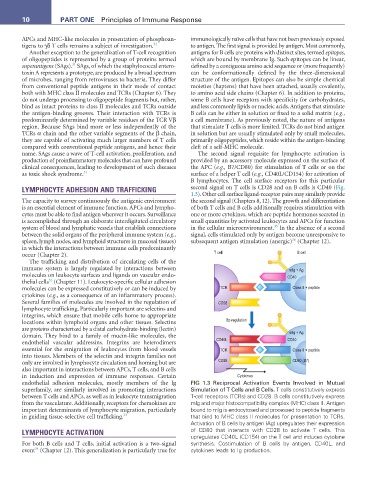
        name. SAgs cause a wave of T-cell activation, proliferation, and   The  second  signal  requisite  for  lymphocyte  activation  is
        production of proinflammatory molecules that can have profound   provided by an accessory molecule expressed on the surface of
        clinical consequences, leading to development of such diseases   the APC (e.g., B7/CD80) for stimulation of T cells or on the
        as toxic shock syndrome. 31                            surface of a helper T cell (e.g., CD40L/CD154) for activation of
                                                               B lymphocytes. The cell surface receptors for this particular
        LYMPHOCYTE ADHESION AND TRAFFICKING                    second signal on T cells is CD28 and on B cells is CD40 (Fig.
                                                               1.3). Other cell surface ligand-receptor pairs may similarly provide
        The capacity to survey continuously the antigenic environment   the second signal (Chapters 8, 12). The growth and differentiation
        is an essential element of immune function. APCs and lympho-  of both T cells and B cells additionally requires stimulation with
        cytes must be able to find antigen wherever it occurs. Surveillance   one or more cytokines, which are peptide hormones secreted in
        is accomplished through an elaborate interdigitated circulatory   small quantities by activated leukocytes and APCs for function
                                                                                           35
        system of blood and lymphatic vessels that establish connections   in the cellular microenvironment.  In the absence of a second
        between the solid organs of the peripheral immune system (e.g.,   signal, cells stimulated only by antigen become unresponsive to
                                                                                                 36
        spleen, lymph nodes, and lymphoid structures in mucosal tissues)   subsequent antigen stimulation (anergic)  (Chapter 12).
        in which the interactions between immune cells predominantly
        occur (Chapter 2).                                             T cell                     B cell
           The trafficking and distribution of circulating cells of the
        immune system is largely regulated by interactions between                              mIg + Ag
        molecules on leukocyte surfaces and ligands on vascular endo-                          CD40
                 32
        thelial cells  (Chapter 11). Leukocyte-specific cellular adhesion
        molecules can be expressed constitutively or can be induced by   TCR                     Class II + peptide
        cytokines (e.g., as a consequence of an inflammatory process).
        Several families of molecules are involved in the regulation of   CD28
        lymphocyte trafficking. Particularly important are selectins and
        integrins, which ensure that mobile cells home to appropriate
        locations within lymphoid organs and other tissues. Selectins      Up-regulation
        are proteins characterized by a distal carbohydrate-binding (lectin)
        domain. They bind to a family of mucin-like molecules, the                              mIg + Ag
        endothelial vascular addressins. Integrins are heterodimers     CD40L                  CD40
        essential for the emigration of leukocytes from blood vessels    TCR                     Class II + peptide
        into tissues. Members of the selectin and integrin families not
        only are involved in lymphocyte circulation and homing but are   CD28                    CD80 (B7)
        also important in interactions between APCs, T cells, and B cells
        in induction and expression of immune responses. Certain               Cytokines
        endothelial adhesion molecules, mostly members of the Ig   FIG 1.3  Reciprocal Activation Events Involved in Mutual
        superfamily, are  similarly  involved  in promoting  interactions   Simulation of T Cells and B Cells. T cells constitutively express
        between T cells and APCs, as well as in leukocyte transmigration   T-cell receptors (TCRs) and CD28. B cells constitutively express
        from the vasculature. Additionally, receptors for chemokines are   mIg and major histocompatibility complex (MHC) class II. Antigen
        important determinants of lymphocyte migration, particularly   bound to mIg is endocytosed and processed to peptide fragments
        in guiding tissue-selective cell trafficking. 33       that bind to MHC class II molecules for presentation to TCRs.
                                                               Activation of B cells by antigen (Ag) upregulates their expression
        LYMPHOCYTE ACTIVATION                                  of CD80 that interacts with CD28 to activate T cells. This
                                                               upregulates CD40L (CD154) on the T cell and induces cytokine
        For both B cells and T cells, initial activation is a two-signal   synthesis. Costimulation of B cells by antigen, CD40L, and
            34
        event  (Chapter 12). This generalization is particularly true for   cytokines leads to Ig production.

