


Page 22 - Clinical Immunology_ Principles and Practice ( PDFDrive )
P. 22
8            Part one  Principles of Immune Response


        self-molecule, either class I or class II, expressed by a resident   messenger RNAs (mRNAs) to include or exclude a transmembrane
        thymic epithelial cell or APC. Because their receptors are generated   segment that is encoded by the Ig heavy-chain genes.
        by a process of semirandom joining of rearranging exon segments
        coupled with N-nucleotide additions, most thymocytes fail this   Immunoglobulin Class Switching
        test. They are consequently deleted as not being useful to an   In addition to synthesizing both membrane and secreted forms
        immune system that requires T cells to recognize antigen that   of Igs, B cells also undergo class switching. Antibody molecules
        is bound to self-MHC molecules. Thymocytes surviving this   are comprised of five major classes (isotypes). In order of
                                                21
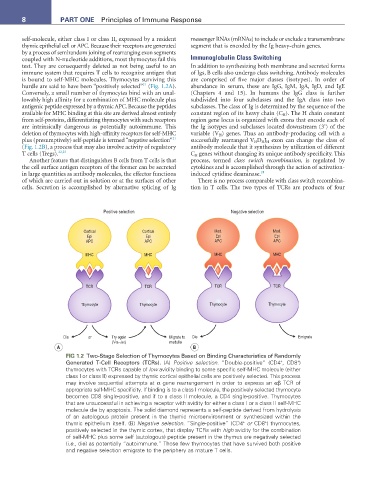
        hurdle are said to have been “positively selected”  (Fig. 1.2A).   abundance in serum, these are IgG, IgM, IgA, IgD, and IgE
        Conversely, a small number of thymocytes bind with an unal-  (Chapters 4 and 15). In humans the IgG class is further
        lowably high affinity for a combination of MHC molecule plus   subdivided into four subclasses and the IgA class into two
        antigenic peptide expressed by a thymic APC. Because the peptides   subclasses. The class of Ig is determined by the sequence of the
        available for MHC binding at this site are derived almost entirely   constant region of its heavy chain (C H ). The H chain constant
        from self-proteins, differentiating thymocytes with such receptors   region gene locus is organized with exons that encode each of
        are intrinsically dangerous as potentially autoimmune. This   the Ig isotypes and subclasses located downstream (3’) of the
        deletion of thymocytes with high-affinity receptors for self-MHC   variable (V H ) genes. Thus an antibody-producing cell with a
                                                         21
        plus (presumptively) self-peptide is termed “negative selection”    successfully  rearranged V H D H J H  exon can change the class of
        (Fig. 1.2B), a process that may also involve activity of regulatory   antibody molecule that it synthesizes by utilization of different
        T cells (Tregs). 22,23                                 C H  genes without changing its unique antibody specificity. This
           Another feature that distinguishes B cells from T cells is that   process, termed  class switch recombination, is regulated by
        the cell surface antigen receptors of the former can be secreted   cytokines and is accomplished through the action of activation-
        in large quantities as antibody molecules, the effector functions   induced cytidine deaminase. 24
        of which are carried out in solution or at the surfaces of other   There is no process comparable with class switch recombina-
        cells. Secretion is accomplished by alternative splicing of Ig   tion in T cells. The two types of TCRs are products of four


                                   Positive selection                        Negative selection


                            Cortical            Cortical               Med.               Med.
                              Epi                Epi                    Epi                Epi
                             APC                APC                    APC                APC
                             MHC                MHC                    MHC                MHC


                             TCR                TCR                    TCR                TCR


                            Thymocyte          Thymocyte              Thymocyte          Thymocyte


                      Die     or      Try again         Migrate to  Die                            Emigrate
                                      (Vα–Jα)           medulla
                    A                                           B
                       FIG 1.2  Two-Stage Selection of Thymocytes Based on Binding Characteristics of Randomly
                                                                                                  +
                                                                                             +
                       Generated T-Cell Receptors (TCRs). (A)  Positive selection. “Double-positive” (CD4 , CD8 )
                       thymocytes with TCRs capable of low avidity binding to some specific self-MHC molecule (either
                       class I or class II) expressed by thymic cortical epithelial cells are positively selected. This process
                       may involve sequential attempts at α gene rearrangement in order to express an αβ TCR of
                       appropriate self-MHC specificity. If binding is to a class I molecule, the positively selected thymocyte
                       becomes CD8 single-positive, and if to a class II molecule, a CD4 single-positive. Thymocytes
                       that are unsuccessful in achieving a receptor with avidity for either a class I or a class II self-MHC
                       molecule die by apoptosis. The solid diamond represents a self-peptide derived from hydrolysis
                       of  an  autologous  protein  present  in  the  thymic  microenvironment  or  synthesized  within  the
                                                                                        +
                                                                                 +
                       thymic epithelium itself. (B) Negative selection. “Single-positive” (CD4  or CD8 ) thymocytes,
                       positively selected in the thymic cortex, that display TCRs with high avidity for the combination
                       of self-MHC plus some self (autologous) peptide present in the thymus are negatively selected
                       (i.e., die) as potentially “autoimmune.” Those few thymocytes that have survived both positive
                       and negative selection emigrate to the periphery as mature T cells.

