


Page 26 - Clinical Immunology_ Principles and Practice ( PDFDrive )
P. 26
12           Part one  Principles of Immune Response


        cells. Other Tregs are noted for production of inhibitory cytokines,    KeY ConCePtS
        including IL-10-  and TGF-β–secreting Th3 cells, and IL-10–
        producing Tr1 cells. 44,45                               Biological Properties of Immunoglobulin
                                                                 (Ig) Classes
        CD8 T Cells
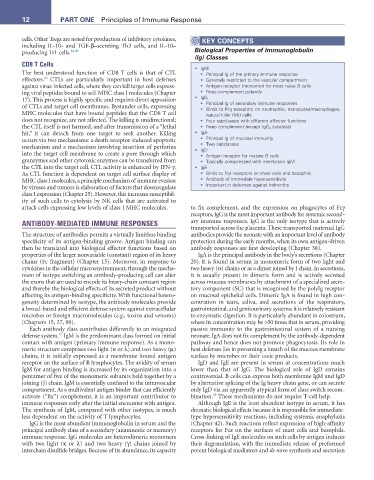
                                                                 •  IgM
        The best understood function of CD8 T cells is that of CTL   •  Principal Ig of the primary immune response
               46
        effectors.  CTLs are particularly important in host defenses   •  Generally restricted to the vascular compartment
        against virus-infected cells, where they can kill target cells express-  •  Antigen receptor (monomer) for most naïve B cells
        ing viral peptides bound to self-MHC class I molecules (Chapter   •  Fixes complement potently
        17). This process is highly specific and requires direct apposition   •  IgG
        of CTLs and target cell membranes. Bystander cells, expressing   •  Principal Ig of secondary immune responses
                                                                   •  Binds to Fcγ receptors on neutrophils, monocytes/macrophages,
        MHC molecules that have bound peptides that the CD8 T cell   natural killer (NK) cells
        does not recognize, are not affected. The killing is unidirectional;   •  Four subclasses with different effector functions
        the CTL itself is not harmed, and after transmission of a “lethal   •  Fixes complement (except IgG 4  subclass)
        hit,” it can detach from one target to seek another. Killing    •  IgA
        occurs via two mechanisms: a death-receptor-induced apoptotic   •  Principal Ig of mucosal immunity
                                                                   •  Two subclasses
        mechanism and a mechanism involving insertion of perforins   •  IgD
        into the target cell membrane to create a pore through which   •  Antigen receptor for mature B cells
        granzymes and other cytotoxic enzymes can be transferred from   •  Typically coexpressed with membrane IgM
        the CTL into the target cell. CTL activity is enhanced by IFN-γ.   •  IgE
        As CTL function is dependent on target cell surface display of   •  Binds to Fcε receptors on mast cells and basophils
        MHC class I molecules, a principle mechanism of immune evasion   •  Antibody of immediate hypersensitivity
        by viruses and tumors is elaboration of factors that downregulate   •  Important in defenses against helminths
        class I expression (Chapter 25). However, this increases susceptibil-
        ity of such cells to cytolysis by NK cells that are activated to
        attack cells expressing low levels of class I MHC molecules.  to fix complement, and the expression on phagocytes of Fcγ
                                                               receptors, IgG is the most important antibody for systemic second-
        ANTIBODY-MEDIATED IMMUNE RESPONSES                     ary immune responses. IgG is the only isotype that is actively
                                                               transported across the placenta. These transported maternal IgG
        The structure of antibodies permits a virtually limitless binding   antibodies provide the neonate with an important level of antibody
        specificity of its antigen-binding groove. Antigen binding can   protection during the early months, when its own antigen-driven
        then be translated into biological effector functions based on   antibody responses are first developing (Chapter 38).
        properties of the larger nonvariable (constant) region of its heavy   IgA is the principal antibody in the body’s secretions (Chapter
        chains (Fc fragment) (Chapter 15). Moreover, in response to   20). It is found in serum in monomeric form of two light and
        cytokines in the cellular microenvironment, through the mecha-  two heavy (α) chains or as a dimer joined by J chain. In secretions,
        nism of isotype switching an antibody-producing cell can alter   it is usually present in dimeric form and is actively secreted
        the exons that are used to encode its heavy-chain constant region   across mucous membranes by attachment of a specialized secre-
        and thereby the biological effects of its secreted product without   tory component (SC) that is recognized by the polyIg receptor
        affecting its antigen-binding specificity. With functional hetero-  on mucosal epithelial cells. Dimeric IgA is found in high con-
        geneity determined by isotype, the antibody molecules provide   centration in tears, saliva, and secretions of the respiratory,
        a broad-based and efficient defense system against extracellular   gastrointestinal, and genitourinary systems; it is relatively resistant
        microbes or foreign macromolecules (e.g., toxins and venoms)   to enzymatic digestion. It is particularly abundant in colostrum,
        (Chapters 15, 27, 90).                                 where its concentration may be >50 times that in serum, providing
           Each antibody class contributes differently to an integrated   passive  immunity to the  gastrointestinal  system of  a  nursing
                    47
        defense system.  IgM is the predominant class formed on initial   neonate. IgA does not fix complement by the antibody-dependent
        contact with antigen (primary immune response). As a mono-  pathway and hence does not promote phagocytosis. Its role in
        meric structure comprises two light (κ or λ) and two heavy (µ)   host defenses lies in preventing a breach of the mucous membrane
        chains, it is initially expressed as a membrane bound antigen   surface by microbes or their toxic products.
        receptor on the surface of B lymphocytes. The avidity of serum   IgD and IgE are present in serum at concentrations much
        IgM for antigen binding is increased by its organization into a   lower than that of IgG. The biological role of IgD remains
        pentamer of five of the monomeric subunits held together by a   controversial. B cells can express both membrane IgM and IgD
        joining (J) chain. IgM is essentially confined to the intravascular   by alternative splicing of the Ig heavy chain gene, or can secrete
        compartment. As a multivalent antigen binder that can efficiently   only IgD via an apparently atypical form of class switch recom-
                                                                       48
        activate (“fix”) complement, it is an important contributor to   bination.  These mechanisms do not require T-cell help.
        immune responses early after the initial encounter with antigen.   Although IgE is the least abundant isotype in serum, it has
        The synthesis of IgM, compared with other isotypes, is much   dramatic biological effects because it is responsible for immediate-
        less dependent on the activity of T lymphocytes.       type hypersensitivity reactions, including systemic anaphylaxis
           IgG is the most abundant immunoglobulin in serum and the   (Chapter 42). Such reactions reflect expression of high-affinity
        principal antibody class of a secondary (anamnestic or memory)   receptors for Fcε on the surfaces of mast cells and basophils.
        immune response. IgG molecules are heterodimeric monomers   Cross-linking of IgE molecules on such cells by antigen induces
        with two light (κ or  λ) and two heavy (γ) chains joined by   their degranulation, with the immediate release of preformed
        interchain disulfide bridges. Because of its abundance, its capacity   potent biological mediators and de novo synthesis and secretion

