


Page 239 - Clinical Immunology_ Principles and Practice ( PDFDrive )
P. 239
218          Part One  Principles of Immune Response


        has been linked to improved sanitation and diets low in fiber   3.  Gomez de Aguero M, Ganal-Vonarburg SC, Fuhrer T, et al. The maternal
        but rich in unhealthy fats and carbohydrates. These factors have   microbiota drives early postnatal innate immune development. Science
        contributed to dramatic shifts in microbial diversity away from   2016;351:1296–302.
        that of our ancestral microbiota. Restoration of the richness of   4.  Spits H, Di Santo JP. The expanding family of innate lymphoid cells:
        the microbiota using probiotics—live microorganisms that, when   regulators and effectors of immunity and tissue remodeling. Nat
                                                                  Immunol 2011;12:21–7.
        administered in adequate amounts, provide a measurable health   5.  Ismail AS, Severson KM, Vaishnava S, et al. γδ intraepithelial lymphocytes
        benefit to the host—may  be helpful in  slowing and  possibly   are essential mediators of host-microbial homeostasis at the intestinal
        reversing this trend. Long-term persistence of probiotic organisms   mucosal surface. Proc Natl Acad Sci USA 2011;108:8743–8.
        within the complex microbiota of the host is essential if these   6.  Rogier EW, Frantz AL, Bruno ME, et al. Secretory antibodies in breast
        organisms are to induce durable shifts in microbiota dynamics.   milk promote long-term intestinal homeostasis by regulating the gut
        Complementary prebiotic regimens that support the growth and   microbiota and host gene expression. Proc Natl Acad Sci USA
        survival of the introduced microbes without detrimental altera-  2014;111:3074–9.
        tions in the distribution of functions of other species will likely   7.  Niewiesk S. Maternal antibodies: clinical significance, mechanism of
        be helpful in this regard.                                interference with immune responses, and possible vaccination strategies.
                                                                  Front Immunol 2014;5:446.
                                                                8.  Koch MA, Reiner GL, Lugo KA, et al. Maternal IgG and IgA Antibodies
        SUMMARY                                                   Dampen Mucosal T Helper Cell Responses in Early Life. Cell
                                                                  2016;165:827–41.
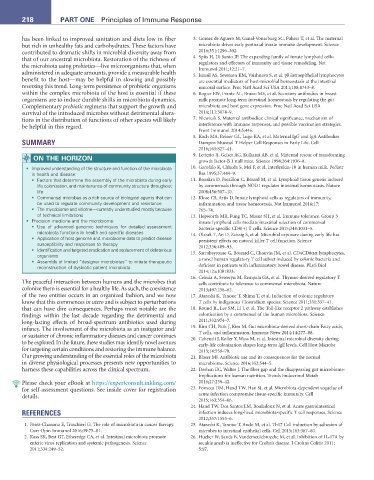
            On tHe HOrIZOn                                      9.  Letterio JJ, Geiser AG, Kulkarni AB, et al. Maternal rescue of transforming
                                                                  growth factor-β 1 null mice. Science 1994;264:1936–8.
          •  Improved understanding of the structure and function of the microbiota   10.  Garofalo R, Chheda S, Mei F, et al. Interleukin-10 in human milk. Pediatr
           in health and disease:                                 Res 1995;37:444–9.
           •  Factors that determine the assembly of the microbiota during early   11.  Bouskra D, Brezillon C, Berard M, et al. Lymphoid tissue genesis induced
             life colonization, and maintenance of community structure throughout   by commensals through NOD1 regulates intestinal homeostasis. Nature
             life                                                 2008;456:507–10.
           •  Commensal microbes as a rich source of biological agents that can   12.  Klose CS, Artis D. Innate lymphoid cells as regulators of immunity,
             be used to regulate community development and resistance  inflammation and tissue homeostasis. Nat Immunol 2016;17:
           •  The mycobiome and viriome—currently understudied mostly because   765–74.
             of technical limitations                          13.  Hepworth MR, Fung TC, Masur SH, et al. Immune tolerance. Group 3
          •  Precision medicine and the microbiome:               innate lymphoid cells mediate intestinal selection of commensal
           •  Use of advanced genomic techniques for detailed assessment   bacteria-specific CD4(+) T cells. Science 2015;348:1031–5.
             microbiota functions in health and specific diseases  14.  Olszak T, An D, Zeissig S, et al. Microbial exposure during early life has
           •  Application of host genome and microbiome data to predict disease   persistent effects on natural killer T cell function. Science
             susceptibility and responses to therapy              2012;336:489–93.
           •  Identification and targeted eradication and replacement of deleterious   15.  Sarrabayrouse G, Bossard C, Chauvin JM, et al. CD4CD8αα lymphocytes,
             organisms
           •  Assembly of limited “designer microbiotas” to initiate therapeutic   a novel human regulatory T cell subset induced by colonic bacteria and
             reconstruction of dysbiotic patient microbiota       deficient in patients with inflammatory bowel disease. PLoS Biol
                                                                  2014;12:e1001833.
                                                               16.  Cebula A, Seweryn M, Rempala GA, et al. Thymus-derived regulatory T
        The peaceful interaction between humans and the microbes that   cells contribute to tolerance to commensal microbiota. Nature
        colonize them is essential for a healthy life. As such, the coexistence   2013;497:258–62.
        of the two entities occurs in an organized fashion, and we now   17.  Atarashi K, Tanoue T, Shima T, et al. Induction of colonic regulatory
        know that this commences in utero and is subject to perturbations   T cells by indigenous Clostridium species. Science 2011;331:337–41.
        that can have dire consequences. Perhaps most notable are the   18.  Round JL, Lee SM, Li J, et al. The Toll-like receptor 2 pathway establishes
        findings within the last decade regarding the detrimental and   colonization by a commensal of the human microbiota. Science
        long-lasting effects of broad-spectrum antibiotics used during   2011;332:974–7.
        infancy. The involvement of the microbiota as an instigator and/  19.  Kim CH, Park J, Kim M. Gut microbiota-derived short-chain Fatty acids,
                                                                  T cells, and inflammation. Immune Netw 2014;14:277–88.
        or sustainer of chronic inflammatory diseases and cancer continues   20.  Cahenzli J, Koller Y, Wyss M, et al. Intestinal microbial diversity during
        to be explored. In the future, these studies may identify novel avenues   early-life colonization shapes long-term IgE levels. Cell Host Microbe
        for targeting certain conditions and restoring the immune balance.   2013;14:559–70.
        Our growing understanding of the essential roles of the microbiota   21.  Blaser MJ. Antibiotic use and its consequences for the normal
        in diverse physiological processes presents new opportunities to   microbiome. Science 2016;352:544–5.
        harness these capabilities across the clinical spectrum.  22.  Deehan EC, Walter J. The fiber gap and the disappearing gut microbiome:
                                                                  Implications for human nutrition. Trends Endocrinol Metab
        Please check your eBook at https://expertconsult.inkling.com/   2016;27:239–42.
        for self-assessment questions. See inside cover for registration   23.  Fonseca DM, Hand TW, Han SJ, et al. Microbiota-dependent sequelae of
        details.                                                  acute infection compromise tissue-specific immunity. Cell
                                                                  2015;163:354–66.
                                                               24.  Hand TW, Dos Santos LM, Bouladoux N, et al. Acute gastrointestinal
        REFERENCES                                                infection induces long-lived microbiota-specific T cell responses. Science
                                                                  2012;337:1553–6.
         1.  Perez-Chanona E, Trinchieri G. The role of microbiota in cancer therapy.   25.  Atarashi K, Tanoue T, Ando M, et al. Th17 Cell induction by adhesion of
           Curr Opin Immunol 2016;39:75–81.                       microbes to intestinal epithelial cells. Cell 2015;163:367–80.
         2.  Kuss SK, Best GT, Etheredge CA, et al. Intestinal microbiota promote   26.  Hueber W, Sands B, Vandemeulebroecke M, et al. Inhibition of IL-17A by
           enteric virus replication and systemic pathogenesis. Science   secukinumab is ineffective for Crohn’s disease. J Crohns Colitis 2011;
           2011;334:249–52.                                       5:S7.

