


Page 235 - Clinical Immunology_ Principles and Practice ( PDFDrive )
P. 235
214          Part One  Principles of Immune Response


        bacteria. Murine norovirus induces inflammation in mice with   secretion of cytokines, including IL-6 and TNF-α. Obesity-related
        disruption in the IBD susceptibility gene Atg16L1. Antibiotic   inflammation also contributes to defective insulin signaling or
                                                33
        administration reverses this viral-induced disease.  Conversely,   insulin resistance, a major player in the transition from metabolic
        antiviral pretreatment of otherwise healthy mice can exacerbate   syndrome to diseases, including type 2 diabetes, hepatic steatosis,
        acute experimental colitis by disrupting the production of   and cardiovascular disease. 37
        antiinflammatory IFN-β. 34                                Although the microbiota (usually fecal) is distinct in certain
                                                               non-GI diseases, including ankylosing spondylitis (Chapter 57),
        EXTRAINTESTINAL MANIFESTATIONS OF GUT                  multiple sclerosis (Chapter 66), and asthma (Chapter 41), whether
        MICROBIOTA–IMMUNE SYSTEM INTERACTION                   these changes precede or follow disease development is not clear.
                                                               One measure might be the effect of microbiota-induced immune
        Obesity develops when energy intake exceeds expenditure and   mediators on disease pathology in extraintestinal tissues. For
        culminates in deposition of excess adipose tissue. The associated   example, although gut microbes that can adhere to the epithelial
        chronic complications, collectively and clinically referred to as   cells induce robust expression of IL-17, their functions in the
        metabolic syndrome, include hyperglycemia, hypertriglyceridemia,   gut are largely protective. In contrast, microbiota-induced IL-17
        dyslipidemia, and hypertension. Studies in mice and humans   can be proinflammatory in extraintestinal tissues. In germ-free
        have revealed that there are alterations in the gut microbiota in   mice colonized with SFB and subjected to experimental models
        certain conditions, such as obesity and associated metabolic   of arthritis or multiple sclerosis, severe IL-17–dependent disease
                                                                       38
        diseases brought on by increased gut permeability, immune   develops.  Elevated induction of RORγt and IL-17 in the central
        responsiveness, and aberrant bacterial translocation.  nervous system is also a hallmark of virus-induced maternal
           Perhaps the most striking evidence for the direct role of the   immune activation (MIA), which can lead to autism spectrum
        microbiota in at least sustaining the obese phenotype was seen   disorder (ASD)–like symptoms in a murine model.
        in mice transplanted with human fecal microbiota from obese
        or lean cotwins. Mice transplanted with the obese microbiota   CANCER AND THE MICROBIOTA
        displayed increased weight gain and adipose tissue relative to
        those transplanted with the microbiota of the lean cotwins. 35  The tissue-specific immune inflammatory response that is neces-
           Obesity has been associated an increased abundance of   sary for pathogen eradication or to restore host–microbiota
        Firmicutes relative to Bacteroidetes, and differential responses   homeostasis can be deleterious to the host if allowed to reach
        of the lean and obese microbiota to the caloric content of the   chronicity. In addition to causing permanent tissue damage
            36
        diet.  The altered composition can also lead to a reduction in   (scarring), such a chronic inflammatory response predisposes
        microbial gene richness, which, in turn, affects the “inflammatory   to tumor development and the production of neo-self antigens
        tone” of the microbiota and likely contributes the chronic low-  that are now recognized as foreign to the host. The antitumor
        grade inflammation characteristic of obesity. Lipopolysaccharides   immunity that ensues possesses characteristics similar to those
        (LPSs), also known as endotoxins, derived from the outer cell   of the antipathogen response and ultimately has the same
        membrane of gram-negative bacteria, are found at low concentra-  goal—eradication of a foreign body. Likewise, antiinflammatory
        tions in the circulation of healthy individuals but are dramatically   or regulatory mechanisms are deployed to limit the magnitude
        increased in obese individuals and even more so in those who   and duration of the inflammatory response in an effort to restore
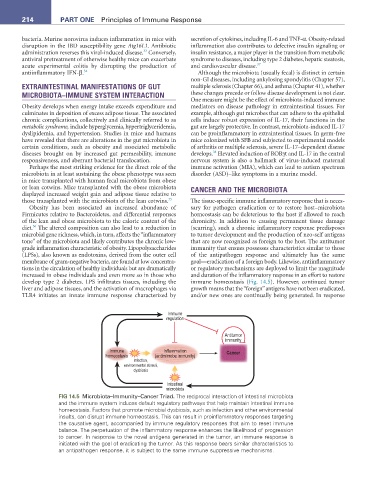
        develop type 2 diabetes. LPS infiltrates tissues, including the   immune homeostasis (Fig. 14.5). However, continued tumor
        liver and adipose tissues, and the activation of macrophages via   growth means that the “foreign” antigens have not been eradicated,
        TLR4 initiates an innate immune response characterized by   and/or new ones are continually being generated. In response

                                                        Immune
                                                       regulation


                                                                           Antitumor
                                                                           immunity
                                     Immune            Inflammation        Cancer
                                    homeostasis     (antimicrobe immunity)
                                             Infection,
                                          environmental stimuli,
                                             dysbiosis

                                                        Intestinal
                                                       microbiota
                    FIG 14.5  Microbiota–Immunity–Cancer Triad. The reciprocal interaction of intestinal microbiota
                    and the immune system induces default regulatory pathways that help maintain intestinal immune
                    homeostasis. Factors that promote microbial dysbiosis, such as infection and other environmental
                    insults, can disrupt immune homeostasis. This can result in proinflammatory responses targeting
                    the causative agent, accompanied by immune regulatory responses that aim to reset immune
                    balance. The perpetuation of the inflammatory response enhances the likelihood of progression
                    to cancer. In response to the novel antigens generated in the tumor, an immune response is
                    initiated with the goal of eradicating the tumor. As this response bears similar characteristics to
                    an antipathogen response, it is subject to the same immune suppressive mechanisms.

