


Page 244 - Clinical Immunology_ Principles and Practice ( PDFDrive )
P. 244
CHaPtEr 15  Immunoglobulin Function                225


                                    Ag                     Ag                      Ag


                                                                                             Ag
                                                                  Ab
                                Ab                                             Ab


                            A    Monovalent          B  Monogamous                   Cross-linking
                                   binding             bivalent binding        C   (bivalent) binding
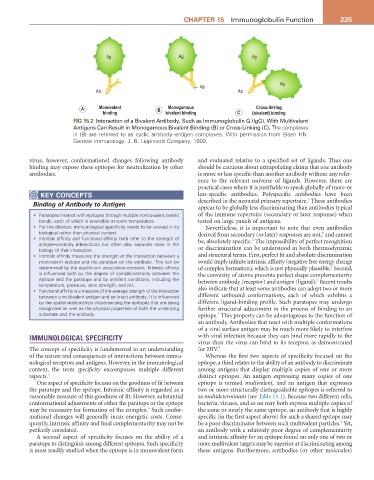
                         FIG 15.2  Interaction of a Bivalent Antibody, Such as Immunoglobulin G (IgG), With Multivalent
                         Antigens Can Result in Monogamous Bivalent Binding (B) or Cross-Linking (C). The complexes
                         in (B) are referred to as cyclic antibody–antigen complexes. With permission from Eisen HN.
                         General immunology. J. B. Lippincott Company; 1990.


           virus; however, conformational changes following antibody   and evaluated relative to a specified set of ligands. Thus one
           binding may expose these epitopes for neutralization by other   should be cautious about extrapolating claims that one antibody
           antibodies.                                            is more or less specific than another antibody without any refer-
                                                                  ence to the relevant universe of ligands. However, there are
                                                                  practical cases where it is justifiable to speak globally of more-or
               KEY CoNCEPtS                                       less-specific antibodies. Polyspecific antibodies have been
                                                                                                      5
            Binding of Antibody to Antigen                        described in the neonatal primary repertoire.  These antibodies
                                                                  appear to be globally less discriminating than antibodies typical
            •  Paratopes interact with epitopes through multiple noncovalent (weak)   of the immune repertoire (secondary or later response) when
              bonds, each of which is reversible at room temperature.  tested on large panels of antigens.
            •  For the clinician, immunological specificity needs to be viewed in its   Nevertheless, it  is important  to note that  even  antibodies
              biological rather than physical context.            derived from secondary (or later) responses are not,  and cannot
                                                                                                          6
            •  Intrinsic affinity and functional affinity both refer to the strength of   be, absolutely specific.  The impossibility of perfect recognition
                                                                                   2
              antigen–antibody interactions but often play separate roles in the
              biology of that interaction.                        or discrimination can be understood in both thermodynamic
            •  Intrinsic affinity measures the strength of the interaction between a   and structural terms. First, perfect fit and absolute discrimination
              monovalent epitope and the paratope on the antibody. This can be   would imply infinite intrinsic affinity (negative free energy change
                                                                                                             2
              determined by the equilibrium association constant. Intrinsic affinity   of complex formation), which is not physically plausible.  Second,
              is influenced both by the degree of complementarity between the   the convexity of atoms prevents perfect shape complementarity
              epitope and the paratope and by ambient conditions, including the   between antibody (receptor) and antigen (ligand).  Recent results
                                                                                                         2
              temperature, pressure, ionic strength, and pH.
            •  Functional affinity is a measure of the average strength of the interaction   also indicate that at least some antibodies can adopt two or more
              between a multivalent antigen and an intact antibody. It is influenced   different unbound conformations, each of which exhibits a
              by the spatial relationships characterizing the epitopes that are being   different ligand-binding profile. Such paratopes may undergo
              recognized as well as the physical properties of both the underlying   further structural adjustment in the process of binding to an
              substrate and the antibody.                         epitope.  This property can be advantageous to the function of
                                                                        7
                                                                  an antibody. Antibodies that react with multiple conformations
                                                                  of a viral surface antigen may be much more likely to interfere
           IMMUNOLOGICAL SPECIFICITY                              with viral infection because they can bind more rapidly to the
                                                                  virus than the virus can bind to its receptor, as demonstrated
           The concept of specificity is fundamental to an understanding   for HIV. 8
           of the nature and consequences of interactions between immu-  Whereas the first two aspects of specificity focused on the
           nological receptors and antigens. However, in the immunological   epitope, a third relates to the ability of an antibody to discriminate
           context, the term  specificity encompasses multiple different   among  antigens that  display multiple copies  of  one or more
           aspects. 2                                             distinct epitopes.  An antigen expressing many copies of one
             One aspect of specificity focuses on the goodness of fit between   epitope is termed  multivalent, and an antigen that expresses
           the paratope and the epitope. Intrinsic affinity is regarded as a   two or more structurally distinguishable epitopes is referred to
           reasonable measure of this goodness of fit. However, substantial   as multideterminant (see Table 15.1). Because two different cells,
           conformational adjustments of either the paratope or the epitope   bacteria, viruses, and so on may both express multiple copies of
                                                 4
           may be necessary for formation of the complex.  Such confor-  the same or nearly the same epitope, an antibody that is highly
           mational changes will generally incur energetic costs. Conse-  specific (in the first aspect above) for such a shared epitope may
                                                                                                                2
           quently, intrinsic affinity and final complementarity may not be   be a poor discriminator between such multivalent particles.  Yet,
           perfectly correlated.                                  an antibody with a relatively poor degree of complementarity
             A second aspect of specificity focuses on the ability of a   and intrinsic affinity for an epitope found on only one of two or
           paratope to distinguish among different epitopes. Such specificity   more multivalent targets may be superior at discriminating among
           is most readily studied when the epitope is in monovalent form   these antigens. Furthermore, antibodies (or other molecules)

