


Page 247 - Clinical Immunology_ Principles and Practice ( PDFDrive )
P. 247
228          Part two  Host Defense Mechanisms and Inflammation


                                                                   KEY CoNCEPtS
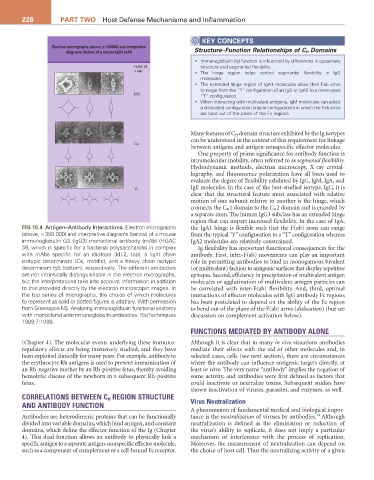
                  Electron micrographs (above; x 350000) and interpretive  Structure–Function Relationships of C H  Domains
                       diagrams (below) of a mouse IgG3 mAb
                                                                 •  Immunoglobulin (Ig) function is influenced by differences in quaternary
                                             HGAC 39               structure and segmental flexibility.
                                             + Anti-             •  The hinge region helps control segmental flexibility in IgG
                                                                   molecules.
                                                                 •  The extended hinge region of IgA1 molecules allow their Fab arms
                                                                   to range from the “Y” configuration of an IgG or IgA2 to a more open
                                             Idl-2
                                                                   “T” configuration.
                                                                 •  When interacting with multivalent antigens, IgM molecules can adopt
                                                                   a dislocated configuration (staple configuration) in which the Fab arms
                                                                   are bent out of the plane of the Fc regions.


                                                               Many features of C H  domain structure exhibited by the Ig isotypes
                                                               can be understood in the context of this requirement for linkage
                                             Cκ
                                                               between antigens and antigen-nonspecific effector molecules.
                                                                  One property of prime significance for antibody function is
                                                               intramolecular mobility, often referred to as segmental flexibility.
                                                               Hydrodynamic methods, electron microscopy, X-ray crystal-
                                                               lography, and fluorescence polarization have all been used to
                                                               evaluate the degree of flexibility exhibited by IgG, IgM, IgA, and
                                             γ3                IgE molecules. In the case of the best-studied isotype, IgG, it is
                                                               clear that the structural feature most associated with relative
                                                               motion of one subunit relative to another is the hinge, which
                                                               connects the C H 1 domain to the C H 2 domain and is encoded by
                                                               a separate exon. The human IgG3 subclass has an extended hinge
                                                               region that can impart increased flexibility. In the case of IgA,
        FIG 15.4  Antigen–Antibody Interactions. Electron micrographs   the IgA1 hinge is flexible such that the F(ab) arms can range
        (above; × 350 000) and interpretive diagrams (below) of a mouse   from the typical “Y” configuration to a “T” configuration whereas
        immunoglobulin G3 (IgG3) monoclonal antibody (mAb) (HGAC   IgA2 molecules are relatively constrained.
        39, which is specific for a bacterial polysaccharide) in complex   Ig flexibility has important functional consequences for the
        with mAbs specific for an idiotope (IdI-2, top), a light chain   antibody. First, inter-F(ab) movements can play an important
        isotypic determinant (Cκ, middle), and a heavy chain isotypic   role in permitting antibodies to bind in monogamous bivalent
        determinant (γ3; bottom), respectively. The different antibodies   (or multivalent) fashion to antigenic surfaces that display repetitive
        are not intrinsically distinguishable in the electron micrographs,   epitopes. Second, efficiency in precipitation of multivalent antigen
        but the interpretations take into account information in addition   molecules or agglutination of multivalent antigen particles can
        to that provided directly by the electron microscopic images. In   be correlated with inter-F(ab) flexibility.  And, third, optimal
        the top series of micrographs, the choice of which molecules   interactions of effector molecules with IgG antibody Fc regions
        to represent as solid or dotted figures is arbitrary. With permission   has been postulated to depend on the ability of the Fc region
        from Greenspan NS. Analyzing immunoglobulin functional anatomy   to bend out of the plane of the F(ab) arms (dislocation) (but see
        with monoclonal antiimmunoglobulin antibodies. BioTechniques   discussion on complement activation below).
        1989;7:1086.
                                                               FUNCTIONS MEDIATED BY ANTIBODY ALONE
        (Chapter 4). The molecular events underlying these immuno-  Although it is clear that in many in vivo situations antibodies
        regulatory effects are being intensively studied, and they have   mediate their effects with the aid of other molecules and, in
        been exploited clinically for many years. For example, antibody to   selected cases, cells (see next section), there are circumstances
        the erythrocyte Rh antigens is used to prevent immunization of   where the antibody can influence antigenic targets directly, at
        an Rh-negative mother by an Rh-positive fetus, thereby avoiding   least in vitro. The very name “antibody” implies the negation of
        hemolytic disease of the newborn in a subsequent Rh-positive   some activity, and antibodies were first defined as factors that
        fetus.                                                 could inactivate or neutralize toxins. Subsequent studies have
                                                               shown inactivation of viruses, parasites, and enzymes, as well.
        CORRELATIONS BETWEEN C H REGION STRUCTURE
        AND ANTIBODY FUNCTION                                  Virus Neutralization
                                                               A phenomenon of fundamental medical and biological impor-
                                                                                                         14
        Antibodies are heterodimeric proteins that can be functionally   tance is the neutralization of viruses by antibodies.  Although
        divided into variable domains, which bind antigen, and constant   neutralization is defined as the elimination or reduction of
        domains, which define the effector function of the Ig (Chapter   the virus’s ability to replicate, it does not imply a particular
        4). This dual function allows an antibody to physically link a   mechanism of interference with the process of replication.
        specific antigen to a separate antigen-nonspecific effector molecule,   Moreover, the measurement of neutralization can depend on
        such as a component of complement or a cell-bound Fc receptor.   the choice of host cell. Thus the neutralizing activity of a given

