


Page 245 - Clinical Immunology_ Principles and Practice ( PDFDrive )
P. 245
226          Part two  Host Defense Mechanisms and Inflammation


                             Conformational epitope      Linear epitope            Neo-epitope
                                                                               (created by proteolysis)
                                                               Accessible
                                                               epitope
                                              Inaccessible                    Epitope
                                                 epitope                      absent
                                                             C                           C
                                                       N                            N
                                                                                        Site of limited
                                          C                                             proteolysis
                                    N
                           Denaturation            Denaturation  Denaturation   Proteolysis

                                         C                C                C            New epitope
                                                                                    C
                                                                                    N
                          N                N                N                       C
                                                                               N


                               Epitope lost by  Ig binds to epitope  Ig binds to epitope in both
                               denaturation  in denatured protein only  native and denatured protein
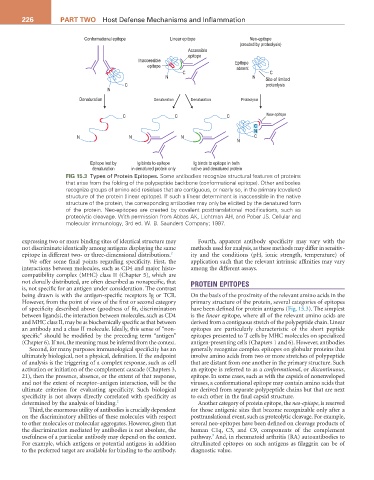
                       FIG 15.3  Types of Protein Epitopes. Some antibodies recognize structural features of proteins
                       that arise from the folding of the polypeptide backbone (conformational epitope). Other antibodies
                       recognize groups of amino acid residues that are contiguous, or nearly so, in the primary (covalent)
                       structure of the protein (linear epitope). If such a linear determinant is inaccessible in the native
                       structure of the protein, the corresponding antibodies may only be elicited by the denatured form
                       of the protein. Neo-epitopes are created by covalent posttranslational modifications, such as
                       proteolytic cleavage. With permission from Abbas AK, Lichtman AH, and Pober JS. Cellular and
                       molecular immunology, 3rd ed. W. B. Saunders Company; 1997.


        expressing two or more binding sites of identical structure may   Fourth, apparent antibody specificity may vary with the
        not discriminate identically among antigens displaying the same   methods used for analysis, as these methods may differ in sensitiv-
        epitope in different two- or three-dimensional distributions. 2  ity  and  the  conditions  (pH,  ionic  strength,  temperature)  of
           We offer some final points regarding specificity. First, the   application such that the relevant intrinsic affinities may vary
        interactions between molecules, such as CD4 and major histo-  among the different assays.
        compatibility complex (MHC) class II (Chapter 5), which are
        not clonally distributed, are often described as nonspecific, that   PROTEIN EPITOPES
        is, not specific for an antigen under consideration. The contrast
        being drawn is with the antigen-specific receptors Ig or TCR.   On the basis of the proximity of the relevant amino acids in the
        However, from the point of view of the first or second category   primary structure of the protein, several categories of epitopes
        of specificity described above (goodness of fit, discrimination   have been defined for protein antigens (Fig. 15.3). The simplest
        between ligands), the interaction between molecules, such as CD4   is the linear epitope, where all of the relevant amino acids are
        and MHC class II, may be as biochemically specific as that between   derived from a contiguous stretch of the polypeptide chain. Linear
        an antibody and a class II molecule. Ideally, this sense of “non-  epitopes are particularly characteristic of the short peptide
        specific” should be modified by the preceding term “antigen”   epitopes presented to T cells by MHC molecules on specialized
        (Chapter 6). If not, the meaning must be inferred from the context.  antigen-presenting cells (Chapters 1 and 6). However, antibodies
           Second, for many purposes immunological specificity has an   generally recognize complex epitopes on globular proteins that
        ultimately biological, not a physical, definition. If the endpoint   involve amino acids from two or more stretches of polypeptide
        of analysis is the triggering of a complex response, such as cell   that are distant from one another in the primary structure. Such
        activation or initiation of the complement cascade (Chapters 3,   an epitope is referred to as a conformational, or discontinuous,
        21), then the presence, absence, or the extent of that response,   epitope. In some cases, such as with the capsids of nonenveloped
        and not the extent of receptor–antigen interaction, will be the   viruses, a conformational epitope may contain amino acids that
        ultimate criterion for evaluating specificity. Such biological   are derived from separate polypeptide chains but that are next
        specificity is not always directly correlated with specificity as   to each other in the final capsid structure.
        determined by the analysis of binding. 2                  Another category of protein epitope, the neo-epitope, is reserved
           Third, the enormous utility of antibodies is crucially dependent   for those antigenic sites that become recognizable only after a
        on the discriminatory abilities of these molecules with respect   posttranslational event, such as proteolytic cleavage. For example,
        to other molecules or molecular aggregates. However, given that   several neo-epitopes have been defined on cleavage products of
        the discrimination mediated by antibodies is not absolute, the   human C1q, C3, and C9, components of the complement
                                                                      9
        usefulness of a particular antibody may depend on the context.   pathway.  And, in rheumatoid arthritis (RA) autoantibodies to
        For example, which antigens or potential antigens in addition   citrullinated epitopes on such antigens as filaggrin can be of
        to the preferred target are available for binding to the antibody.  diagnostic value.

