


Page 250 - Clinical Immunology_ Principles and Practice ( PDFDrive )
P. 250
CHaPtEr 15  Immunoglobulin Function                231


              Receptor     FcγRI     FcγRII-A   FcγRII-B2  FcγRII-B3    FcγRIII    FcεRI      FcαRI     Fcα/µR
                          (CD64)      (CD32)     (CD32)     (CD32)      (CD16)                (CD89)
                            α 72 kDa  α 40 kDa                        α 50-70  kDa  α 45 kDa  α 55-75 kDa  α 70 kDa
              Structure
                                                                                   β 33 kDa
                                                                        or  γ  or ζ  γ 9 kDa   γ 9 kDa
                                         γ ~like    ITIM
                                         domain                ITIM
              Binding      IgG1        IgG1       IgG1       IgG1       IgG1        IgE      IgA1, IgA2   IgA, IgM
                          10 M       2X10 M     2X10 M     2X10 M      5X10 M     10 10   -1  10 M       3x10 M
                           8   -1
                                                                          5   -1
                                                                                               7   -1
                                                                                     M
                                                              6   -1
                                                                                                            9   -1
                                        6   -1
                                                   6   -1
              Order of  1) IgG1=IgG3  1) IgG1  1) IgG1=IgG3  1) IgG1=IgG3  IgG1=IgG3         IgA1=IgA2  1) IgM
              affinity  2) IgG4     2) IgG3=IgG2*  2) IgG4  2) IgG4                                     2) IgA
                        3) IgG2     3) IgG2    3) IgG2    3) IgG2
              Cell type  Macrophages  Macrophages  Macrophages  B cells  NK cells  Mast cells  Macrophages  Macrophages
                         Neutrophils †  Neutrophils  Neutrophils  Mast cells  Eosinophils  Eosinophils †  Neutrophils  B cells
                         Eosinophils †  Eosinophils  Eosinophils      Macrophages  Basophils  Eosinophils ‡
                        Dendritic cells  Platelets                     Neutrophils
                                   Langerhans’ cells                   Mast cells
              Effect of   Uptake      Uptake     Uptake    No uptake   Induction  Secretion   Uptake      Uptake
              ligation   Stimulation  Granule   Inhibition  Inhibition of  of killing  of granules  Induction of
                         Activation of  release  of stimulation  stimulation  (NK cells)       killing
                         respiratory  (eosinophils)
                           burst
                       Induction of killing
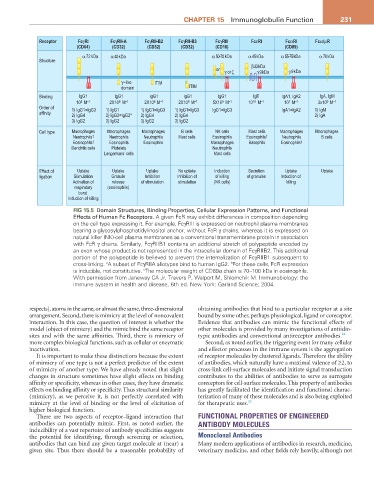
                         FIG 15.5  Domain Structures, Binding Properties, Cellular Expression Patterns, and Functional
                         Effects of Human Fc Receptors. A given FcR may exhibit differences in composition depending
                         on the cell type expressing it. For example, FcγRIII is expressed on neutrophil plasma membranes
                         bearing a glycosylphosphatidylinositol anchor, without FcR γ chains, whereas it is expressed on
                         natural killer (NK)-cell plasma membranes as a conventional transmembrane protein in association
                         with FcR γ chains. Similarly, FcγRIIB1 contains an additional stretch of polypeptide encoded by
                         an exon whose product is not represented in the intracellular domain of FcγRIIB2. This additional
                         portion of the polypeptide is believed to prevent the internalization of FcγRIIB1 subsequent to
                         cross-linking.  A subset of FcγRIIA allotypes bind to human IgG2.  For these cells, FcR expression
                                                                            b
                                    a
                         is inducible, not constitutive.  The molecular weight of CD89α chain is 70–100 kDa in eosinophils.
                                                c
                         With permission from Janeway CA Jr, Travers P, Walport M, Shlomchik M. Immunobiology: the
                         immune system in health and disease, 6th ed. New York: Garland Science; 2004.

           respects), atoms in the same, or almost the same, three-dimensional   obtaining antibodies that bind to a particular receptor at a site
           arrangement. Second, there is mimicry at the level of noncovalent   bound by some other, perhaps physiological, ligand or coreceptor.
           interaction. In this case, the question of interest is whether the   Evidence that antibodies can mimic the functional effects of
           model (object of mimicry) and the mimic bind the same receptor   other molecules is provided by many investigations of antiidio-
           sites and with the same affinities. Third, there is mimicry of   typic antibodies and conventional antireceptor antibodies. 24
           more complex biological functions, such as cellular or enzymatic   Second, as noted earlier, the triggering event for many cellular
           inactivation.                                          and effector processes in the immune system is the aggregation
             It is important to make these distinctions because the extent   of receptor molecules by clustered ligands. Therefore the ability
           of mimicry of one type is not a perfect predictor of the extent   of antibodies, which naturally have a maximal valence of ≥2, to
           of mimicry of another type. We have already noted that slight   cross-link cell-surface molecules and initiate signal transduction
           changes in structure sometimes have slight effects on binding   contributes to the abilities of antibodies to serve as surrogate
           affinity or specificity, whereas in other cases, they have dramatic   coreceptors for cell-surface molecules. This property of antibodies
           effects on binding affinity or specificity. Thus structural similarity   has greatly facilitated the identification and functional charac-
           (mimicry), as we perceive it, is not perfectly correlated with   terization of many of these molecules and is also being exploited
           mimicry at the level of binding or the level of elicitation of   for therapeutic uses. 25
           higher biological function.
             There are two aspects of receptor–ligand interaction that   FUNCTIONAL PROPERTIES OF ENGINEERED
           antibodies can potentially mimic. First, as noted earlier, the   ANTIBODY MOLECULES
           inducibility of a vast repertoire of antibody specificities suggests
           the potential for identifying, through screening or selection,   Monoclonal Antibodies
           antibodies that can bind any given target molecule at (near) a   Many modern applications of antibodies in research, medicine,
           given site. Thus there should be a reasonable probability of   veterinary medicine, and other fields rely heavily, although not

