


Page 251 - Clinical Immunology_ Principles and Practice ( PDFDrive )
P. 251
232          Part two  Host Defense Mechanisms and Inflammation


        exclusively, on mAbs. By definition, a mAb population is derived
        from a clonal population of B-lineage cells (Chapter 7). Therefore
        all of the molecules express identical variable domains and                                     scFv-toxin
        identical antigen specificities. It is the homogeneity of V-domain                         scFv
        structure associated with mAbs that most crucially distinguishes
        them from polyclonal antibodies, such as those conventionally
        derived from the serum. Homogeneous antibodies give more                            Fv
        reproducible and more easily interpreted results for many kinds                            dAb
        of assays.
                                                                                  Fab
            KEY CoNCEPtS                                                                                  m.r.u
         Monoclonal Antibodies From Hybridomas
                                                                   Mouse antibody
          •  Hybridomas are created by fusing normal lymphocytes from immunized          Fab enzyme
           animals or immune humans with transformed cells of B-lymphocyte
           lineage (myeloma cells).                                                Fc
          •  Monoclonal antibodies (mAbs) produced by a hybridoma are generally
           homogeneous, expressing a single amino acid sequence.
          •  Hybridomas can be grown indefinitely in tissue culture.
          •  Hybridomas can be selected on the basis of the antigenic specificity
           or functional properties of the mAb secreted by the hybridoma.
                                                                                           CD4
                                                                     Chimeric           immunoadhesin
           mAbs of selected specificity were first produced by cells referred   mouse antibody
                      26
        to as hybridomas.  In contrast, a myeloma protein would be an
        example of an mAb of unselected specificity. Hybridomas are
        hybrid transformed cells that are created by the fusion of two
                                                                                'Reshaped'
        types of cells, with each parental cell endowing the hybridoma         human antibody
        with desirable properties. One parent of a hybridoma (the fusion
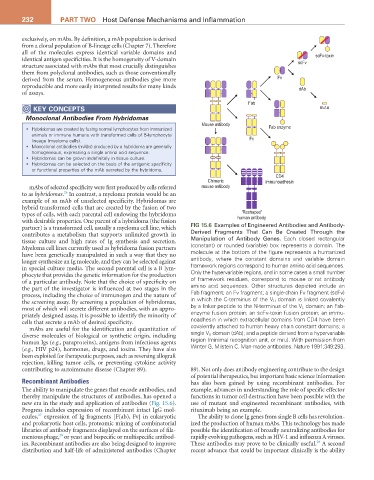
        partner) is a transformed cell, usually a myeloma cell line, which   FIG 15.6  Examples of Engineered Antibodies and Antibody-
        contributes a metabolism that supports unlimited growth in   Derived Fragments That Can Be Created Through the
        tissue culture and high rates of Ig synthesis and secretion.   Manipulation of Antibody Genes. Each closed rectangular
        Myeloma cell lines currently used as hybridoma fusion partners   (constant) or rounded (variable) box represents a domain. The
        have been genetically manipulated in such a way that they no   molecule at the bottom of the figure represents a humanized
        longer synthesize an Ig molecule, and they can be selected against   antibody, where the constant domains and variable domain
        in special culture media. The second parental cell is a B lym-  framework regions correspond to human amino acid sequences.
        phocyte that provides the genetic information for the production   Only the hypervariable regions, and in some cases a small number
        of a particular antibody. Note that the choice of specificity on   of framework residues, correspond to mouse or rat antibody
        the part of the investigator is influenced at two stages in the   amino acid sequences. Other structures depicted include an
        process, including the choice of immunogen and the nature of   Fab fragment; an Fv fragment; a single-chain Fv fragment (scFv)
        the screening assay. By screening a population of hybridomas,   in which the C-terminus of the V H  domain is linked covalently
        most of which will secrete different antibodies, with an appro-  by a linker peptide to the N-terminus of the V L domain; an Fab-
        priately designed assay, it is possible to identify the minority of   enzyme fusion protein; an scFv-toxin fusion protein; an immu-
        cells that secrete a mAb of desired specificity.       noadhesin in which extracellular domains from CD4 have been
           mAbs are useful for the identification and quantitation of   covalently attached to human heavy chain constant domains; a
        diverse  molecules  of  biological  or  synthetic  origin,  including   single V H  domain (dAb); and a peptide derived from a hypervariable
        human Igs (e.g., paraproteins), antigens from infectious agents   region (minimal recognition unit, or mru). With permission from
        (e.g., HIV p24), hormones, drugs, and toxins. They have also   Winter G, Milstein C. Man-made antibodies. Nature 1991;349:293.
        been exploited for therapeutic purposes, such as reversing allograft
        rejection,  killing  tumor  cells,  or  preventing  cytokine  activity
        contributing to autoimmune disease (Chapter 89).       89). Not only does antibody engineering contribute to the design
                                                               of potential therapeutics, but important basic science information
        Recombinant Antibodies                                 has also been gained by using recombinant antibodies. For
        The ability to manipulate the genes that encode antibodies, and   example, advances in understanding the role of specific effector
        thereby manipulate the structures of antibodies, has opened a   functions in tumor cell destruction have been possible with the
        new era in the study and application of antibodies (Fig. 15.6).   use of mutant and engineered recombinant antibodies, with
        Progress includes expression of recombinant intact IgG mol-  rituximab being an example.
             27
        ecules,  expression of Ig fragments [F(ab), Fv] in eukaryotic   The ability to clone Ig genes from single B cells has revolution-
        and prokaryotic host cells, proteomic mining of combinatorial   ized the production of human mAbs. This technology has made
        libraries of antibody fragments displayed on the surfaces of fila-  possible the identification of broadly neutralizing antibodies for
                    28
        mentous phage,  or yeast and bispecific or multispecific antibod-  rapidly evolving pathogens, such as HIV-1 and influenza A viruses.
                                                                                                         29
        ies. Recombinant antibodies are also being designed to improve   These antibodies may prove to be clinically useful.  A second
        distribution and half-life of administered antibodies (Chapter   recent advance that could be important clinically is the ability

