


Page 320 - Clinical Immunology_ Principles and Practice ( PDFDrive )
P. 320
300          Part two  Host Defense Mechanisms and Inflammation


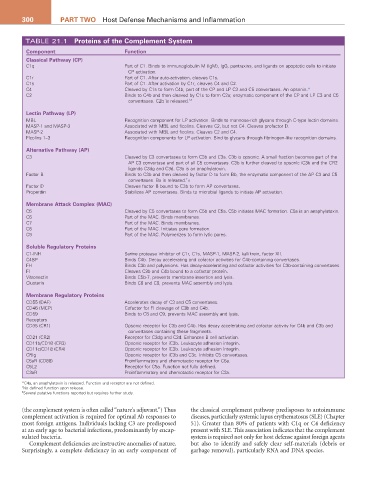
         TABLE 21.1  Proteins of the Complement System
          Component                       Function
          Classical Pathway (CP)
          C1q                             Part of C1. Binds to immunoglobulin M (IgM), IgG, pentraxins, and ligands on apoptotic cells to initiate
                                           CP activation.
          C1r                             Part of C1. After auto-activation, cleaves C1s.
          C1s                             Part of C1. After activation by C1r, cleaves C4 and C2.
          C4                              Cleaved by C1s to form C4b, part of the CP and LP C3 and C5 convertases. An opsonin.*
          C2                              Binds to C4b and then cleaved by C1s to form C2a; enzymatic component of the CP and LP C3 and C5
                                           convertases. C2b is released. †Δ
          Lectin Pathway (LP)
          MBL                             Recognition component for LP activation. Binds to mannose-rich glycans through C-type lectin domains.
          MASP-1 and MASP-3               Associated with MBL and ficolins. Cleaves C2, but not C4. Cleaves profactor D.
          MASP-2                          Associated with MBL and ficolins. Cleaves C2 and C4.
          Ficolins 1–3                    Recognition components for LP activation. Bind to glycans through fibrinogen-like recognition domains.
          alternative Pathway (aP)
          C3                              Cleaved by C3 convertases to form C3b and C3a. C3b is opsonic. A small fraction becomes part of the
                                           AP C3 convertase and part of all C5 convertases. C3b is further cleaved to opsonic iC3b and the CR2
                                           ligands C3dg and C3d. C3a is an anaphylatoxin.
          Factor B                        Binds to C3b and then cleaved by factor D to form Bb, the enzymatic component of the AP C3 and C5
                                           convertases. Ba is released. ○
                                                              ‡
          Factor D                        Cleaves factor B bound to C3b to form AP convertases.
          Properdin                       Stabilizes AP convertases. Binds to microbial ligands to initiate AP activation.
          Membrane attack Complex (MaC)
          C5                              Cleaved by C5 convertases to form C5b and C5a. C5b initiates MAC formation. C5a is an anaphylatoxin.
          C6                              Part of the MAC. Binds membranes.
          C7                              Part of the MAC. Binds membranes.
          C8                              Part of the MAC. Initiates pore formation.
          C9                              Part of the MAC. Polymerizes to form lytic pores.

          Soluble regulatory Proteins
          C1-INH                          Serine protease inhibitor of C1r, C1s, MASP-1, MASP-2, kallikrein, factor XII.
          C4BP                            Binds C4b. Decay accelerating and cofactor activities for C4b-containing convertases.
          FH                              Binds C3b and polyanions. Has decay-accelerating and cofactor activities for C3b-containing convertases.
          FI                              Cleaves C3b and C4b bound to a cofactor protein.
          Vitronectin                     Binds C5b-7, prevents membrane insertion and lysis.
          Clusterin                       Binds C8 and C9, prevents MAC assembly and lysis.

          Membrane regulatory Proteins
          CD55 (DAF)                      Accelerates decay of C3 and C5 convertases.
          CD46 (MCP)                      Cofactor for FI cleavage of C3b and C4b.
          CD59                            Binds to C8 and C9, prevents MAC assembly and lysis.
          Receptors
          CD35 (CR1)                      Opsonic receptor for C3b and C4b. Has decay accelerating and cofactor activity for C4b and C3b and
                                           convertases containing these fragments.
          CD21 (CR2)                      Receptor for C3dg and C3d. Enhances B cell activation.
          CD11b/CD18 (CR3)                Opsonic receptor for iC3b. Leukocyte adhesion integrin.
          CD11c/CD18 (CR4)                Opsonic receptor for iC3b. Leukocyte adhesion integrin.
          CRIg                            Opsonic receptor for iC3b and C3c. Inhibits C5 convertases.
          C5aR (CD88)                     Proinflammatory and chemotactic receptor for C5a.
          C5L2                            Receptor for C5a. Function not fully defined.
          C3aR                            Proinflammatory and chemotactic receptor for C3a.

        *C4a, an anaphylatoxin is released. Function and receptor are not defined.
        † No defined function upon release.
        ‡ Several putative functions reported but requires further study.

        (the complement system is often called “nature’s adjuvant.”) Thus   the classical complement pathway predisposes to autoimmune
        complement activation is required for optimal Ab responses to   diseases, particularly systemic lupus erythematosus (SLE) (Chapter
        most foreign antigens. Individuals lacking C3 are predisposed   51). Greater than 80% of patients with C1q or C4 deficiency
        at an early age to bacterial infections, predominantly by encap-  present with SLE. This association indicates that the complement
        sulated bacteria.                                      system is required not only for host defense against foreign agents
           Complement deficiencies are instructive anomalies of nature.   but also to identify and safely clear self-materials (debris or
        Surprisingly, a complete deficiency in an early component of   garbage removal), particularly RNA and DNA species.

