


Page 321 - Clinical Immunology_ Principles and Practice ( PDFDrive )
P. 321
CHaPtEr 21  The Human Complement System: Basic Concepts and Clinical Relevance                     301


             Much  complement-mediated  pathology  revolves  around   participates with natural IgM in early host defense and provides
           disturbances of the AP and thus its potent amplification loop.   a mechanism for immune complex and apoptotic cell clearance.
           It must be rigorously regulated to prevent activation on normal   The lectin pathway (LP) uses most of the CP components but
           self and excessive activation on injured self. Even haploinsuffi-  is activated by mannan-binding lectin (MBL) and the ficolins,
           ciency of its two major inhibitors predisposes to endothelial   which are lectins that recognize repeating carbohydrate patterns
                                                                                  7
           damage in atypical hemolytic–uremic syndrome and retinal   on microorganisms.  The AP is the most ancient pathway and
           damage in age-related macular degeneration (ARMD).     also has the broadest recognition ability. The AP is engaged by
             In clinical medicine, the complement system participates in   surface components of all types of microorganisms, including
                                                                                                                8
           three pathological processes: (1) bacterial infections and/or   bacteria, fungi, parasites, viruses, and virus-infected cells.  It is
           autoimmunity are caused by complete component deficiencies;   continuously turning over and autoactivates if its inhibitors are
           (2) tissue damage results from complement activation by auto-  lacking. Activation of the AP can also be initiated by properdin
           antibodies forming immune complexes (e.g., SLE); and (3)   (P), a molecule that binds to pathogens and apoptotic cells. This
           excessive activation at sites of cellular and tissue injury occurs   mechanism further promotes its function as an innate and rapid
                                                                                    9
           in individuals carrying dysfunctional genetic variants in comple-  responder to infection.  The AP is an important amplification
           ment regulators.                                       mechanism for CP or LP activation, resulting in greater opsoniza-
             Knowledge of how complement is activated and how it can   tion and generation of the terminal lytic pathway. For example,
           be controlled points to opportunities for the development of   the initial trigger on a pathogen surface may be IgM or a lectin,
           therapeutic agents. One such example is anti-C5 monoclonal   but the majority of the C3b deposited is via AP’s amplification
           antibody (mAb) therapy, which has been recently approved to   or feedback loop that is engaged by just having C3b on a target.
           treat several complement-dependent hemolytic disorders. Other   The cleavage of C3 to C3a and C3b is central to all three
           new complement therapeutics and diagnostics are on the horizon   pathways of complement activation. This enzymatic step exposes
           as biotechnology companies pursue novel complement inhibitors   a highly reactive thioester bond through which C3b covalently
           and genetic evaluations are increasingly utilized for helping to   attaches  to  nearby  molecules  (Fig.  21.2). Activation  of  C3  to
           define diseases in which the complement system is involved.  C3b also exposes sites for interactions with other complement
                                                                  proteins, inhibitors, and receptors. Recent results have shed new
           COMPLEMENT PATHWAYS                                    light on the structural basis for C3 activation. In 2006, several
                                                                  studies reported the first x-ray structure of C3b, the activated
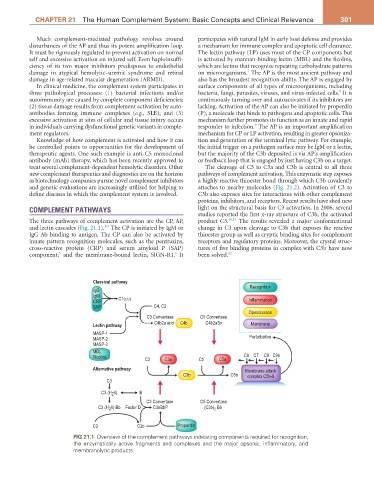
           The three pathways of complement activation are the CP, AP,   product C3. 10,11  The results revealed a major conformational
                                   1-4
           and lectin cascades (Fig. 21.1).  The CP is initiated by IgM or   change in C3 upon cleavage to C3b that exposes the reactive
           IgG Ab binding to antigen. The CP can also be activated by   thioester group as well as cryptic binding sites for complement
           innate pattern recognition molecules, such as the pentraxins,   receptors and regulatory proteins. Moreover, the crystal struc-
           cross-reactive protein (CRP) and serum amyloid P (SAP)   tures of five binding proteins in complex with C3b have now
                                                          6
                    5
           component,  and the membrane-bound lectin, SIGN-R1.  It   been solved. 12


                               Classical pathway
                                                                                   Recognition
                               IgG
                               IgM
                               CRP      C1q,r,s                                   Inflammation
                               SAP                 C4, C2
                                                                                  Opsonization
                                                 C3 Convertase     C5 Convertase
                                                   C4b2a and  C4b   C4b2a3b
                               Lectin pathway                                      Membrane
                               MASP-1
                               MASP-2                                              Perturbation
                               MASP-3
                               MBL
                               Ficolins         C3     C3a        C5     C5a     C6 C7  C8 C9n

                               Alternative pathway                               Membrane attack
                                                             C3b            C5b   complex C5b-9
                                    C3

                                  C3 (H 0)     B
                                      2
                                                 C3 Convertase     C5 Convertase
                                 C3 (H 0) Bb Factor D  C3bBbP       (C3b) 2  Bb
                                     2
                               C3             C3b          Properdin
                         FIG 21.1  Overview of the complement pathways indicating components required for recognition,
                         the enzymatically active fragments and complexes and the major opsonic, inflammatory, and
                         membranolytic products.

