


Page 325 - Clinical Immunology_ Principles and Practice ( PDFDrive )
P. 325
CHaPtEr 21  The Human Complement System: Basic Concepts and Clinical Relevance                     305


                                                                  SIPRα. However, none has been definitively established as a
                                                                  receptor in the classic sense. 1,5,16,31
                                                                  Complement Receptor 1 (CR1, CD35)
                                                                  There are five identified receptors for bound fragments of C3
                               s s
                                    CR3                           and/or C4. CD35 is a large protein composed of a linear string
             CR1                   CD11b                          of CCPs, a transmembrane region, and a short intracytoplasmic
             CD35                  CD18                           domain.  Different allelic forms of CD35 are found, the most
                                                                        32
                       CRIg                            CR2        common being composed of 30 CCPs with a molecular weight of
                                                      CD21        190 kDa. These CCPs are organized into groups of seven, creating
                    C3b          iC3b                             structures termed long homologous repeats (LHRs), each of which
                                                                  contains a single binding site. The predominant allele of CD35
                     SS  S  S     SS  S  S                        contains two binding sites for C3b, three for C4b, and one for
                                                                  C1q. CR1 is expressed on human erythrocytes, monocytes and
                                                        C3dg      macrophages, neutrophils, B lymphocytes, a small percentage of
                     HS C=O       HS C=O           HS C=O         T lymphocytes, eosinophils, FDCs, and glomerular podocytes.
                       O            O                O              CD35 on primate erythrocytes  provides a  mechanism for
                                                                  clearing soluble immune complexes from the circulation. Although
                                                                  the number of receptors on each erythrocyte is low, the large
                                                                  number of erythrocytes provides the major pool of CR1 in the
                                                                  circulation. Soluble immune complexes that fix complement attach
                                                                  quickly to erythrocytes in the circulation, bypassing monocytes
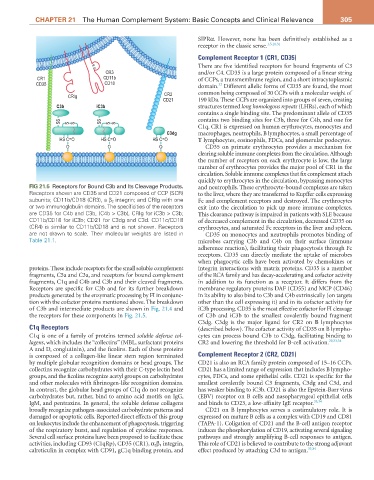
           FIG 21.5  Receptors for Bound C3b and Its Cleavage Products.   and neutrophils. These erythrocyte-bound complexes are taken
           Receptors shown are CD35 and CD21 composed of CCP (SCR)   to the liver, where they are transferred to Kupffer cells expressing
           subunits; CD11b/CD18 (CR3), a β 2  integrin; and CRIg with one   Fc and complement receptors and destroyed. The erythrocytes
           or two immunoglobulin domains. The specificities of the receptors   exit into the circulation to pick up more immune complexes.
           are CD35 for C4b and C3b, (C4b > C3b), CRIg for iC3b > C3b;   This clearance pathway is impaired in patients with SLE because
           CD11b/CD18 for iC3b; CD21 for C3dg and C3d. CD11c/CD18   of decreased complement in the circulation, decreased CD35 on
           (CR4) is similar to CD11b/CD18 and is not shown. Receptors   erythrocytes, and saturated Fc receptors in the liver and spleen.
           are not drawn to scale. Their molecular weights are listed in   CD35 on monocytes and neutrophils promotes binding of
           Table 21.1.                                            microbes carrying C3b and C4b on their surface (immune
                                                                  adherence reaction), facilitating their phagocytosis through Fc
                                                                  receptors. CD35 can directly mediate the uptake of microbes
                                                                  when phagocytic cells have been activated by chemokines or
           proteins. These include receptors for the small soluble complement   integrin interactions with matrix proteins. CD35 is a member
           fragments, C5a and C3a, and receptors for bound complement   of the RCA family and has decay-accelerating and cofactor activity
           fragments, C1q and C4b and C3b and their cleaved fragments.   in addition to its function as a receptor. It differs from the
           Receptors are specific for C3b and for its further breakdown   membrane regulatory proteins DAF (CD55) and MCP (CD46)
           products generated by the enzymatic processing by FI in conjunc-  in its ability to also bind to C3b and C4b extrinsically (on targets
           tion with the cofactor proteins mentioned above. The breakdown   other than the cell expressing it) and in its cofactor activity for
           of C3b and intermediate products are shown in Fig. 21.4 and   iC3b processing. CD35 is the most effective cofactor for FI cleavage
           the receptors for these components in Fig. 21.5.       of  C3b  and  iC3b  to  the  smallest  covalently  bound  fragment
                                                                  C3dg. C3dg is the major ligand for CR2 on B lymphocytes
           C1q Receptors                                          (described below). The cofactor activity of CD35 on B lympho-
           C1q is one of a family of proteins termed soluble defense col-  cytes can process bound C3b to C3dg, facilitating binding to
           lagens, which includes the “collectins” (MBL, surfactant proteins   CR2 and lowering the threshold for B-cell activation. 29,33,34
           A and D, conglutinin), and the ficolins. Each of these proteins
           is composed of a collagen-like linear stem region terminated   Complement Receptor 2 (CR2, CD21)
           by multiple globular recognition domains or head groups. The   CD21 is also an RCA family protein composed of 15–16 CCPs.
           collectins recognize carbohydrates with their C-type lectin head   CD21 has a limited range of expression that includes B lympho-
           groups, and the ficolins recognize acetyl groups on carbohydrates   cytes, FDCs, and some epithelial cells. CD21 is specific for the
           and other molecules with fibrinogen-like recognition domains.   smallest covalently bound C3 fragments, C3dg and C3d, and
           In contrast, the globular head groups of C1q do not recognize   has weaker binding to iC3b. CD21 is also the Epstein-Barr virus
           carbohydrates but, rather, bind to amino acid motifs on IgG,   (EBV) receptor on B cells and nasopharyngeal epithelial cells
           IgM, and pentraxins. In general, the soluble defense collagens   and binds to CD23, a low-affinity IgE receptor. 33,34
           broadly recognize pathogen-associated carbohydrate patterns and   CD21 on B lymphocytes serves a costimulatory role. It is
           damaged or apoptotic cells. Reported direct effects of this group   expressed on mature B cells as a complex with CD19 and CD81
           on leukocytes include the enhancement of phagocytosis, triggering   (TAPA-1). Coligation of CD21 and the B-cell antigen receptor
           of the respiratory burst, and regulation of cytokine responses.   induces the phosphorylation of CD19, activating several signaling
           Several cell surface proteins have been proposed to facilitate these   pathways and strongly amplifying B-cell responses to antigen.
           activities, including CD93 (C1qRp), CD35 (CR1), α 2 β 1  integrin,   This role of CD21 is believed to contribute to the strong adjuvant
           calreticulin in complex with CD91, gC1q binding protein, and   effect produced by attaching C3d to antigen. 33,34

