


Page 324 - Clinical Immunology_ Principles and Practice ( PDFDrive )
P. 324
304          Part two  Host Defense Mechanisms and Inflammation


                                                               names imply, have decay-accelerating and/or cofactor activity,
                                                               respectively, that inhibits complement activation on cell mem-
                                                                     25
                                                               branes.  Each has an extracellular domain composed exclusively
                                                               of four CCPs. CD55, a glycophosphatidylinositol (GPI)–anchored
                                                               protein, and CD46, a transmembrane protein, are widely dis-
                                                               tributed on cells in contact with blood, with the notable exception
                                                               of erythrocytes that lack CD46. Soluble CD55 is also found in
                                                               most  biological  fluids.  Both  protect  cells  from  complement-
                                                               mediated lysis. CD35 (CR1) has decay-accelerating and cofactor
                                                               activity and is a receptor for bound C3b. The function of CD35
                                                               as a complement receptor is discussed later in the chapter.
                                                                  Complement C2 receptor inhibitor trispanning (CRIT) is a
                                                               non-RCA membrane regulator of the CP. CRIT was originally
                                                               identified on Schistosoma and Trypanosoma parasites and later
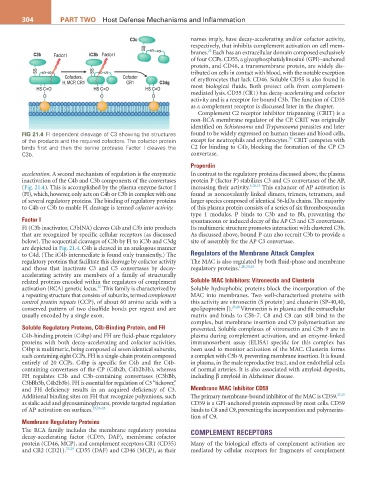
        FIG 21.4  FI dependent cleavage of C3 showing the structures   found to be widely expressed on human tissues and blood cells,
                                                                                               30
        of the products and the required cofactors. The cofactor protein   except for neutrophils and erythrocytes.  CRIT competes with
        binds first and then the serine protease Factor I cleaves the   C2 for binding to C4b, blocking the formation of the CP C3
        C3b.                                                   convertase.
                                                               Properdin
        acceleration. A second mechanism of regulation is the enzymatic   In contrast to the regulatory proteins discussed above, the plasma
        inactivation of the C4b and C3b components of the convertases   protein P (factor P) stabilizes C3 and C5 convertases of the AP,
        (Fig. 21.4). This is accomplished by the plasma enzyme factor I   increasing their activity. 8,18,19  This enhancer of AP activation is
        (FI), which, however, only acts on C4b or C3b in complex with one   found as noncovalently linked dimers, trimers, tetramers, and
        of several regulatory proteins. The binding of regulatory proteins   larger species composed of identical 56-kDa chains. The majority
        to C4b or C3b to enable FI cleavage is termed cofactor activity.  of this plasma protein consists of a series of six thrombospondin
                                                               type 1 modules. P binds to C3b and to Bb, preventing the
        Factor I                                               spontaneous or induced decay of the AP C3 and C5 convertases.
        FI (C3b inactivator, C3bINA) cleaves C4b and C3b into products   Its multimeric structure promotes interaction with clustered C3b.
        that are recognized by specific cellular receptors (as discussed   As discussed above, bound P can also recruit C3b to provide a
        below). The sequential cleavages of C3b by FI to iC3b and C3dg   site of assembly for the AP C3 convertase.
        are depicted in Fig. 21.4. C4b is cleaved in an analogous manner
        to C4d. (The iC4b intermediate is found only transiently.) The   Regulators of the Membrane Attack Complex
        regulatory proteins that facilitate this cleavage by cofactor activity   The MAC is also regulated by both fluid-phase and membrane
        and  those  that  inactivate  C3  and  C5  convertases  by  decay-  regulatory proteins. 1,20,23,29
        accelerating activity are members of a family of structurally
        related proteins encoded within the regulators of complement   Soluble MAC Inhibitors: Vitronectin and Clusterin
                                 25
        activation (RCA) genetic locus.  This family is characterized by   Soluble hydrophobic proteins block the incorporation of the
        a repeating structure that consists of subunits, termed complement   MAC into membranes. Two well-characterized proteins with
        control protein repeats (CCP), of about 60 amino acids with a   this activity are vitronectin (S protein) and clusterin (SP-40,40,
        conserved pattern of two  disulfide bonds  per  repeat and  are   apolipoprotein J). 23,29  Vitronectin is in plasma and the extracellular
        usually encoded by a single exon.                      matrix and binds to C5b-7. C8 and C9 can still bind to the
                                                               complex, but membrane insertion and C9 polymerization are
        Soluble Regulatory Proteins, C4b-Binding Protein, and FH  prevented. Soluble complexes of vitronectin and C5b-9 are in
        C4b-binding protein (C4bp) and FH are fluid-phase regulatory   plasma during complement activation, and an enzyme-linked
        proteins with both  decay-accelerating and  cofactor  activities.   immunosorbent assay (ELISA) specific for this complex has
        C4bp is multimeric, being composed of seven identical subunits,   been used to monitor activation of the MAC. Clusterin forms
        each containing eight CCPs. FH is a single-chain protein composed   a complex with C5b-9, preventing membrane insertion. It is found
        entirely of 20 CCPs. C4bp is specific for C4b and the C4b-  in plasma, in the male reproductive tract, and on endothelial cells
        containing convertases of the CP (C4b2b, C4b2b3b), whereas   of normal arteries. It is also associated with amyloid deposits,
        FH regulates C3b and C3b-containing convertases (C3bBb,   including β amyloid in Alzheimer disease.
        C3bBb3b, C4b2b3b). FH is essential for regulation of C3 “tickover,”
        and FH deficiency results in an acquired deficiency of C3.   Membrane MAC Inhibitor CD59
        Additional binding sites on FH that recognize polyanions, such   The primary membrane-bound inhibitor of the MAC is CD59. 23,29
        as sialic acid and glycosaminoglycans, provide targeted regulation   CD59 is a GPI-anchored protein expressed by most cells. CD59
        of AP activation on surfaces. 23,26-28                 binds to C8 and C9, preventing the incorporation and polymeriza-
                                                               tion of C9.
        Membrane Regulatory Proteins
        The RCA family includes the membrane  regulatory proteins   COMPLEMENT RECEPTORS
        decay-accelerating factor (CD55, DAF), membrane cofactor
        protein (CD46, MCP), and complement receptors CR1 (CD35)   Many of the biological effects of complement activation are
        and CR2 (CD21). 25,29  CD55 (DAF) and CD46 (MCP), as their   mediated by cellular receptors for fragments  of complement

