


Page 340 - Clinical Immunology_ Principles and Practice ( PDFDrive )
P. 340
320          Part two  Host Defense Mechanisms and Inflammation


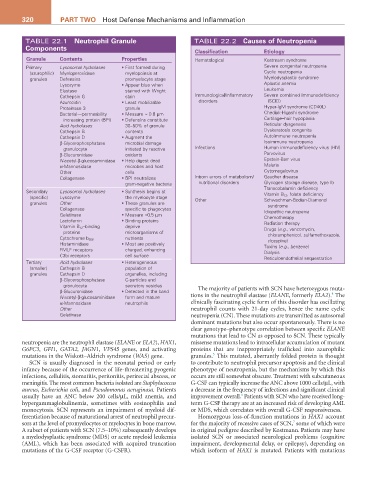
         TABLE 22.1  Neutrophil Granule                          TABLE 22.2  Causes of Neutropenia
         Components                                              Classification        Etiology
          Granule    Contents            Properties              Hematological         Kostmann syndrome
          Primary    Lysosomal hydrolases  • First formed during                       Severe congenital neutropenia
           (azurophilic)   Myeloperoxidase  myelopoiesis at                            Cyclic neutropenia
           granules  Defensins            promyelocyte stage                           Myelodysplastic syndrome
                     Lysozyme            • Appear blue when                            Aplastic anemia
                     Elastase             stained with Wright                          Leukemia
                     Cathepsin G          stain                  Immunological/inflammatory   Severe combined immunodeficiency
                     Azurocidin          • Least mobilizable      disorders              (SCID)
                     Proteinase 3         granule                                      Hyper-IgM syndrome (CD40L)
                     Bacterial—permeability   • Measure ≈ 0.8 µm                       Chediak-Higashi syndrome
                      increasing protein (BPI)  • Defensins constitute                 Cartilage–hair hypoplasia
                     Acid hydrolases      30–50% of granule                            Reticular dysgenesis
                     Cathepsin B          contents                                     Dyskeratosis congenita
                     Cathepsin D         • Augment the                                 Autoimmune neutropenia
                     β-Glycerophosphatase   microbial damage                           Isoimmune neutropenia
                      granulocyte         initiated by reactive   Infections           Human immunodeficiency virus (HIV)
                     β-Glucuronidase      oxidants                                     Parvovirus
                     N-acetyl-β-glucosaminidase  • Help digest dead                    Epstein-Barr virus
                     α-Mannosidase        microbes and host                            Malaria
                     Other                cells                                        Cytomegalovirus
                     Collagenase         • BPI neutralizes       Inborn errors of metabolism/  Gaucher disease
                                          gram-negative bacteria  nutritional disorders  Glycogen storage disease, type lb
                                                                                       Transcobalamin deficiency
          Secondary   Lysosomal hydrolases  • Synthesis begins at                      Vitamin B 12 , folate deficiency
           (specific)   Lysozyme          the myelocyte stage    Other                 Schwachman-Bodian-Diamond
           granules  Other               • These granules are                            syndrome
                     Collagenase          specific to phagocytes                       Idiopathic neutropenia
                     Gelatinase          • Measure ≈0.5 µm                             Chemotherapy
                     Lactoferrin         • Binding proteins                            Radiation therapy
                     Vitamin B 12 –binding   deprive                                   Drugs (e.g., vancomycin,
                      proteins            microorganisms of                              chloramphenicol, sulfamethoxazole,
                                          nutrients
                     Cytochrome b 558                                                    clozapine)
                     Histaminidase       • Most are positively                         Toxins (e.g., benzene)
                     FMLF receptors       charged, enhancing                           Dialysis
                     C3bi receptors       cell surface                                 Reticuloendothelial sequestration
          Tertiary   Acid hydrolases     • Heterogeneous
           (smaller)   Cathepsin B        population of
           granules  Cathepsin D          organelles, including
                     β-Glycerophosphatase   C-particles and
                      granulocyte         secretory vesicles
                     β-Glucuronidase     • Detected in the band   The majority of patients with SCN have heterozygous muta-
                                                                                                              4
                     N-acetyl-β-glucosaminidase  form and mature   tions in the neutrophil elastase (ELANE, formerly ELA2).  The
                     α-Mannosidase        neutrophils          clinically fascinating cyclic form of this disorder has oscillating
                     Other                                     neutrophil counts with 21-day cycles, hence the name cyclic
                     Gelatinase                                neutropenia (CN). These mutations are transmitted as autosomal
                                                               dominant mutations but also occur spontaneously. There is no
                                                               clear genotype–phenotype correlation between specific ELANE
                                                               mutations that lead to CN as opposed to SCN. These typically
        neutropenia are the neutrophil elastase (ELANE or ELA2), HAX1,   missense mutations lead to intracellular accumulation of mutant
        G6PC3,  GFI1,  GATA2, JAGN1,  VPS45 genes, and activating   proteins that are inappropriately trafficked into azurophilic
                                                                       5
        mutations in the Wiskott–Aldrich syndrome (WAS) gene.  granules.  This mutated, aberrantly folded protein is thought
           SCN is usually diagnosed in the neonatal period or early   to contribute to neutrophil precursor apoptosis and the clinical
        infancy because of the occurrence of life-threatening pyogenic   phenotype of neutropenia, but the mechanisms by which this
        infections, cellulitis, stomatitis, peritonitis, perirectal abscess, or   occurs are still somewhat obscure. Treatment with subcutaneous
        meningitis. The most common bacteria isolated are Staphylococcus   G-CSF can typically increase the ANC above 1000 cells/µL, with
        aureus, Escherichia coli, and Pseudomonas aeruginosa. Patients   a decrease in the frequency of infections and significant clinical
                                                                                6
        usually have an  ANC below 200 cells/µL, mild anemia, and   improvement overall.  Patients with SCN who have received long-
        hypergammaglobulinemia, sometimes with eosinophilia and   term G-CSF therapy are at an increased risk of developing AML
        monocytosis. SCN represents an impairment of myeloid dif-  or MDS, which correlates with overall G-CSF responsiveness.
        ferentiation because of maturational arrest of neutrophil precur-  Homozygous loss-of-function mutations in HAX1 account
                                                                                                 7
        sors at the level of promyelocytes or myelocytes in bone marrow.   for the majority of recessive cases of SCN,  some of which were
        A subset of patients with SCN (7.5–10%) subsequently develops   in original pedigree described by Kostmann. Patients may have
        a myelodysplastic syndrome (MDS) or acute myeloid leukemia   isolated SCN or associated neurological problems (cognitive
        (AML), which has been associated with acquired truncation   impairment, developmental delay, or epilepsy), depending on
        mutations of the G-CSF receptor (G-CSFR).              which isoform of  HAX1 is mutated. Patients with mutations

