


Page 345 - Clinical Immunology_ Principles and Practice ( PDFDrive )
P. 345
CHaPtEr 22  Phagocyte Deficiencies              325


           diminished levels of Kell blood group antigens. Patients may   Pulmonary aspergillosis remains a major cause of death in
                                                                      23
           eventually  develop progressive neurodegenerative  symptoms,   CGD.   Aspergillus fumigatus is the most commonly isolated
           such as areflexia, dystonia, and choreiform movements. In patients   fungus, but it is now easily and successfully treated with azole
           with McLeod syndrome, anti-Kx and anti-Km antibodies are   antifungals. In contrast, A. nidulans and A. viridinutans, species
           formed when transfusions are given, making future transfusions   with low pathogenicity in the normal host, cause severe disease in
           extremely difficult. Deletions centromeric from CYBB may cause   CGD. 34,35  Surgical resection of these infections is often required.
           ornithine decarboxylase deficiency along with CGD. 28  Aspergillus infections in CGD are often unaccompanied by fever
                                                                                34
                                                                  and leukocytosis.  Acute diffuse pulmonary fungal infection in
           Autosomal Recessive CGD                                CGD is referred to as “mulch pneumonitis,” characterized by fever,
           Mutations in p47 phox  (NCF1, located at 7q11.23) cause the majority   hypoxia, and diffuse pulmonary infiltrates caused by inhalation
                                                                                                                   36
           of the recessive cases of CGD, around 25%, usually caused by   of fungi, typically during mulching, leaf raking, or gardening.
           homozygous deletions of the canonical GT splice site at the start   This syndrome can be the initial presentation of CGD in older
                  29
           of exon 2.  p22 phox  (CYBA, located at 16q24) and p67 phox  (NCF2,   children and adults and is important to recognize, since it best
           located at 1q25) are responsible for less than 5% of CGD cases   responds to a combination of antifungals and steroids.
           each. p40 phox  (NCF4, located at 22q13.1) deficiency has been   Septicemia is relatively uncommon but may occur with B.
           reported in a boy with early-onset severe granulomatous fistulizing   cepacia complex and Chromobacterium violaceum. Granulibacter
                                                 30
           colitis without a significant infectious phenotype.  No autosomal   bethesdensis is a pathognomonic gram-negative rod that causes
           dominant cases of CGD have been identified.            chronic necrotic lymph node and spleen involvement in CGD. 37
                                                                    Inflammatory granuloma formation is one of the hallmarks
           Clinical Manifestations of CGD                         of CGD. Pyloric outlet obstruction, bladder outlet obstruction,
           The first severe infection usually occurs in infancy or childhood   and ureteral obstruction are common. Crohn-like IBD affects
           but can also occur in adulthood. Later diagnoses usually are   between 30–50% of patients, predominantly X-linked, and may
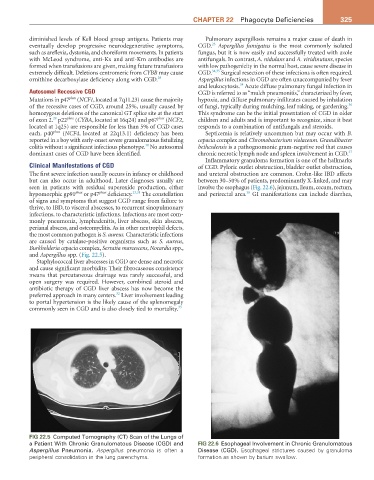
           seen in patients with residual superoxide production, either   involve the esophagus (Fig. 22.6), jejunum, ileum, cecum, rectum,
                                                                                  38
           hypomorphic gp91 phox  or p47 phox  deficiency. 23,31  The constellation   and perirectal area.  GI manifestations can include diarrhea,
           of signs and symptoms that suggest CGD range from failure to
           thrive, to IBD, to visceral abscesses, to recurrent sinopulmonary
           infections, to characteristic infections. Infections are most com-
           monly pneumonia, lymphadenitis, liver abscess, skin abscess,
           perianal abscess, and osteomyelitis. As in other neutrophil defects,
           the most common pathogen is S. aureus. Characteristic infections
           are caused by catalase-positive organisms such as  S. aureus,
           Burkholderia cepacia complex, Serratia marcescens, Nocardia spp.,
           and Aspergillus spp. (Fig. 22.5).
             Staphylococcal liver abscesses in CGD are dense and necrotic
           and cause significant morbidity. Their fibrocaseous consistency
           means that percutaneous drainage was rarely successful, and
           open surgery  was required. However, combined steroid and
           antibiotic therapy of CGD liver abscess has now become the
                                       32
           preferred approach in many centers.  Liver involvement leading
           to portal hypertension is the likely cause of the splenomegaly
           commonly seen in CGD and is also closely tied to mortality. 33


           FIG 22.5  Computed Tomography (CT) Scan of the Lungs of
           a Patient With Chronic Granulomatous Disease (CGD) and   FIG 22.6  Esophageal Involvement in Chronic Granulomatous
           Aspergillus Pneumonia.  Aspergillus pneumonia is often a   Disease (CGD). Esophageal strictures caused by granuloma
           peripheral consolidation in the lung parenchyma.       formation as shown by barium swallow.

