


Page 342 - Clinical Immunology_ Principles and Practice ( PDFDrive )
P. 342
322          Part two  Host Defense Mechanisms and Inflammation


        After activation by chemotactic factors, such as the complement   transmigration of neutrophils between endothelial cells out to
        fragment C5a, IL-8, leukotriene B4 (LTB4), or the bacterial   the extracellular matrix (ECM).
        product formyl-methionyl-leucyl-phenylalanine (fMLF), leuko-
        cytes rapidly become adhesive to the endothelium, other leuko-  Leukocyte Adhesion Defect-1
        cytes, or laboratory surfaces. The activation process involves   In the 1970s, infants and children were recognized with severe,
        translocation of subcellular granules containing adhesion   recurrent life-threatening bacterial infections affecting the skin,
        molecules (CD18/CD11b) to the polymorphonuclear leukocyte   gingiva, and lungs. A common clinical feature was delayed separa-
        (PMN) surface and qualitative alterations in the adhesion   tion of the umbilical stump with severe omphalitis. These patients
        molecules constitutively expressed on the plasma membrane.   were shown to have defects in membrane expression of the
        Adhesion and transmigration of leukocytes occur as a result of   leukocyte adhesion glycoproteins of the integrin superfamily. 15,16
        interactions between three groups of molecules: leukocyte   Integrins  are  noncovalently  associated,  heterodimeric  cell
        integrins, endothelial intercellular adhesion molecules (ICAMs,   surface receptors, comprising one α subunit (CD11a, CD11b,
        members of the immunoglobulin supergene family), and gly-  or CD11c) and a common β chain (CD18), which is required
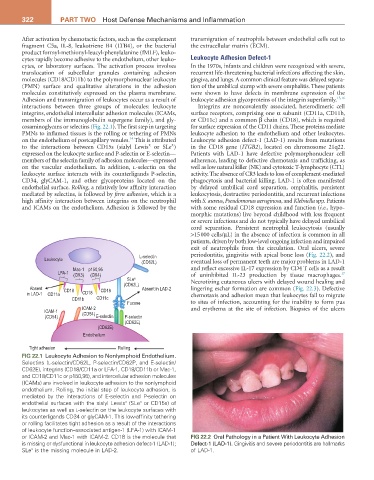
        cosaminoglycans or selectins (Fig. 22.1). The first step in targeting   for surface expression of the CD11 chains. These proteins mediate
        PMNs to inflamed tissues is the rolling or tethering of PMNs   leukocyte adhesion to the endothelium and other leukocytes.
                                           14
        on the endothelium of postcapillary venules.  This is attributed   Leukocyte adhesion defect-1 (LAD-1) results from mutations
                                                  X
                                                         X
        to the interactions between CD15s (sialyl Lewis  or SLe )   in the CD18 gene (ITGB2), located on chromosome 21q22.
        expressed on the leukocyte surface and P-selectin or E-selectin—  Patients with LAD-1 have defective polymorphonuclear cell
        members of the selectin family of adhesion molecules—expressed   adherence, leading to defective chemotaxis and trafficking, as
        on the vascular endothelium. In addition,  l-selectin on the   well as low natural killer (NK) and cytotoxic T-lymphocyte (CTL)
        leukocyte  surface  interacts  with  its counterligands  P-selectin,   activity. The absence of CR3 leads to loss of complement-mediated
        CD34, glyCAM-1, and other glycoproteins located on the   phagocytosis and bacterial killing. LAD-1 is often manifested
        endothelial surface. Rolling, a relatively low affinity interaction   by delayed umbilical cord separation, omphalitis, persistent
        mediated by selectins, is followed by firm adhesion, which is a   leukocytosis, destructive periodontitis, and recurrent infections
        high affinity interaction between integrins on the neutrophil   with S. aureus, Pseudomonas aeruginosa, and Klebsiella spp. Patients
        and ICAMs on the endothelium. Adhesion is followed by the   with some residual CD18 expression and function (i.e., hypo-
                                                               morphic mutations) live beyond childhood with less frequent
                                                               or severe infections and do not typically have delayed umbilical
                                                               cord separation. Persistent neutrophil leukocytosis (usually
                                                               >15 000 cells/µL) in the absence of infection is common in all
                                                               patients, driven by both low-level ongoing infection and impaired
                                                               exit  of  neutrophils  from the  circulation.  Oral  ulcers,  severe
                Leukocyte                      L-selectin      periodontitis, gingivitis with apical bone loss (Fig. 22.2), and
                                                               eventual loss of permanent teeth are major problems in LAD-1
                                               (CD62L)
                         Mac-1 p150,95                         and reflect excessive IL-17 expression by CD4 T cells as a result
                    LFA-1  (CR3)  (CR4)                        of uninhibited IL-23 production by tissue macrophages.
                                                                                                                 17
                                           SLe x
                                          (CD62L)              Necrotizing cutaneous ulcers with delayed wound healing and
           Absent     CD18        CD18         Absent in LAD-2  lingering eschar formation are common (Fig. 22.3). Defective
          in LAD-1  CD11a   CD18                               chemotaxis and adhesion mean that leukocytes fail to migrate
                         CD11b   CD11c
                                           Fucose              to sites of infection, accounting for the inability to form pus
                            ICAM-2                             and erythema at the site of infection. Biopsies of the ulcers
                ICAM-1      (CD54)
                (CD54)          E-selectin  P-selectin
                                          (CD62E)
                                 (CD62E)
                            Endothelium
           Tight adhesion               Rolling
        FIG 22.1  Leukocyte Adhesion to Nonlymphoid Endothelium.
        Selectins (L-selectin/CD62L, P-selectin/CD62P, and E-selectin/
        CD62E), integrins (CD18/CD11a or LFA-1, CD18/CD11b or Mac-1,
        and CD18/CD11c or p150,95), and intercellular adhesion molecules
        (ICAMs) are involved in leukocyte adhesion to the nonlymphoid
        endothelium. Rolling, the initial step of leukocyte adhesion, is
        mediated by the interactions of E-selectin and P-selectin on
        endothelial surfaces with the sialyl Lewis  (SLe  or CD15s) of
                                               x
                                          x
        leukocytes as well as L-selectin on the leukocyte surfaces with
        its counterligands CD34 or glyCAM-1. This low-affinity tethering
        or rolling facilitates tight adhesion as a result of the interactions
        of leukocyte function–associated antigen-1 (LFA-1) with ICAM-1
        or ICAM-2 and Mac-1 with ICAM-2. CD18 is the molecule that   FIG 22.2  Oral Pathology in a Patient With Leukocyte Adhesion
        is missing or dysfunctional in leukocyte adhesion defect-1 (LAD-1);   Defect-1 (LAD-1). Gingivitis and severe periodontitis are hallmarks
           x
        SLe  is the missing molecule in LAD-2.                 of LAD-1.

