


Page 349 - Clinical Immunology_ Principles and Practice ( PDFDrive )
P. 349
CHaPtEr 22  Phagocyte Deficiencies              329


           and worsened pancytopenia, which may resemble the virus-  is retained primary teeth causing delayed eruption of permanent
           associated hemophagocytic syndromes or familial hemophagocytic   teeth.
           lymphohistiocytosis. Although chemotherapy can induce transient
           remissions, relapses are common. Bone marrow transplantation
           prevents the accelerated phase and restores NK-cell function,    KEY CoNCEPtS
           but it does not resolve the central or peripheral nervous system   Hyper-IgE Recurrent Infection Syndrome (HIES)
           abnormalities. Demonstration of giant azurophilic cytoplasmic   or Job’s Syndrome
           inclusions on peripheral blood smear is very suggestive of the
           diagnosis of CHS; mutation analysis confirms the diagnosis.  •  Recurrent infections of the lower respiratory system and skin, chronic
                                                                     eczema, extremely elevated immunoglobulin E (IgE) levels, and
                                                                     eosinophilia are the hallmarks of the syndrome.
           HYPER-IGE RECURRENT INFECTION,                          •  Facial, skeletal, and dental abnormalities are very common.
           OR JOB’S SYNDROME                                       •  Lung abscesses and pneumatoceles following pneumonias caused
                                                                     by Staphylococcus aureus and Haemophilus influenzae are the major
           Davis et al. first described hypoinflammatory recurrent infections   factors for morbidity.
           with severe eczema in 1966. This was further refined and expanded
           by Buckley et al. in 1972, who recognized the characteristic IgE
           elevation. We now consider this to be a multisystem autosomal   Infections and Immunological Characteristics
           dominant disorder caused by heterozygous mutations in signal   Moderate to severe eczema presenting within the first hours to
           transducer and activator of transcription 3 (STAT3, located at   weeks of life is almost universal in HIES. Mucocutaneous can-
                 44
           17q21).  Mutations in STAT3 are mostly missense and clustered   didiasis involving finger and toenails, mouth, vagina, and
           in either the DNA-binding domain or Src homology 2 (SH2)   intertriginous areas is seen in most patients. Primary pulmonary
           domains. Hyper-IgE recurrent infection (HIES, or Job’s syndrome)   infections are caused by S. aureus, Haemophilus influenzae, and
           is characterized by recurrent infections of the lower respiratory   Streptococcus pneumoniae. These pneumonias are often associated
           system and skin, chronic eczema, arterial anomalies, including   with abscess formation and usually lead to the development of
           coronary arterial tortuosity and aneurysms, extremely elevated   pneumatoceles (see Fig. 22.10). Once lung cavities are formed,
           IgE levels, and eosinophilia (Table 22.4). HIES occurs in all racial   they provide an attractive environment for superinfection with
           and ethnic groups.                                     Pseudomonas or Aspergillus spp. The clinical morphotype suggests
                                                                  abnormal tissue remodeling. Pneumocystis jiroveci pneumonia,
           Facial, Skeletal, and Dental Abnormalities             cryptococcosis, histoplasmosis, and coccidioidomycosis have been
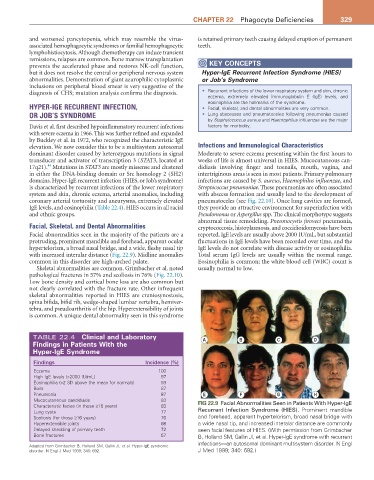
           Facial abnormalities seen in the majority of the patients are a   reported. IgE levels are usually above 2000 IU/mL, but substantial
           protruding, prominent mandible and forehead, apparent ocular   fluctuations in IgE levels have been recorded over time, and the
           hypertelorism, a broad nasal bridge, and a wide, fleshy nasal tip   IgE levels do not correlate with disease activity or eosinophilia.
           with increased interalar distance (Fig. 22.9). Midline anomalies   Total serum IgG levels are usually within the normal range.
           common in this disorder are high-arched palate.        Eosinophilia is common; the white blood cell (WBC) count is
             Skeletal abnormalities are common. Grimbacher et al. noted   usually normal to low.
           pathological fractures in 57% and scoliosis in 76% (Fig. 22.10).
           Low bone density and cortical bone loss are also common but
           not clearly correlated with the fracture rate. Other infrequent
           skeletal abnormalities reported in HIES are craniosynostosis,
           spina bifida, bifid rib, wedge-shaped lumbar vertebra, hemiver-
           tebra, and pseudoarthritis of the hip. Hyperextensibility of joints
           is common. A unique dental abnormality seen in this syndrome


            TABLE 22.4  Clinical and Laboratory                    A           B            C           D
            Findings in Patients with the
            Hyper-IgE Syndrome
            Findings                             Incidence (%)
            Eczema                                   100
            High IgE levels (>2000 IU/mL)             97
            Eosinophilia (>2 SD above the mean for normals)  93
            Boils                                     87
            Pneumonia                                 87           E           F            G           H
            Mucocutaneous candidiasis                 83          FIG 22.9  Facial Abnormalities Seen in Patients With Hyper-IgE
            Characteristic facies (in those ≥16 years)  83
            Lung cysts                                77          Recurrent Infection Syndrome (HIES). Prominent mandible
            Scoliosis (for those ≥16 years)           76          and forehead, apparent hypertelorism, broad nasal bridge with
            Hyperextensible joints                    68          a wide nasal tip, and increased interalar distance are commonly
            Delayed shedding of primary teeth         72          seen facial features of HIES. (With permission from Grimbacher
            Bone fractures                            57          B, Holland SM, Gallin JI, et al. Hyper-IgE syndrome with recurrent
                                                                  infections—an autosomal dominant multisystem disorder. N Engl
           Adapted from Grimbacher B, Holland SM, Gallin JI, et al. Hyper-IgE syndrome
           disorder. N Engl J Med 1999; 340: 692.                 J Med 1999; 340: 692.)

