


Page 357 - Clinical Immunology_ Principles and Practice ( PDFDrive )
P. 357
CHaPTEr 23  Mast Cells, Basophils, and Mastocytosis              337


                                                                  carboxypeptidase  A3 (CPA3).  Accordingly, the anatomically
                                                                  distinct mouse mast cell subpopulations express very different
                                                                  profiles of proteases (and correspondingly different GAG composi-
                                                                  tions), dependent on the microenvironment. 16
                                                                    In contrast to the mouse, human mast cells express only a
                                                                  single mast cell–specific chymase gene and thus exhibit less
                                                                  heterogeneity compared with their rodent counterparts. Human
                                                                  mast cells can express up to four tryptase genes (α, β, γ and δ),
                                                                  and CPA3. All human mast cells express tryptase β, and some
                                                                  also express chymase, CPA3, and cathepsin G. Human mast cells
                                                                  expressing tryptase in the absence (MC T ) or presence (MC TC )
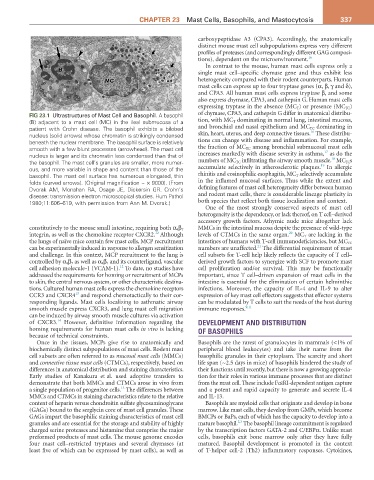
           FIG 23.1  Ultrastructures of Mast Cell and Basophil. A basophil   of chymase, CPA3, and cathepsin G differ in anatomical distribu-
           (B) adjacent to a mast cell (MC) in the ileal submucosa of a   tion, with MC T  dominating in normal lung, intestinal mucosa,
           patient with Crohn disease. The basophil exhibits a bilobed   and bronchial and nasal epithelium and MC TC  dominating in
                                                                                                       16
           nucleus (solid arrows) whose chromatin is strikingly condensed   skin, heart, uterus, and deep connective tissues.  These distribu-
           beneath the nuclear membrane. The basophil surface is relatively   tions can change with disease and inflammation. For example,
           smooth with a few blunt processes (arrowhead). The mast cell   the fraction of MC TC  among bronchial submucosal mast cells
                                                                                                           17
           nucleus is larger and its chromatin less condensed than that of   increases markedly with disease severity in asthma,  as do the
                                                                                                             18
           the basophil. The mast cell’s granules are smaller, more numer-  numbers of MC TC  infiltrating the airway smooth muscle.  MC TC s
                                                                                                          19
           ous, and more variable in shape and content than those of the   accumulate  selectively in  atherosclerotic  plaques.   In allergic
           basophil. The mast cell surface has numerous elongated, thin   rhinitis and eosinophilic esophagitis, MC T  selectively accumulate
           folds (curved arrows). (Original magnification ~ × 9000). (From   in the inflamed mucosal surfaces. Thus while the extent and
           Dvorak AM, Monahan RA, Osage JE, Dickersin GR. Crohn’s   defining features of mast cell heterogeneity differ between human
           disease: transmission electron microscopical studies. Hum Pathol   and rodent mast cells, there is considerable lineage plasticity in
           1980;11:606–619, with permission from Ann M. Dvorak.)  both species that reflect both tissue localization and context.
                                                                    One of the most strongly conserved aspects of mast cell
                                                                  heterogeneity is the dependency, or lack thereof, on T cell–derived
                                                                  accessory growth factors. Athymic nude mice altogether lack
           constitutively to the mouse small intestine, requiring both α 4 β 7    MMCs in the intestinal mucosa despite the presence of wild-type
                                                                                                20
                                                    12
           integrin, as well as the chemokine receptor CXCR2.  Although   levels of CTMCs in the same organ.  MC T  are lacking in the
           the lungs of naïve mice contain few mast cells, MCP recruitment   intestines of humans with T-cell immunodeficiencies, but MC TC
                                                                                     21
           can be experimentally induced in response to allergen sensitization   numbers are unaffected.  The differential requirement of mast
           and challenge. In this context, MCP recruitment to the lung is   cell subsets for T-cell help likely reflects the capacity of T cell–
           controlled by α 4 β 7  as well as α 4 β 1  and its counterligand, vascular   derived growth factors to synergize with SCF to promote mast
                                        12
           cell adhesion molecule-1 (VCAM-1).  To date, no studies have   cell proliferation and/or survival. This may be functionally
           addressed the requirements for homing or recruitment of MCPs   important, since T cell–driven expansion of mast cells in the
           to skin, the central nervous system, or other characteristic destina-  intestine is essential for the elimination of certain helminthic
           tions. Cultured human mast cells express the chemokine receptors   infections.  Moreover,  the  capacity  of  IL-4  and  IL-9  to  alter
                          13
           CCR3 and CXCR4  and respond chemotactically to their cor-  expression of key mast cell effectors suggests that effector systems
           responding ligands. Mast cells localizing to asthmatic airway   can be modulated by T cells to suit the needs of the host during
           smooth muscle express CXCR3, and lung mast cell migration   immune responses. 9,11
           can be induced by airway smooth muscle cultures via activation
                    14
           of CXCR3.  However, definitive information regarding the   DEVELOPMENT AND DISTRIBUTION
           homing requirements for human mast cells in vivo is lacking   OF BASOPHILS
           because of technical constraints.
             Once in  the tissues, MCPs give rise to anatomically and   Basophils are the rarest of granulocytes in mammals (<1% of
           biochemically distinct subpopulations of mast cells. Rodent mast   peripheral blood leukocytes) and take their name from the
           cell subsets are often referred to as mucosal mast cells (MMCs)   basophilic granules in their cytoplasm. The scarcity and short
           and connective tissue mast cells (CTMCs), respectively, based on   life span (~2.5 days in mice) of basophils hindered the study of
           differences in anatomical distribution and staining characteristics.   their functions until recently, but there is now a growing apprecia-
           Early studies of Kanakura et al. used adoptive transfers to   tion for their roles in various immune processes that are distinct
           demonstrate that both MMCs and CTMCs arose in vivo from   from the mast cell. These include FcεRI-dependent antigen capture
                                         15
           a single population of progenitor cells.  The differences between   and a potent and rapid capacity to generate and secrete IL-4
           MMCs and CTMCs in staining characteristics relate to the relative   and IL-13.
           content of heparin versus chondroitin sulfate glycosaminoglycans   Basophils are myeloid cells that originate and develop in bone
           (GAGs) bound to the serglycin core of mast cell granules. These   marrow. Like mast cells, they develop from GMPs, which become
           GAGs impart the basophilic staining characteristics of mast cell   BMCPs or BaPs, each of which has the capacity to develop into a
                                                                               2,3
           granules and are essential for the storage and stability of highly   mature basophil.  The basophil lineage commitment is regulated
           charged serine proteases and histamine that comprise the major   by the transcription factors GATA-2 and C/EBPα. Unlike mast
           preformed products of mast cells. The mouse genome encodes   cells, basophils exit bone marrow only after they have fully
           four mast cell–restricted tryptases and several chymases (at     matured. Basophil development is promoted in the context
           least five of which can be expressed by mast cells), as well as   of T-helper cell-2 (Th2) inflammatory responses. Cytokines,

