


Page 358 - Clinical Immunology_ Principles and Practice ( PDFDrive )
P. 358
338          ParT TwO  Host Defense Mechanisms and Inflammation


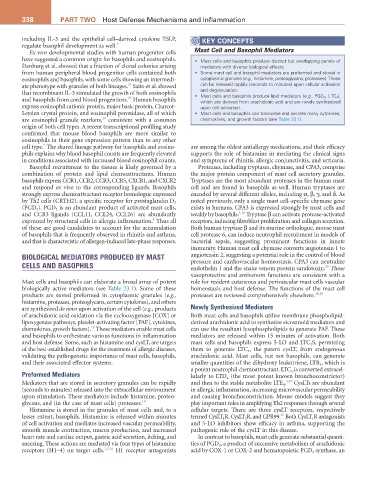
        including  IL-3  and  the  epithelial  cell–derived  cytokine  TSLP,    KEY CONCEPTS
        regulate basophil development as well. 3
           Ex vivo developmental studies with human progenitor cells   Mast Cell and Basophil Mediators
        have suggested a common origin for basophils and eosinophils.   •  Mast cells and basophils produce distinct but overlapping panels of
        Denburg et al. showed that a fraction of clonal colonies arising   mediators with diverse biological effects.
        from human peripheral blood progenitor cells contained both   •  Some mast cell and basophil mediators are preformed and stored in
        eosinophils and basophils, with some cells showing an intermedi-  cytoplasmic granules (e.g., histamine, proteoglycans, proteases). These
                                           22
        ate phenotype with granules of both lineages.  Saito et al. showed   can be released rapidly (seconds to minutes) upon cellular activation
                                                                   and degranulation.
        that recombinant IL-3 stimulated the growth of both eosinophils   •  Mast cells and basophils produce lipid mediators (e.g., PGD 2 , LTC 4 ),
                                           23
        and basophils from cord blood progenitors.  Human basophils   which are derived from arachidonic acid and are newly synthesized
        express eosinophil cationic protein, major basic protein, Charcot-  upon cell activation.
        Leyden crystal protein, and eosinophil peroxidase, all of which   •  Mast cells and basophils can transcribe and secrete many cytokines,
                                  24
        are eosinophil  granule markers,  consistent with  a common   chemokines, and growth factors (see Table 23.1).
        origin of both cell types. A recent transcriptional profiling study
        confirmed that mouse blood basophils are more similar to
        eosinophils in their gene expression pattern than to any other
               5
        cell type.  The shared lineage pathway for basophils and eosino-  are among the oldest antiallergy medications, and their efficacy
        phils explains why blood basophil counts are frequently elevated   supports the role of histamine in mediating the clinical signs
        in conditions associated with increased blood eosinophil counts.  and symptoms of rhinitis, allergic conjunctivitis, and urticaria.
           Basophil recruitment to the tissues is likely governed by a   Proteases, including tryptases, chymase, and CPA3, comprise
        combination of protein and lipid chemoattractants. Human   the major protein component of mast cell secretory granules.
        basophils express CCR1, CCR2, CCR3, CCR5, CXCR1, and CXCR2   Tryptases are the most abundant proteases in the human mast
        and respond  ex vivo to the corresponding ligands. Basophils   cell and are found in basophils as well. Human tryptases are
        strongly express chemoattractant receptor homologue expressed   encoded by several different alleles, including α, β, γ, and δ. As
        by Th2 cells (CRTH2), a specific receptor for prostaglandin D 2    noted previously, only a single mast cell–specific chymase gene
        (PGD 2 ). PGD 2  is an abundant product of activated mast cells,   exists in humans. CPA3 is expressed strongly by mast cells and
                                                                               1,16
        and CCR3 ligands (CCL11, CCL24, CCL26) are abundantly   weakly by basophils.  Tryptase β can activate protease-activated
                                                   1
        expressed by structural cells in allergic inflammation.  Thus all   receptors, inducing fibroblast proliferation and collagen secretion.
        of these are good candidates to account for the accumulation   Both human tryptase β and its murine orthologue, mouse mast
        of basophils that is frequently observed in rhinitis and asthma,   cell protease 6, can induce neutrophil recruitment in models of
        and that is characteristic of allergen-induced late-phase responses.  bacterial sepsis, suggesting prominent functions in innate
                                                               immunity. Human mast cell chymase converts angiotensin 1 to
        BIOLOGICAL MEDIATORS PRODUCED BY MAST                  angiotensin 2, suggesting a potential role in the control of blood
        CELLS AND BASOPHILS                                    pressure and cardiovascular homeostasis. CPA3 can neutralize
                                                                                                           25
                                                               endothelin 1 and the snake venom protein sarafotoxin.  These
                                                               vasoprotective and antivenom functions are consistent with a
        Mast cells and basophils can elaborate a broad array of potent   role for resident cutaneous and perivascular mast cells vascular
        biologically active mediators (see  Table 23.1). Some of these   homeostasis and host defense. The functions of the mast cell
        products  are  stored  preformed  in  cytoplasmic  granules  (e.g.,   proteases are reviewed comprehensively elsewhere. 16,26
        histamine, proteases, proteoglycans, certain cytokines), and others
        are synthesized de novo upon activation of the cell (e.g., products   Newly Synthesized Mediators
        of arachidonic acid oxidation via the cyclooxygenase [COX] or   Both mast cells and basophils utilize membrane phospholipid-
        lipoxygenase pathways, platelet-activating factor [PAF], cytokines,   derived arachidonic acid to synthesize eicosanoid mediators and
                               19
        chemokines, growth factors).  These mediators enable mast cells   can use the resultant lysophospholipids to generate PAF. These
        and basophils to orchestrate various functions in inflammation   mediators are released within 15 minutes of activation. Both
        and host defense. Some, such as histamine and cysLT, are targets   mast cells and basophils express 5-LO and LTC 4 S, permitting
        of the best-established drugs for the treatment of allergic diseases,   them to generate LTC 4 , the parent cysLT, from endogenous
        validating the pathogenetic importance of mast cells, basophils,   arachidonic acid. Mast cells, but not basophils, can generate
        and their associated effector systems.                 smaller quantities of the dihydroxy leukotriene, LTB 4 , which is
                                                               a potent neutrophil chemoattractant. LTC 4  is converted extracel-
        Preformed Mediators                                    lularly to LTD 4  (the most potent known bronchoconstrictor)
        Mediators that are stored in secretory granules can be rapidly   and then to the stable metabolite LTE 4 . 3,19  CysLTs are abundant
        (seconds to minutes) released into the extracellular environment   in allergic inflammation, increasing microvascular permeability
        upon stimulation. These mediators include histamine, proteo-  and causing bronchoconstriction. Mouse models suggest they
        glycans, and (in the case of mast cells) proteases. 19  play important roles in amplifying Th2 responses through several
           Histamine is stored in the granules of mast cells and, to a   cellular targets. There are three cysLT receptors, respectively
                                                                                             27
        lesser extent, basophils. Histamine is released within minutes   termed CysLT 1 R, CysLT 2 R, and GPR99.  Both CysLT 1 R antagonists
        of cell activation and mediates increased vascular permeability,   and 5-LO inhibitors show efficacy in asthma, supporting the
        smooth muscle contraction, mucus production, and increased   pathogenic role of the cysLT in this disease.
        heart rate and cardiac output, gastric acid secretion, itching, and   In contrast to basophils, mast cells generate substantial quanti-
        sneezing. These actions are mediated via four types of histamine   ties of PGD 2 , a product of successive metabolism of arachidonic
        receptors (H1–4) on target cells. 1,3,16  H1 receptor antagonists   acid by COX-1 or COX-2 and hematopoietic PGD 2  synthase, an

