


Page 361 - Clinical Immunology_ Principles and Practice ( PDFDrive )
P. 361
CHaPTEr 23  Mast Cells, Basophils, and Mastocytosis              341


                                                            B


                    A
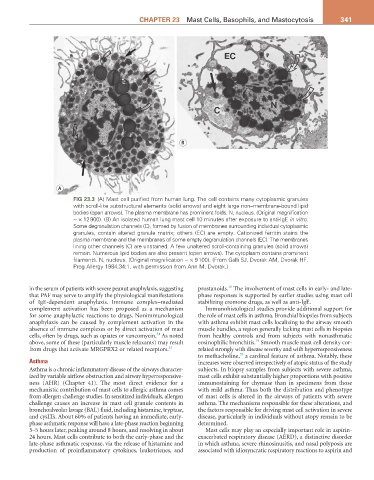
                         FIG 23.3  (A) Mast cell purified from human lung. The cell contains many cytoplasmic granules
                         with scroll-like substructural elements (solid arrows) and eight large non–membrane-bound lipid
                         bodies (open arrows). The plasma membrane has prominent folds. N, nucleus. (Original magnification
                         ~ × 12 900). (B) An isolated human lung mast cell 10 minutes after exposure to anti-IgE in vitro.
                         Some degranulation channels (C), formed by fusion of membranes surrounding individual cytoplasmic
                         granules, contain altered granule matrix; others (EC) are empty. Cationized ferritin stains the
                         plasma membrane and the membranes of some empty degranulation channels (EC). The membranes
                         lining other channels (C) are unstained. A few unaltered scroll-containing granules (solid arrows)
                         remain. Numerous lipid bodies are also present (open arrows). The cytoplasm contains prominent
                         filaments. N, nucleus. (Original magnification ~ × 9 100). (From Galli SJ, Dvorak AM, Dvorak HF.
                         Prog Allergy 1984;34:1, with permission from Ann M. Dvorak.)


                                                                            19
           in the serum of patients with severe peanut anaphylaxis, suggesting   prostanoids.  The involvement of mast cells in early- and late-
           that PAF may serve to amplify the physiological manifestations   phase responses is supported by earlier studies using mast cell
           of IgE-dependent anaphylaxis. Immune complex–mediated   stabilizing cromone drugs, as well as anti-IgE.
           complement activation has been proposed as a mechanism     Immunohistological studies provide additional support for
           for some anaphylactic reactions to drugs. Nonimmunological   the role of mast cells in asthma. Bronchial biopsies from subjects
           anaphylaxis can be caused by complement activation in the   with asthma exhibit mast cells localizing to the airway smooth
           absence of immune complexes or by direct activation of mast   muscle bundles, a region generally lacking mast cells in biopsies
                                                    34
           cells, often by drugs, such as opiates or vancomycin.  As noted   from healthy controls and from subjects with nonasthmatic
                                                                                     19
           above, some of these (particularly muscle relaxants) may result   eosinophilic bronchitis.  Smooth muscle mast cell density cor-
           from drugs that activate MRGPRX2 or related receptors. 32  related strongly with disease severity and with hyperresponsiveness
                                                                               35
                                                                  to methacholine,  a cardinal feature of asthma. Notably, these
           Asthma                                                 increases were observed irrespectively of atopic status of the study
           Asthma is a chronic inflammatory disease of the airways character-  subjects. In biopsy samples from subjects with severe asthma,
           ized by variable airflow obstruction and airway hyperresponsive-  mast cells exhibit substantially higher proportions with positive
           ness (AHR) (Chapter 41). The most direct evidence for a   immunostaining for chymase than in specimens from those
           mechanistic contribution of mast cells to allergic asthma comes   with mild asthma. Thus both the distribution and phenotype
           from allergen challenge studies. In sensitized individuals, allergen   of mast cells is altered in the airways of patients with severe
           challenge causes an increase in mast cell granule contents in   asthma. The mechanisms responsible for these alterations, and
           bronchoalveolar lavage (BAL) fluid, including histamine, tryptase,   the factors responsible for driving mast cell activation in severe
           and cysLTs. About 60% of patients having an immediate, early-  disease, particularly in individuals without atopy remain to be
           phase asthmatic response will have a late-phase reaction beginning   determined.
           3–5 hours later, peaking around 8 hours, and resolving in about   Mast cells may play an especially important role in aspirin-
           24 hours. Mast cells contribute to both the early-phase and the   exacerbated respiratory disease (AERD), a distinctive disorder
           late-phase asthmatic response, via the release of histamine and   in which asthma, severe rhinosinusitis, and nasal polyposis are
           production of proinflammatory cytokines, leukotrienes, and   associated with idiosyncratic respiratory reactions to aspirin and

