


Page 36 - Clinical Immunology_ Principles and Practice ( PDFDrive )
P. 36
22           Part one  Principles of Immune Response


           Cytokines (Chapter 9) affect the growth and maintenance of   a low level of proliferation of stem cells is required to avoid
        pluripotent stem cells, as well as the development and differentia-  exhaustion. The entry of stem cells into the cell cycle and the
        tion of specific cell lineages. The effect of the cytokine can depend   subsequent proliferation, as well as commitment to particular
        on whether the cell has previously been or is concurrently being   lineages, are controlled by cytokines and transcription factors.
        stimulated by other cytokines. The stage of differentiation, as   Data suggest that flt-3 ligand, c-kit ligand, and megakaryocyte
        well as the presence or absence of the cytokine’s receptor on the   growth and development factor all promote long-term stem cell
        cell surface, also affects the cellular response.      expansion. The combination of c-kit ligand, IL-3, and IL-6 causes
           Stromal cells located within bone marrow and the thymus   more rapid expansion but does not allow long-term extension
        regulate hematopoietic and lymphoid cell growth and differ-  of precursor cells. 11
        entiation by releasing cytokines, such as interleukin 4 (IL-4),   Several cytokines, alone or in combination, promote stem
                                                                                 4
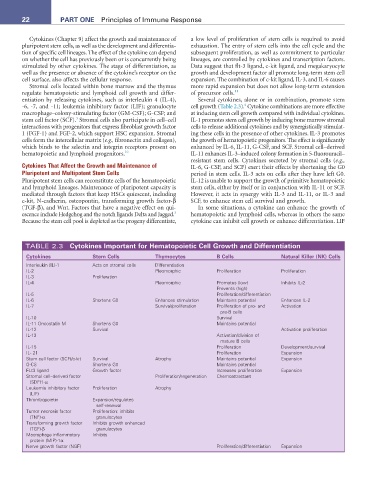
        -6, -7, and -11; leukemia inhibitory factor (LIF); granulocyte   cell growth (Table 2.3).  Cytokine combinations are more effective
        macrophage–colony-stimulating factor (GM-CSF); G-CSF; and   at inducing stem cell growth compared with individual cytokines.
                          3
        stem cell factor (SCF).  Stromal cells also participate in cell–cell   IL-1 promotes stem cell growth by inducing bone marrow stromal
        interactions with progenitors that express fibroblast growth factor   cells to release additional cytokines and by synergistically stimulat-
        1 (FGF-1) and FGF-2, which support HSC expansion. Stromal   ing these cells in the presence of other cytokines. IL-3 promotes
        cells form the intercellular matrix (e.g., fibronectin and collagen),   the growth of hematopoietic progenitors. The effect is significantly
        which binds to the selectin and integrin receptors present on   enhanced by IL-6, IL-11, G-CSF, and SCF. Stromal cell–derived
        hematopoietic and lymphoid progenitors. 10             IL-11 enhances IL-3–induced colony formation in 5-fluorouracil–
                                                               resistant stem cells. Cytokines secreted by stromal cells (e.g.,
        Cytokines That Affect the Growth and Maintenance of    IL-6, G-CSF, and SCF) exert their effects by shortening the G0
        Pluripotent and Multipotent Stem Cells                 period in stem cells. IL-3 acts on cells after they have left G0.
        Pluripotent stem cells can reconstitute cells of the hematopoietic   IL-12 is unable to support the growth of primitive hematopoietic
        and lymphoid lineages. Maintenance of pluripotent capacity is   stem cells, either by itself or in conjunction with IL-11 or SCF.
        mediated through factors that keep HSCs quiescent, including   However, it acts in synergy with IL-3 and IL-11, or IL-3 and
        c-kit, N-cadherin, osteopontin, transforming growth factor-β   SCF, to enhance stem cell survival and growth.
        (TGF-β), and Wnt. Factors that have a negative effect on qui-  In some situations, a cytokine can enhance the growth of
                                                          3
        escence include Hedgehog and the notch ligands Delta and Jagged.    hematopoietic and lymphoid cells, whereas in others the same
        Because the stem cell pool is depleted as the progeny differentiate,   cytokine can inhibit cell growth or enhance differentiation. LIF


         TABLE 2.3  Cytokines Important for Hematopoietic Cell Growth and Differentiation

          Cytokines            Stem Cells           thymocytes          B Cells              natural Killer (nK) Cells
          Interleukin (IL)-1   Acts on stromal cells  Differentiation
          IL-2                                      Pleomorphic         Proliferation        Proliferation
          IL-3                 Proliferation
          IL-4                                      Pleomorphic         Promotes (low)       Inhibits IL-2
                                                                        Prevents (high)
          IL-5                                                          Proliferation/differentiation
          IL-6                 Shortens G0          Enhances stimulation  Maintains potential  Enhances IL-2
          IL-7                                      Survival/proliferation  Proliferation of pro- and   Activation
                                                                         pre-B cells
          IL-10                                                         Survival
          IL-11 Oncostatin M   Shortens G0                              Maintains potential
          IL-12                Survival                                                      Activation proliferation
          IL-13                                                         Activation/division of
                                                                         mature B cells
          IL-15                                                         Proliferation        Development/survival
          IL- 21                                                        Proliferation        Expansion
          Stem cell factor (SCF)/c-kit  Survival    Atrophy             Maintains potential  Expansion
          G-CS                 Shortens G0                              Maintains potential
          FLt3 ligand          Growth factor                            Increases proliferation  Expansion
          Stromal cell–derived factor               Proliferation/regeneration  Chemoattractant
           (SDF)1-α
          Leukemia inhibitory factor   Proliferation  Atrophy
           (LIF)
          Thrombopoietin       Expansion/regulates
                                 self-renewal
          Tumor necrosis factor   Proliferation: inhibits
           (TNF)-α               granulocytes
          Transforming growth factor   Inhibits growth enhanced
           (TGF)-β               granulocytes
          Macrophage inflammatory   Inhibits
           protein (MIP)-1α
          Nerve growth factor (NGF)                                     Proliferation/differentiation  Expansion

