


Page 37 - Clinical Immunology_ Principles and Practice ( PDFDrive )
P. 37
CHaPter 2  Organization of the Immune System                  23


           can enhance the growth and development of bone marrow
           progenitor cells along multiple lineages in media containing IL-3,   Mature Cells of the Immune System
           IL-6, and GM-CSF. However, in the absence of other cytokines   The mature cells of the immune system primarily arise from
           or factors in serum, LIF has little effect on the growth and   progenitor cells in bone marrow. They include both nonspecific
                            +
           development of CD34  progenitors. TGF-β and IL-4 are potent   and antigen-specific effector cells.
           inhibitors of hematopoietic progenitor cell growth; yet they
           enhance granulocyte development. Tumor necrosis factor-α   Antigen-Presenting Cells
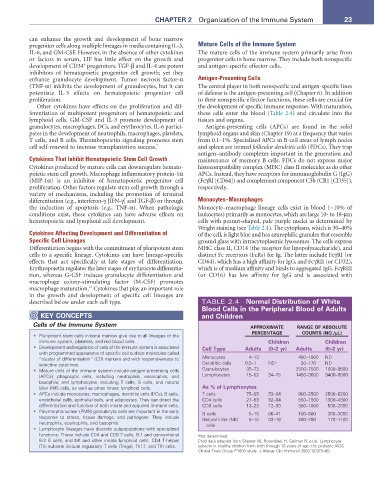
           (TNF-α) inhibits the development of granulocytes, but it can   The central player in both nonspecific and antigen-specific lines
           potentiate IL-3 effects on hematopoietic progenitor cell   of defense is the antigen-presenting cell (Chapter 6). In addition
           proliferation.                                         to their nonspecific effector functions, these cells are crucial for
             Other cytokines have effects on the proliferation and dif-  the development of specific immune responses. With maturation,
           ferentiation of multipotent progenitors of hematopoietic and   these cells enter the blood (Table 2.4) and circulate into the
           lymphoid cells. GM-CSF and IL-3 promote development of   tissues and organs.
           granulocytes, macrophages, DCs, and erythrocytes. IL-6 partici-  Antigen-presenting cells (APCs) are found in the solid
           pates in the development of neutrophils, macrophages, platelets,   lymphoid organs and skin (Chapter 19) at a frequency that varies
           T cells, and B cells. Thrombopoietin signaling promotes stem   from 0.1–1%. Specialized APCs in B-cell areas of lymph nodes
           cell self-renewal to increase transplantation success. 7  and spleen are termed follicular dendritic cells (FDCs). They trap
                                                                  antigen–antibody complexes important in the generation and
           Cytokines That Inhibit Hematopoietic Stem Cell Growth  maintenance of memory B cells. FDCs do not express major
           Cytokines produced by mature cells can downregulate hemato-  histocompatibility complex (MHC) class II molecules as do other
           poietic stem cell growth. Macrophage inflammatory protein-1α   APCs. Instead, they have receptors for immunoglobulin G (IgG)
           (MIP-1α) is an inhibitor of hematopoietic progenitor cell   (FcγRI [CD64]) and complement component C3b (CR1 [CD35]),
           proliferation. Other factors regulate stem cell growth through a   respectively.
           variety of mechanisms, including the promotion of terminal
           differentiation (e.g., interferon-γ [IFN-γ] and TGF-β) or through   Monocytes–Macrophages
           the induction of apoptosis  (e.g., TNF-α). When  pathologic   Monocyte–macrophage lineage cells exist in  blood (~10% of
           conditions exist, these cytokines can have adverse effects on   leukocytes) primarily as monocytes, which are large 10- to 18-µm
           hematopoietic and lymphoid cell development.           cells with peanut-shaped, pale purple nuclei as determined by
                                                                  Wright staining (see Table 2.4). The cytoplasm, which is 30–40%
           Cytokines Affecting Development and Differentiation of   of the cell, is light blue and has azurophilic granules that resemble
           Specific Cell Lineages                                 ground glass with intracytoplasmic lysosomes. The cells express
           Differentiation begins with the commitment of pluripotent stem   MHC class II, CD14 (the receptor for lipopolysaccharide), and
           cells to a specific lineage. Cytokines can have lineage-specific   distinct Fc receptors (FcRs) for Ig. The latter include FcγRI (or
           effects that act specifically at late stages of differentiation.   CD64), which has a high affinity for IgG, and FcγRII (or CD32),
           Erythropoietin regulates the later stages of erythrocyte differentia-  which is of medium affinity and binds to aggregated IgG. FcγRIII
           tion, whereas G-CSF induces granulocyte differentiation and   (or CD16) has low affinity for IgG and is associated with
           macrophage colony-stimulating factor (M-CSF) promotes
                              12
           macrophage maturation.  Cytokines that play an important role
           in the growth and development of specific cell lineages are
           described below under each cell type.                   TABLE 2.4  normal Distribution of White
                                                                   Blood Cells in the Peripheral Blood of adults
               KeY ConCePtS                                        and Children
            Cells of the Immune System                                             aPProXIMate    ranGe oF aBSoLUte
                                                                                   PerCentaGe       CoUntS (no./µL)
            •  Pluripotent stem cells in bone marrow give rise to all lineages of the
              immune system, platelets, and red blood cells.                             Children          Children
            •  Development and regulation of cells of the immune system is associated   Cell type  adults  (0–2 yr)  adults  (0–2 yr)
              with programmed appearance of specific cell surface molecules called
              “cluster of differentiation” (CD) markers and with responsiveness to   Monocytes  4–13  400–1000  ND
              selective cytokines.                                 Dendritic cells  0.5–1  ND a    30–170  ND
            •  Mature cells of the immune system include antigen-presenting cells   Granulocytes  35–73  2500–7500  1000–8500
              (APCs); phagocytic cells, including neutrophils, eosinophils, and   Lymphocytes  15–52  34–75  1450–3600  3400–9000
              basophils; and lymphocytes, including T cells, B cells, and natural
              killer (NK) cells, as well as other innate lymphoid cells.  as % of Lymphocytes
            •  APCs include monocytes, macrophages, dendritic cells (DCs), B cells,   T cells  75–85  53–84  900–2500  2500–6200
              endothelial cells, epithelial cells, and adipocytes. They can direct the   CD4 cells  27–53  32–64  550–1500  1300–4300
              differentiation and function of both innate and acquired immune cells.  CD8 cells  13–23  12–30  300–1000  500–2000
            •  Polymorphonuclear (PMN) granulocyte cells are important in the early   B cells  5–15  06–41  100–600  300–3000
              response to stress, tissue damage, and pathogens. They include   Natural killer (NK)   5–15  03–18  200–700  170–1100
              neutrophils, eosinophils, and basophils.              cells
            •  Lymphocyte lineages have discrete subpopulations with specialized
              functions. These include CD4 and CD8 T cells, B-1 and conventional   a Not determined.
              B-2 B cells, and NK and other innate lymphoid cells. CD4 T-helper   Child data adapted from Shearer W, Rosenblatt H, Gelman R, et al. Lymphocyte
              (Th) subsets include regulatory T cells (Tregs), Th17, and Tfh cells.  subsets in healthy children from birth through 18 years of age: the pediatric AIDS
                                                                  Clinical Trials Group P1009 study. J Allergy Clin Immunol 2003;12:973–80.

