


Page 424 - Clinical Immunology_ Principles and Practice ( PDFDrive )
P. 424
404          Part tHrEE  Host Defenses to Infectious Agents


                                                               that the disease is underreported and that the suspected real
                                                               number of cases may be much higher.
                                20-30µm                           An early hallmark of infection is the appearance of a skin
            0.2-0.3µm                                          rash, known as erythema migrans (Fig. 28.2), which appears at
                                                               the inoculation site, often during the first week of infection
                                                               (stage I Lyme disease), as a result of local inflammatory responses.
           A                                                   Other symptoms secondary to the local inflammatory responses
                                               Outer membrane  occurring during stage I can affect more distal sites and may
                                                               include fever, headache, malaise, myalgia, and/or arthralgia.
           Periplasmic flagella                Inner membrane  Hematogenous dissemination of the spirochete is stage II Lyme
                                                               disease and results in colonization of different tissues and/or
                                               Protoplasm      organs and presentation of a range of symptoms, such as conduc-
                                                               tion system abnormalities, meningitis, and acute arthritis. Joint
                                                               inflammation appears in 60% of untreated individuals in the
                                                               United States and predominately affects large joints, especially
                                                               the synovium of the knee. Some untreated individuals develop
           B                                                   stage III Lyme disease, which is generally characterized by
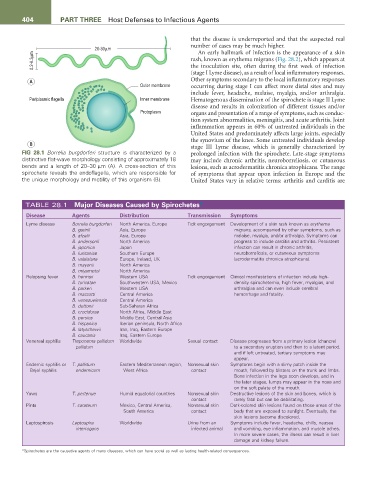
        FIG  28.1  Borrelia  burgdorferi  structure  is  characterized  by  a   prolonged infection with the spirochete. Late-stage symptoms
        distinctive flat-wave morphology consisting of approximately 18   may include chronic arthritis, neuroborreliosis, or cutaneous
        bends and  a length of  20–30 µm  (A). A  cross-section of  this   lesions, such as acrodermatitis chronica atrophicans. The range
        spirochete reveals the endoflagella, which are responsible for   of  symptoms  that  appear  upon  infection  in  Europe  and  the
        the unique morphology and motility of this organism (B).   United States vary in relative terms: arthritis and carditis are


         TABLE 28.1  Major Diseases Caused by Spirochetes*
          Disease        agents         Distribution          transmission  Symptoms
          Lyme disease   Borrelia burgdorferi  North America, Europe  Tick engorgement  Development of a skin rash known as erythema
                         B. garinii     Asia, Europe                          migrans, accompanied by other symptoms, such as
                         B. afzelii     Asia, Europe                          malaise, myalgia, and/or arthralgia. Symptoms can
                         B. andersonii  North America                         progress to include carditis and arthritis. Persistent
                         B. japonica    Japan                                 infection can result in chronic arthritis,
                         B. lusitaniae  Southern Europe                       neuroborreliosis, or cutaneous symptoms
                         B. valaisiana  Europe, Ireland, UK                   (acrodermatitis chronica atrophicans).
                         B. mayonii     North America
                         B. miyamotoi   North America
          Relapsing fever  B. hermsii   Western USA           Tick engorgement  Clinical manifestations of infection include high-
                         B. turicatae   Southwestern USA, Mexico              density spirochetemia, high fever, myalgias, and
                         B. parkeri     Western USA                           arthralgias and can even include cerebral
                         B. mazzotti    Central America                       hemorrhage and fatality.
                         B. venezuelensis  Central America
                         B. duttonii    Sub-Saharan Africa
                         B. crocidurae  North Africa, Middle East
                         B. persica     Middle East, Central Asia
                         B. hispanica   Iberian peninsula, North Africa
                         B. latyschewii  Iran, Iraq, Eastern Europe
                         B. caucasia    Iraq, Eastern Europe
          Venereal syphilis  Treponema pallidum   Worldwide   Sexual contact  Disease progresses from a primary lesion (chancre)
                          pallidum                                            to a secondary eruption and then to a latent period,
                                                                              and if left untreated, tertiary symptoms may
                                                                              appear.
          Endemic syphilis or  T. pallidum   Eastern Mediterranean region,  Nonsexual skin   Symptoms begin with a slimy patch inside the
           Bejel syphilis  endemicum     West Africa            contact       mouth, followed by blisters on the trunk and limbs.
                                                                              Bone infection in the legs soon develops, and in
                                                                              the later stages, lumps may appear in the nose and
                                                                              on the soft palate of the mouth.
          Yaws           T. pertenue    Humid equatorial countries  Nonsexual skin   Destructive lesions of the skin and bones, which is
                                                                contact       rarely fatal but can be debilitating.
          Pinta          T. carateum    Mexico, Central America,   Nonsexual skin   Dark-colored skin lesions found on those areas of the
                                         South America          contact       body that are exposed to sunlight. Eventually, the
                                                                              skin lesions become discolored.
          Leptospirosis  Leptospira     Worldwide             Urine from an   Symptoms include fever, headache, chills, nausea
                          interrogans                           infected animal  and vomiting, eye inflammation, and muscle aches.
                                                                              In more severe cases, the illness can result in liver
                                                                              damage and kidney failure.
        *Spirochetes are the causative agents of many diseases, which can have social as well as lasting health-related consequences.

