


Page 419 - Clinical Immunology_ Principles and Practice ( PDFDrive )
P. 419
400          PARt tHREE  Host Defenses to Infectious Agents


                          Gram-negative bacteria                                         Macrophage

                                                            Release of
                                                             cytokines
                                                                                    Cytokine
                                       LPS                                           gene
                                                                                    expression

                                                                                   Nucleus
                                 Release of LPS in vesicles or by  mCD14
                                 the action of bacteriolytic agents                Mobilization of
                                                                                 transcription factors
                                 LPS oligosaccharide
                                                                    mCD14            Signal
                                                                    MD-2           transduction
                              Lipid A

                          LBP
                                                  sCD14                       TLR-4
                              LBP                         sCD14

                           LPS   Lipopolysaccharide  mCD14  Membrane-bound CD14
                           LBP   LPS-binding protein  TLR-4  Toll-like receptor 4
                           sCD14  Soluble CD14
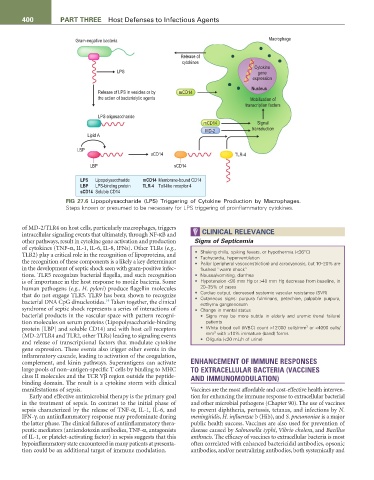
                       FIG 27.6  Lipopolysaccharide (LPS) Triggering of Cytokine Production by Macrophages.
                       Steps known or presumed to be necessary for LPS triggering of proinflammatory cytokines.


        of MD-2/TLR4 on host cells, particularly macrophages, triggers
        intracellular signaling events that ultimately, through NF-κB and    CLINICAL RELEVANCE
        other pathways, result in cytokine gene activation and production   Signs of Septicemia
        of cytokines (TNF-α, IL-1, IL-6, IL-8, IFNs). Other TLRs (e.g.,
        TLR2) play a critical role in the recognition of lipoproteins, and   •  Shaking chills, spiking fevers, or hypothermia (<36°C)
                                                                 •  Tachycardia, hyperventilation
        the recognition of these components is a likely a key determinant   •  Pallor (peripheral vasoconstriction) and acrocyanosis, but 10–20% are
        in the development of septic shock seen with gram-positive infec-  flushed “warm shock”
        tions. TLR5 recognizes bacterial flagella, and such recognition   •  Nausea/vomiting, diarrhea
        is of importance in the host response to motile bacteria. Some   •  Hypotension <90 mm Hg or >40 mm Hg decrease from baseline, in
        human pathogens (e.g., H. pylori) produce flagellin molecules   20–35% of cases
        that do not engage TLR5. TLR9 has been shown to recognize   •  Cardiac output, decreased systemic vascular resistance (SVR)
                                                                 •  Cutaneous signs: purpura fulminans, petechiae, palpable purpura,
                                    14
        bacterial DNA CpG dinucleotides.  Taken together, the clinical   ecthyma gangrenosum
        syndrome of septic shock represents a series of interactions of   •  Change in mental status
        bacterial products in the vascular space with pattern recogni-  •  Signs  may  be  more  subtle  in  elderly  and  uremic  (renal  failure)
        tion molecules on serum proteins (Lipopolysaccharide-binding   patients
                                                                                                     3
        protein [LBP] and soluble CD14) and with host cell receptors   •  White blood cell (WBC) count >12 000 cells/mm  or <4000 cells/
                                                                       3
        (MD-2/TLR4 and TLR2, other TLRs) leading to signaling events   mm  with >10% immature (band) forms
        and release of transcriptional factors that modulate cytokine   •  Oliguria (<20 mL/h of urine)
        gene expression. These events also trigger other events in the
        inflammatory cascade, leading to activation of the coagulation,
        complement, and kinin pathways. Superantigens can activate   ENHANCEMENT OF IMMUNE RESPONSES
        large pools of non–antigen-specific T cells by binding to MHC   TO EXTRACELLULAR BACTERIA (VACCINES
        class II molecules and the TCR Vβ region outside the peptide-  AND IMMUNOMODULATION)
        binding domain. The result is  a cytokine storm with clinical
        manifestations of sepsis.                              Vaccines are the most affordable and cost-effective health interven-
           Early and effective antimicrobial therapy is the primary goal   tion for enhancing the immune response to extracellular bacterial
        in the treatment of sepsis. In contrast to the initial phase of   and other microbial pathogens (Chapter 90). The use of vaccines
        sepsis characterized by the release of TNF-α, IL-1, IL-6, and   to prevent diphtheria, pertussis, tetanus, and infections by N.
        IFN-γ, an antiinflammatory response may predominate during   meningitidis, H. influenzae b (Hib), and S. pneumoniae is a major
        the latter phase. The clinical failures of antiinflammatory thera-  public health success. Vaccines are also used for prevention of
        peutic mediators (antiendotoxin antibodies, TNF-α, antagonists   disease caused by Salmonella typhi, Vibrio cholera, and Bacillus
        of IL-1, or platelet-activating factor) in sepsis suggests that this   anthracis. The efficacy of vaccines to extracellular bacteria is most
        hypoinflammatory state encountered in many patients at presenta-  often correlated with enhanced bactericidal antibodies, opsonic
        tion could be an additional target of immune modulation.  antibodies, and/or neutralizing antibodies, both systemically and

