


Page 437 - Clinical Immunology_ Principles and Practice ( PDFDrive )
P. 437
ChaPTEr 29  Host Defenses to Fungal Pathogens                417


                Fungi           C. albicans           C. albicans       A. fumigatus  Candida spp.  Candida spp.
                                A. fumigatus          A. fumigatus      RNA           A. fumigatus  RNA
                                C. neoformans         C. neoformans                   C. neoformans
                                                                                      DNA

                PAMPs           GXM                   GXM
                                Mannan (O-linked)     PLM (phospholipomannans)


                                                      TLR2   TLR6

                                         Plasma membrane
                TLR            TLR4


                                                                                      Endosome
                                                          IFNδ
                                                          IL-12
                                                          TNFα              TLR3
                                   IFNγ                   TGF-β
                Gene expression    IL-12                  IL-10                        TLR9
                                                          IL-23
                output
                                                                                                    TLR7


                                                                        IFNβ

                                                                                     IL-6
                                                                                     IL-10
                                                                                     IFNβ           IFNβ
                                                                                     IL-12          IL-12


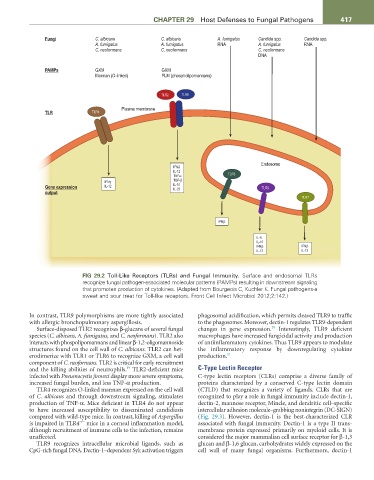
                            FIG 29.2  Toll-Like Receptors (TLRs) and Fungal Immunity. Surface and endosomal TLRs
                            recognize fungal pathogen-associated molecular patterns (PAMPs) resulting in downstream signaling
                            that promotes production of cytokines. (Adapted from Bourgeois C, Kuchler K. Fungal pathogens-a
                            sweet and sour treat for Toll-like receptors. Front Cell Infect Microbiol 2012;2:142.)


           In contrast, TLR9 polymorphisms are more tightly associated   phagosomal acidification, which permits cleaved TLR9 to traffic
           with allergic bronchopulmonary aspergillosis.          to the phagosomes. Moreover, dectin-1 regulates TLR9-dependent
                                                                                          20
             Surface-disposed TLR2 recognizes β-glucans of several fungal   changes in gene expression.  Interestingly, TLR9 deficient
           species (C. albicans, A. fumigatus, and C. neoformans). TLR2 also   macrophages have increased fungicidal activity and production
           interacts with phospolipomannans and linear β-1,2-oligomannoside   of antiinflammatory cytokines. Thus TLR9 appears to modulate
           structures found on the cell wall of C. albicans. TLR2 can het-  the inflammatory response by downregulating cytokine
           erodimerize with TLR1 or TLR6 to recognize GXM, a cell wall   production. 21
           component of C. neoformans. TLR2 is critical for early recruitment
                                          19
           and the killing abilities of neutrophils.  TLR2-deficient mice   C-Type Lectin Receptor
           infected with Pneumocystis jiroveci display more severe symptoms,   C-type lectin receptors (CLRs) comprise a diverse family of
           increased fungal burden, and less TNF-α production.    proteins characterized by a conserved C-type lectin domain
             TLR4 recognizes O-linked mannan expressed on the cell wall   (CTLD) that recognizes a variety of ligands. CLRs that are
           of  C.  albicans  and  through  downstream  signaling,  stimulates   recognized to play a role in fungal immunity include dectin-1,
           production of TNF-α. Mice deficient in TLR4 do not appear   dectin-2, mannose receptor, Mincle, and dendritic cell–specific
           to  have increased susceptibility  to disseminated candidiasis   intercellular adhesion molecule–grabbing nonintegrin (DC-SIGN)
           compared with wild-type mice. In contrast, killing of Aspergillus   (Fig. 29.3). However, dectin-1 is the best-characterized CLR
                           −/−
           is impaired in TLR4  mice in a corneal inflammation model,   associated with fungal immunity. Dectin-1 is a type II trans-
           although recruitment of immune cells to the infection, remains   membrane protein expressed primarily on myeloid cells. It is
           unaffected.                                            considered the major mammalian cell surface receptor for β-1,3
             TLR9 recognizes intracellular microbial ligands, such as   glucan and β-1,6 glucan, carbohydrates widely expressed on the
           CpG-rich fungal DNA. Dectin-1–dependent Syk activation triggers   cell wall of many fungal organisms. Furthermore, dectin-1

