


Page 439 - Clinical Immunology_ Principles and Practice ( PDFDrive )
P. 439
ChaPTEr 29  Host Defenses to Fungal Pathogens                419


                                               Fungus


                                        Dectin-1      Dectin-1
                                                                                                         Neutrophil
                                                                                                         recruitment

                 Plasma membrane
                                                                                                          IL-17A
                                                                                                          IL-17F
                                                                                                          IL-2 2


                                                Syk
                                                                                                          Th17

                                               CARD9
                      Raf-1      NFAT                         NADPH                         IL-6, TGFβ
                                            BCl-10  MALT1     oxidase
                                                                      LC3                                  Th2
                                                              ROS     recruitment
                                                                      to phagosome
                                               NF-κβ                                          IL-4
                                                                                                          IL-4
                                                              NRLP3                                       IL-5
                                                                                                          IL-13
                                                                                                          etc.
                                                              caspase1
                                                           pro-IL1β  IL1β

                                      NFKβ                      IL-1β  IL-10                      IL-12
                                            Cytokines           IL-23  IL-12                               Th1
                                                                IL-6  TNFα
                                      NFAT                       IL-2
                                            Cytokines            IL-10                                    IFNδ
                                                                                                          etc.
                                                   Nucleus
                                                                                                         Macrophage
                                                                                                         activation
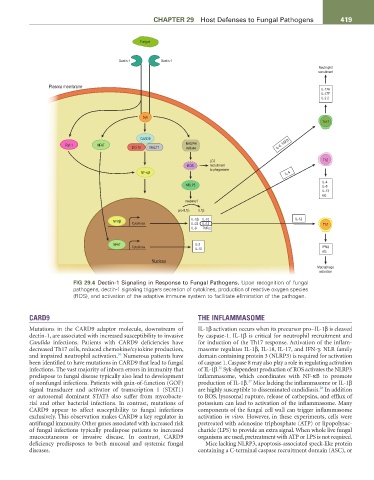
                         FIG 29.4  Dectin-1 Signaling in Response to Fungal Pathogens. Upon recognition of fungal
                         pathogens, dectin-1 signaling triggers secretion of cytokines, production of reactive oxygen species
                         (ROS), and activation of the adaptive immune system to facilitate elimination of the pathogen.


           CARD9                                                  THE INFLAMMASOME
           Mutations in the CARD9 adaptor molecule, downstream of   IL-1β activation occurs when its precursor pro–IL-1β is cleaved
           dectin-1, are associated with increased susceptibility to invasive   by caspase-1. IL-1β is critical for neutrophil recruitment and
           Candida infections. Patients with CARD9 deficiencies have   for induction of the Th17 response. Activation of the inflam-
           decreased Th17 cells, reduced chemokine/cytokine production,   masome regulates IL-1β, IL-18, IL-17, and IFN-γ. NLR family
                                        26
           and impaired neutrophil activation.  Numerous patients have   domain containing protein 3 (NLRP3) is required for activation
           been identified to have mutations in CARD9 that lead to fungal   of caspase 1. Caspase 8 may also play a role in regulating activation
                                                                         26
           infections. The vast majority of inborn errors in immunity that   of IL-1β.  Syk-dependent production of ROS activates the NLRP3
           predispose to fungal disease typically also lead to development   inflammasome, which coordinates with  NF-κB  to promote
                                                                                  27
           of nonfungal infections. Patients with gain-of-function (GOF)   production of IL-1β.  Mice lacking the inflammasome or IL-1β
                                                                                                          28
           signal transducer and activator of transcription 1 (STAT1)   are highly susceptible to disseminated candidiasis.  In addition
           or autosomal dominant STAT3 also suffer from mycobacte-  to ROS, lysosomal rupture, release of cathepsins, and efflux of
           rial  and  other  bacterial  infections. In  contrast,  mutations  of   potassium can lead to activation of the inflammasome. Many
           CARD9 appear to affect susceptibility to fungal infections   components of the fungal cell wall can trigger inflammasome
           exclusively. This observation makes CARD9 a key regulator in   activation  in vitro. However, in these experiments, cells were
           antifungal immunity. Other genes associated with increased risk   pretreated with adenosine triphosphate (ATP) or lipopolysac-
           of fungal infections typically predispose patients to increased   charide (LPS) to provide an extra signal. When whole live fungal
           mucocutaneous or invasive disease. In contrast, CARD9   organisms are used, pretreatment with ATP or LPS is not required.
           deficiency predisposes to both mucosal and systemic fungal     Mice lacking NLRP3, apoptosis-associated speck-like protein
           diseases.                                              containing a C-terminal caspase recruitment domain (ASC), or

