


Page 442 - Clinical Immunology_ Principles and Practice ( PDFDrive )
P. 442
422          ParT ThrEE  Host Defenses to Infectious Agents


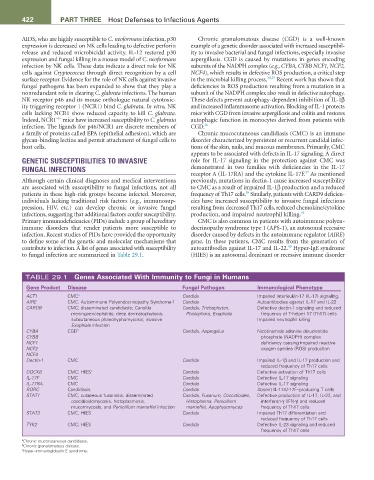
        AIDS, who are highly susceptible to C. neoformans infection, p30   Chronic granulomatous disease (CGD) is a well-known
        expression is decreased on NK cells leading to defective perforin   example of a genetic disorder associated with increased susceptibil-
        release and reduced microbicidal activity. IL-12 restored p30   ity to invasive bacterial and fungal infections, especially invasive
        expression and fungal killing in a mouse model of C. neoformans   aspergillosis. CGD is caused by mutations in genes encoding
        infection by NK cells. These data indicate a direct role for NK   subunits of the NADPH complex (e.g., CYBA, CYBB NCF1, NCF2,
        cells against Cryptococcus through direct recognition by a cell   NCF4), which results in defective ROS production, a critical step
        surface receptor. Evidence for the role of NK cells against invasive   in the microbial killing process. 34,35  Recent work has shown that
        fungal pathogens has been expanded to show that they play a   deficiencies in ROS production resulting from a mutation in a
        nonredundant role in clearing C. glabrata infections. The human   subunit of the NADPH complex also result in defective autophagy.
        NK receptor p46 and its mouse orthologue natural cytotoxic-  These defects prevent autophagy-dependent inhibition of IL-1β
        ity triggering receptor 1 (NCR1) bind C. glabrata. In vitro, NK   and increased inflammasome activation. Blocking of IL-1 protects
        cells lacking NCR1 show reduced capacity to kill C. glabrata.   mice with CGD from invasive aspergillosis and colitis and restores
                   −/−
        Indeed, NCR1  mice have increased susceptibility to C. glabrata   autophagic function in monocytes derived from patients with
        infection. The ligands for p46/NCR1 are discrete members of   CGD. 36
        a family of proteins called EPA (epithelial adhesion), which are   Chronic mucocutaneous candidiasis (CMC) is an immune
        glycan-binding lectins and permit attachment of fungal cells to    disorder characterized by persistent or recurrent candidal infec-
        host cells.                                            tions of the skin, nails, and mucous membranes. Primarily, CMC
                                                               appears to be associated with defects in IL-17 signaling. A direct
        GENETIC SUSCEPTIBILITIES TO INVASIVE                   role for IL-17 signaling in the protection against CMC was
        FUNGAL INFECTIONS                                      demonstrated  in  two  families  with  deficiencies  in  the IL-17
                                                                                                     37
                                                               receptor A (IL-17RA) and the cytokine IL-17F.  As mentioned
        Although certain clinical diagnoses and medical interventions   previously, mutations in dectin-1 cause increased susceptibility
        are associated with susceptibility to fungal infections, not all   to CMC as a result of impaired IL-1β production and a reduced
                                                                                 38
        patients in these high-risk groups become infected. Moreover,   frequency of Th17 cells.  Similarly, patients with CARD9 deficien-
        individuals  lacking  traditional  risk  factors (e.g., immunosup-  cies have increased susceptibility to invasive fungal infections
        pression, HIV, etc.) can develop chronic or invasive fungal   resulting from decreased Th17 cells, reduced chemokine/cytokine
        infections, suggesting that additional factors confer susceptibility.   production, and impaired neutrophil killing. 39
        Primary immunodeficiencies (PIDs) include a group of hereditary   CMC is also common in patients with autoimmune polyen-
        immune disorders that render patients more susceptible to   docrinopathy syndrome type 1 (APS-1), an autosomal recessive
        infection. Recent studies of PIDs have provided the opportunity   disorder caused by defects in the autoimmune regulator (AIRE)
        to define some of the genetic and molecular mechanisms that   gene. In these patients, CMC results from the generation of
                                                                                               40
        contribute to infection. A list of genes associated with susceptibility   autoantibodies against IL-17 and IL-22.  Hyper-IgE syndrome
        to fungal infection are summarized in Table 29.1.      (HIES) is an autosomal dominant or recessive immune disorder


         TABLE 29.1  Genes associated With Immunity to Fungi in humans
          Gene Product  Disease                              Fungal Pathogen         Immunological Phenotype
          ACT1         CMC a                                 Candida                 Impaired interleukin-17 (IL-17) signaling.
          AIRE         CMC; Autoimmune Polyendocrinopathy Syndrome-1  Candida        Autoantibodies against IL-17 and IL-22
          CARD9        CMC; disseminated candidiasis; Candida   Candida, Trichophyton,   Defective dectin-1 signaling and reduced
                        meningoencephalitis; deep dermatophytosis;   Phialophora, Exophiala  frequency of T-helper 17 (Th17) cells
                        subcutaneous phaeohyphomycosis; invasive                     Impaired neutrophil killing
                        Exophiala infection
          CYBA         CGD b                                 Candida, Aspergillus    Nicotinamide adenine dinucleotide
          CYBB                                                                        phosphate (NADPH) complex
          NCF1                                                                        deficiency causing impaired reactive
          NCF2                                                                        oxygen species (ROS) production
          NCF4
          Dectin-1     CMC                                   Candida                 Impaired IL-1β and IL-17 production and
                                                                                      reduced frequency of Th17 cells
          DOCK8        CMC; HIES c                           Candida                 Defective activation of Th17 cells
          IL-17F       CMC                                   Candida                 Defective IL-17 signaling
          IL-17RA      CMC                                   Candida                 Defective IL-17 signaling
          RORC         Candidiasis                           Candida                 Absent IL-17A/-17F–producing T cells
          STAT1        CMC, cutaneous fusariosis, disseminated   Candida, Fusarium, Coccidioides,   Defective production of IL-17, IL-22, and
                        coccidioidomycosis, histoplasmosis,   Histoplasma, Penicillium   interferon-γ (IFN-γ) and reduced
                        mucormycosis, and Penicillium marneffei infection  marneffei, Apophysomyces  frequency of Th17 cells
          STAT3        CMC; HIES                             Candida                 Impaired Th17 differentiation and
                                                                                      reduced frequency of Th17 cells
          TYK2         CMC; HIES                             Candida                 Defective IL-23 signaling and reduced
                                                                                      frequency of Th17 cells
        a Chronic mucocutaneous candidiasis.
        b Chronic granulomatous disease.
        c Hyper–immunoglobulin E syndrome.

