


Page 485 - Clinical Immunology_ Principles and Practice ( PDFDrive )
P. 485
466          ParT FOUr  Immunological Deficiencies


        and other cytokines, caused by mutations in the X-linked gene   are highly prone to developing autoimmunity, while others such
        IL2RG have SCID in which T and NK cells are absent but   as C57BL/6 (B6) are resistant. 18
        nonfunctional B cells are present in normal to high numbers,
         − +
               −
        T B NK  SCID. Mice with the orthologous gene Il2rg mutated   FUNCTIONAL GENOMICS
        or removed can make T cells but have no B cells, which gives
                     −
                + −
        them a T B NK  phenotype. 17                           Immediately after the Human Genome Project was declared to
           Genes other than IL2RG alone must be responsible for this   have been completed in 2003, an important follow-on project
        difference between species. Such genes, known as modifiers, have   was launched to identify the functional segments of DNA,
        not yet been identified. Notably, different strains of mice can   particularly portions in the 98–99% lying outside of the coding
        also have important phenotypic differences in the presence of   exons of genes, for which there was no simple sequence code
        a single gene mutation under study; some strains, for example,   that could be understood the way the triplet codon code can be
        nonobese diabetic (NOD) and Murphy Roths Large (MRL) mice   read. This project, termed ENCODE (for “encyclopedia of DNA
                                                               elements”), began as a pilot project to identify functional elements
                                                               in 1% of the genome, but it was quickly expanded to include
         100%                                                  the entire human genome as well as the genomes of model
         90%                                                            19
         80%                                                   organisms.  Before ENCODE, estimates were that 3–8% of the
         70%                                                   human genome had some role in function, given that this fraction
         60%                                                   of the genome appeared to be highly conserved among species
         50%                                                   with only very limited variation. This estimate was clearly too
         40%                                                   low, as it did not take into account rapidly evolving functional
         30%                                                   elements or those restricted to particular evolutionary lineages.
         20%                                                   This estimate also did not include segments of DNA that were
         10%                                                   too small to show conservation with statistical significance, nor
          0%                                                   did it include the functional elements in repetitive DNA that
            Chimp  Dog  Mouse  Rat Chicken Pufferfish Zebrafish  Fruitfly Mosquito  C. elegans  Rice Amoebae  E. coli  are not reliably scored as being evolutionarily conserved.
                                       Bee
                                                 C. cerevisiae
                                        Mustard weed
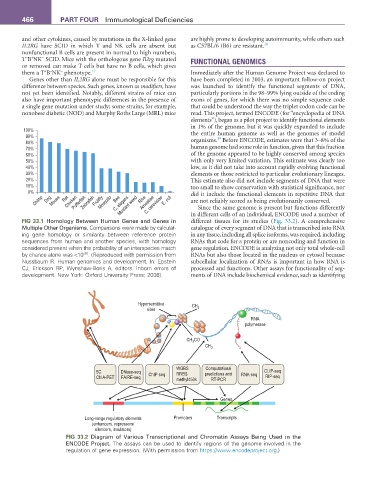
                                                                  Since the same genome is present but functions differently
        FIG 33.1  Homology Between Human Genes and Genes in    in different cells of an individual, ENCODE used a number of
                                                               different tissues for its studies (Fig. 33.2).  A comprehensive
        Multiple Other Organisms. Comparisons were made by calculat-  catalogue of every segment of DNA that is transcribed into RNA
        ing gene homology or similarity between reference protein   in any tissue, including all splice isoforms, was required, including
        sequences from human and another species, with homology   RNAs that code for a protein or are noncoding and function in
        considered present when the probability of an interspecies match   gene regulation. ENCODE is analyzing not only total whole-cell
                            -30
        by chance alone was <10 . (Reproduced with permission from   RNAs but also those located in the nucleus or cytosol because
        Nussbaum R. Human genomics and development. In: Epstein   subcellular localization of RNAs is important in how RNA is
        CJ, Erickson RP, Wynshaw-Boris A, editors. Inborn errors of   processed and functions. Other assays for functionality of seg-
        development. New York: Oxford University Press; 2008).  ments of DNA include biochemical evidence, such as identifying


                                              Hypersensitive    CH
                                                 sites            3
                                                                                   RNA
                                                                                 polymerase

                                                              CH CO
                                                                3
                                                                    CH 3

                                                           WGBS     Computational
                                 5C      DNase-seq  ChIP-seq  RRBS  predictions and  RNA-seq  CLIP-seq
                                 ChIA-PET  FAIRE-seq       methyl450k  RT-PCR           RIP-seq


                                                                         Genes


                             Long-range regulatory elements  Promoters  Transcripts
                               (enhancers, repressors/
                                silencers, insulators)
                       FIG 33.2  Diagram of Various Transcriptional and Chromatin Assays Being Used in the
                       ENCODE Project. The assays can be used to identify regions of the genome involved in the
                       regulation of gene expression. (With permission from https://www.encodeproject.org.)

