


Page 486 - Clinical Immunology_ Principles and Practice ( PDFDrive )
P. 486
CHaPTEr 33  Human Genomics in Immunology                   467


           (i) segments of DNA located in chromatin loops that allow
           chromatin–chromatin interaction; (ii) regions of open chromatin,
           which are accessible to transcription;  (iii) motifs that bind
           transcription factors; (iv) regions that are associated with histones      A     A  a
           that have been modified to either promote or suppress transcrip-           b  Y  b  B
           tion; and (v) regions with differential methylation of cytosine
           residues in different tissues, with methylation being associated
           with inactivity.                                                                           *
             Now, approximately 15 years into the project, ENCODE has   *                 *
           created a large database of more than 4 million functional regions
           of the genome. Mostly on the basis of biochemical evidence, it
           has been estimated that 80% of the genome may be of functional   a  A A  A  a  A  A     A a    a     A A
                    20
           significance,  but this estimate is probably too high and has   b  Y  b b  b  B  B  Y  b  Y  b b  B  Y  b b
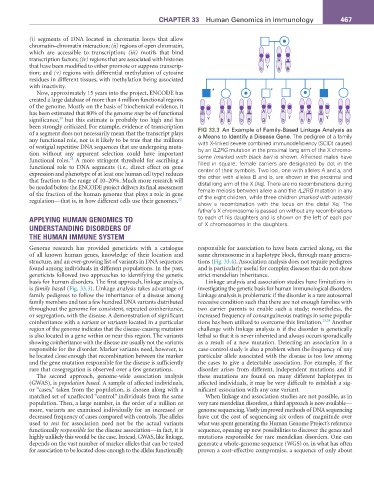
           been strongly criticized. For example, evidence of transcription   FIG 33.3  An Example of Family-Based Linkage Analysis as
           of a segment does not necessarily mean that the transcript plays   a Means to Identify a Disease Gene. The pedigree of a family
           any functional role, nor is it likely to be true that the millions   with X-linked severe combined immunodeficiency (SCID) caused
           of vestigial repetitive DNA sequences that are undergoing muta-  by an IL2RG mutation in the proximal long arm of the X chromo-
           tion  without  any  apparent  selection  could  have  important   some (marked with black bar) is shown. Affected males have
                        21
           functional roles.  A more stringent threshold for ascribing a   filled in square; female carriers are designated by dot in the
           functional role to DNA segments (i.e., direct effect on gene   center of their symbols. Two loci, one with alleles A and a, and
           expression and phenotype of at least one human cell type) reduces   the other with alleles B and b, are shown in the proximal and
           that fraction to the range of 10–20%. Much more research will   distal long arm of the X (Xq). There are no recombinations during
           be needed before the ENCODE project delivers its final assessment   female meiosis between allele a and the IL2RG mutation in any
           of the fraction of the human genome that plays a role in gene   of the eight children, while three children (marked with asterisk)
           regulation—that is, in how different cells use their genomes. 22
                                                                  show a recombination with the locus on the distal Xq. The
                                                                  father’s X chromosome is passed on without any recombinations
           APPLYING HUMAN GENOMICS TO                             to each of his daughters and is shown on the left of each pair
                                                                  of X chromosomes in the daughters.
           UNDERSTANDING DISORDERS OF
           THE HUMAN IMMUNE SYSTEM

           Genome research has provided geneticists with a catalogue   responsible for association to have been carried along, on the
           of all known human  genes, knowledge  of their location and   same chromosome in a haplotype block, through many genera-
           structure, and an ever-growing list of variants in DNA sequences   tions (Fig. 33.4). Association analysis does not require pedigrees
           found among individuals in different populations. In the past,   and is particularly useful for complex diseases that do not show
           geneticists followed two approaches to identifying the genetic   strict mendelian inheritance.
           basis for human disorders. The first approach, linkage analysis,   Linkage analysis and association studies have limitations in
           is family based (Fig. 33.3). Linkage analysis takes advantage of   investigating the genetic basis for human immunological disorders.
           family pedigrees to follow the inheritance of a disease among   Linkage analysis is problematic if the disorder is a rare autosomal
           family members and test a few hundred DNA variants distributed   recessive condition such that there are not enough families with
           throughout the genome for consistent, repeated coinheritance,   two carrier parents to enable such a study; nonetheless, the
           or segregation, with the disease. A demonstration of significant   increased frequency of consanguineous matings in some popula-
           coinheritance with a variant or variants located in a particular   tions has been utilized to overcome this limitation. 23,24  Another
           region of the genome indicates that the disease-causing mutation   challenge with linkage analysis is if the disorder is genetically
           is also located in a gene within or near this region. The variants   lethal so that it is never inherited and always occurs sporadically
           showing coinheritance with the disease are usually not the variants   as a result of a new mutation. Detecting an association in a
           responsible for the disorder. Marker variants need, however, to   case-control study is also a problem when the frequency of any
           be located close enough that recombination between the marker   particular allele associated with the disease is too low among
           and the gene mutation responsible for the disease is sufficiently   the cases to give a detectable association. For example, if the
           rare that cosegregation is observed over a few generations.  disorder arises from different, independent mutations and if
             The second approach, genome-wide association analysis   these mutations are found on many different haplotypes in
           (GWAS), is population based. A sample of affected individuals,   affected individuals, it may be very difficult to establish a sig-
           or “cases,” taken from the population, is chosen along with a   nificant association with any one variant.
           matched set of unaffected “control” individuals from the same   When linkage and association studies are not possible, as in
           population. Then, a large number, in the order of a million or   very rare mendelian disorders, a third approach is now available—
           more, variants are examined individually for an increased or   genome sequencing. Vastly improved methods of DNA sequencing
           decreased frequency of cases compared with controls. The alleles   have cut the cost of sequencing six orders of magnitude over
           used to  test for association need not be the actual variants   what was spent generating the Human Genome Project’s reference
           functionally responsible for the disease association—in fact, it is   sequence, opening up new possibilities to discover the genes and
           highly unlikely this would be the case. Instead, GWAS, like linkage,   mutations responsible for rare mendelian disorders. One can
           depends on the vast number of marker alleles that can be tested   generate a whole-genome sequence (WGS) or, in what has often
           for association to be located close enough to the alleles functionally   proven a cost-effective compromise, a sequence of only about

