


Page 544 - Clinical Immunology_ Principles and Practice ( PDFDrive )
P. 544
CHaPTEr 36  Immunodeficiencies at the Interface of Innate and Adaptive Immunity              522.e1


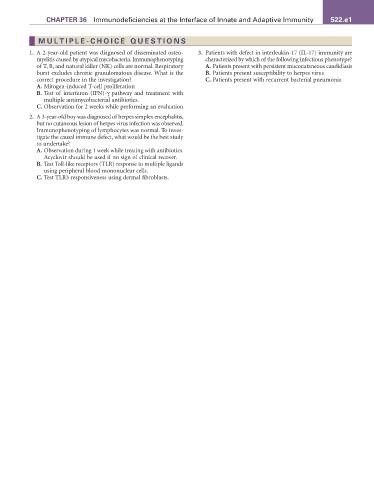
              M u LTIPLE-CHOICE Q u ESTIONS

           1.  A 2-year-old patient was diagnosed of disseminated osteo-  3.  Patients with defect in interleukin-17 (IL-17) immunity are
             myelitis caused by atypical mycobacteria. Immunophenotyping   characterized by which of the following infectious phenotype?
             of T, B, and natural killer (NK) cells are normal. Respiratory    A. Patients present with persistent mucocutaneous candidiasis
             burst excludes chronic granulomatous disease. What is the    B. Patients present susceptibility to herpes virus
             correct procedure in the investigation?                 C. Patients present with recurrent bacterial pneumonia
              A. Mitogen-induced T-cell proliferation
              B. Test of interferon (IFN)-γ pathway and treatment with
               multiple antimycobacterial antibiotics.
              C. Observation for 2 weeks while performing an evaluation
           2.  A 3-year-old boy was diagnosed of herpes simplex encephalitis,
             but no cutaneous lesion of herpes virus infection was observed.
             Immunophenotyping of lymphocytes was normal. To inves-
             tigate the causal immune defect, what would be the best study
             to undertake?
              A. Observation during 1 week while treating with antibiotics.
               Acyclovir should be used if no sign of clinical recover.
              B. Test Toll-like receptors (TLR) response to multiple ligands
               using peripheral blood mononuclear cells.
              C. Test TLR3 responsiveness using dermal fibroblasts.

