


Page 541 - Clinical Immunology_ Principles and Practice ( PDFDrive )
P. 541
520          ParT fOur  Immunological Deficiencies


                    C. albicans                               IL-17A
                                                              IL-17F
                                         IL-17RA
                              PRR
                                              IL-17RC

                            CARD9       ACT1

                                                                                     RORyt


                         NF-κB            MAPK
                                                                           STAT-3      STAT1
                                                                 IL-6R                            IFN-R

                                                          IL-6
                                                          IL-23
                                                                       IL-23R               IL-27R

                            Phagocytes, epithelial cells                       T lymphocytes
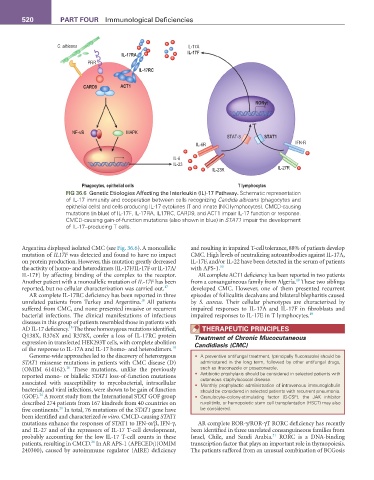
                       fIG 36.6  Genetic Etiologies Affecting the Interleukin (IL)-17 Pathway. Schematic representation
                       of IL-17 immunity and cooperation between cells recognizing Candida albicans (phagocytes and
                       epithelial cells) and cells producing IL-17 cytokines (T and innate [NK] lymphocytes). CMCD-causing
                       mutations (in blue) of IL-17F, IL-17RA, IL17RC, CARD9, and ACT1 impair IL-17 function or response.
                       CMCD-causing gain-of-function mutations (also shown in blue) in STAT1 impair the development
                       of IL-17–producing T cells.


        Argentina displayed isolated CMC (see Fig. 36.6). A monoallelic   and resulting in impaired T-cell tolerance, 88% of patients develop
        mutation of IL17F was detected and found to have no impact   CMC. High levels of neutralizing autoantibodies against IL-17A,
        on protein production. However, this mutation greatly decreased   IL-17F, and/or IL-22 have been detected in the serum of patients
        the activity of homo- and heterodimers (IL-17F/IL-17F or IL-17A/  with APS-1. 50
        IL-17F)  by  affecting  binding  of  the  complex  to  the  receptor.   AR complete ACT1 deficiency has been reported in two patients
                                                                                                  19
        Another patient with a monoallelic mutation of IL-17F has been   from a consanguineous family from Algeria.  These two siblings
        reported, but no cellular characterization was carried out. 17  developed CMC. However, one of them presented recurrent
           AR complete IL-17RC deficiency has been reported in three   episodes of folliculitis decalvans and bilateral blepharitis caused
                                               18
        unrelated patients from Turkey and  Argentina.  All  patients   by  S. aureus. Their cellular phenotypes are characterized by
        suffered from CMC, and none presented invasive or recurrent   impaired responses to IL-17A and IL-17F in fibroblasts and
        bacterial infections. The clinical manifestations of infectious   impaired responses to IL-17E in T lymphocytes. 19
        diseases in this group of patients resembled those in patients with
                        18
        AD IL-17 deficiency.  The three homozygous mutations identified,    THEraPEuTIC PrINCIPLES
        Q138X, R376X and R378X, confer a loss of IL-17RC protein   Treatment of Chronic Mucocutaneous
        expression in transfected HEK293T cells, with complete abolition   Candidiasis (CMC)
        of the response to IL-17A and IL-17 homo- and heterodimers. 18
           Genome-wide approaches led to the discovery of heterozygous   •  A preventive antifungal treatment, (principally fluconazole) should be
        STAT1 missense mutations in patients with CMC disease (D)   administered in the long term, followed by other antifungal drugs,
                       20
        (OMIM 614162).  These mutations, unlike the previously     such as itraconazole or posaconazole.
        reported mono- or biallelic STAT1 loss-of-function mutations   •  Antibiotic prophylaxis should be considered in selected patients with
                                                                   cutaneous staphylococcal disease.
        associated with susceptibility to mycobacterial, intracellular   •  Monthly prophylactic administration of intravenous immunoglobulin
        bacterial, and viral infections, were shown to be gain of function   should be considered in selected patients with recurrent pneumonia.
              24
        (GOF).  A recent study from the International STAT GOF group   •  Granulocyte–colony-stimulating factor (G-CSF), the JAK inhibitor
        described 274 patients from 167 kindreds from 40 countries on   ruxolitinib, or hemopoietic stem cell transplantation (HSCT) may also
                    20
        five continents.  In total, 76 mutations of the STAT1 gene have   be considered.
        been identified and characterized in vitro. CMCD-causing STAT1
        mutations enhance the responses of STAT1 to IFN-α/β, IFN-γ,   AR complete ROR-γ/ROR-γT RORC deficiency has recently
        and IL-27 and of the repressors of IL-17 T-cell development,   been identified in three unrelated consanguineous families from
                                                                                          51
        probably accounting for the low IL-17 T-cell counts in these   Israel, Chile, and Saudi  Arabia.  RORC is a DNA-binding
                               20
        patients, resulting in CMCD.  In AR APS-1 (APECED;)(OMIM   transcription factor that plays an important role in thymopoiesis.
        240300),  caused  by  autoimmune  regulator  (AIRE)  deficiency   The patients suffered from an unusual combination of BCGosis

