


Page 539 - Clinical Immunology_ Principles and Practice ( PDFDrive )
P. 539
518          ParT fOur  Immunological Deficiencies


        patients having had Pneumocystis pneumonia and CMC. Finally,   disease, resulting in the deaths of 20 of the 49 known patients,
        some patients presented with recurrent diarrhea and/or colitis.   all of whom died before the age of 8 years. Eleven of these patients
        Thus a diagnosis of IκBα deficiency should be considered in   died from invasive pneumococcal disease. There is an overall
        children with EDA and CID with impaired T-cell immunity. A   trend toward improvement with age, as shown by the seven adult
        preventive treatment, including antibiotic prophylaxis with   patients doing well with no treatment at ages of 18 to 37 years.
        trimethoprim–sulfamethoxazole and/or penicillin V, should be   Patients with IRAK-4 deficiency should also be immunized
        proposed and IgG substitution should be carried out in patients   with S. pneumonia, H. influenzae, N. meningitidis conjugated
        with IκBα deficiency. The recommendations for febrile patients   vaccine (and  also nonconjugated vaccine when available).  A
        with NEMO deficiency should also be applied to patients with   preventive treatment, including antibiotic prophylaxis with
        IκBα deficiency. HSCT has been reported in four patients with   cotrimoxazole plus penicillin V, should be administered through-
        severe IκBα deficiency causing CID. 45,46              out the life of the patient. Given the severity of bacterial infection
                                                               during childhood and the defective antibody production found
        IL-1 Receptor–Associated Kinase-4 Deficiency           in some patients with IRAK-4 deficiency, we also recommend
        Inherited IRAK-4 deficiency (OMIM 607676) is an AR disorder   the administration of empiric IgG replacement until the patient
                           11
        first described in 2003.  In total, 49 patients have since been   is at least 10 years old. This prophylaxis seems to decrease the
                                                                                                 13
        identified, from 32 kindreds. 13,16  The blood cells of the patients   incidence of invasive bacterial infections.  It is important to
        fail to produce the proinflammatory cytokines IL-1β and IL-18   initiate empiric parenteral antibiotic treatment against S. pneu-
        upon stimulation with all known TLR agonists (with the exception   moniae, S. aureus, and P. aeruginosa as soon as an infection is
        of TLR3 agonists). Patients with IRAK-4 deficiency seem to have   suspected or if the patient develops a moderate fever, without
        normal antigen-specific T- and B-cell responses, as shown in   taking inflammatory parameters into account because patients
        routine immunological investigations, with two notable excep-  may die of rapid invasive bacterial infection despite appropriate
             47
        tions.  First, the glycan-specific IgG and IgM antibody responses   prophylaxis. A diagnosis of IRAK-4 deficiency should be con-
        to pneumococcal and  AB glycans (allohemagglutinins of the   sidered in children presenting with recurrent pyogenic infection
        ABO  system)  are  impaired  in  up  to  one-third of  the  cases   and poor inflammatory responses.
                13
        explored.  Second, serum IgE and IgG4 concentrations are high
        in up to two-thirds and one-third, respectively, of patients tested. 13  MYD88 Deficiency
                                                               MyD88 deficiency is an AR disorder recently described in 22
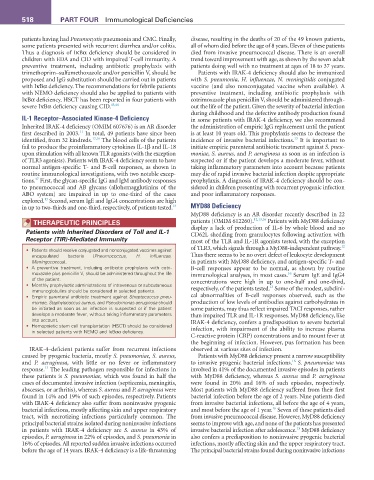
            THEraPEuTIC PrINCIPLES                             patients (OMIM 612260). 12,13,16  Patients with MyD88 deficiency
         Patients with Inherited Disorders of Toll and IL-1    display a lack of production of IL-6 by whole blood and no
                                                               CD62L shedding from granulocytes following activation with
         Receptor (TIR)-Mediated Immunity                      most of the TLR and IL-1R agonists tested, with the exception
                                                                                                                 12
          •  Patients should receive conjugated and nonconjugated vaccines against   of TLR3, which signals through a MyD88-independent pathway.
           encapsulated  bacteria  (Pneumococcus,  H.  influenzae,  Thus there seems to be no overt defect of leukocyte development
           Meningococcus).                                     in patients with MyD88 deficiency, and antigen-specific T- and
          •  A preventive treatment, including antibiotic prophylaxis with cotri-  B-cell responses appear to be normal, as shown by routine
           moxazole plus penicillin V, should be administered throughout the life   immunological analyses, in most cases.  Serum IgE and IgG4
                                                                                               16
           of the patient.                                     concentrations were high in up to one-half and one-third,
          •  Monthly prophylactic administrations of intravenous or subcutaneous         13
           immunoglobulins should be considered in selected patients.  respectively, of the patients tested.  Some of the modest, subclini-
          •  Empiric parenteral antibiotic treatment against Streptococcus pneu-  cal  abnormalities of  B-cell  responses  observed,  such  as  the
           moniae, Staphylococcus aureus, and Pseudomonas aeruginosa should   production of low levels of antibodies against carbohydrates in
           be initiated as soon as an infection is suspected or if the patient   some patients, may thus reflect impaired TACI responses, rather
           develops a moderate fever, without taking inflammatory parameters   than impaired TLR and IL-1R responses. MyD88 deficiency, like
           into account.                                       IRAK-4 deficiency, confers a predisposition to severe bacterial
          •  Hemopoietic stem cell transplantation (HSCT) should be considered   infection, with  impairment  of  the  ability  to increase plasma
           in selected patients with NEMO and IκBαα deficiency.
                                                               C-reactive protein (CRP) concentrations and to mount fever at
                                                               the beginning of infection. However, pus formation has been
           IRAK-4–deficient patients suffer from recurrent infections   observed at various sites of infection.
        caused by pyogenic bacteria, mostly S. pneumoniae, S. aureus,   Patients with MyD88 deficiency present a narrow susceptibility
                                                                                                 16
        and  P. aeruginosa, with little or no fever or inflammatory   to invasive pyogenic bacterial infections.  S. pneumoniae was
                13
        response.  The leading pathogen responsible for infections in   involved in 41% of the documented invasive episodes in patients
        these patients is S. pneumoniae, which was found in half the   with MyD88 deficiency, whereas  S. aureus and  P. aeruginosa
        cases of documented invasive infection (septicemia, meningitis,   were found in 20% and 16% of such episodes, respectively.
        abscesses, or arthritis), whereas S. aureus and P. aeruginosa were   Most patients with MyD88 deficiency suffered from their first
        found in 14% and 19% of such episodes, respectively. Patients   bacterial infection before the age of 2 years. Nine patients died
        with IRAK-4 deficiency also suffer from noninvasive pyogenic   from invasive bacterial infections, all before the age of 4 years,
                                                                                          16
        bacterial infections, mostly affecting skin and upper respiratory   and most before the age of 1 year.  Seven of these patients died
        tract, with  necrotizing  infections particularly common. The   from invasive pneumococcal disease. However, MyD88 deficiency
        principal bacterial strains isolated during noninvasive infections   seems to improve with age, and none of the patients has presented
                                                                                                  13
        in patients with IRAK-4 deficiency are  S. aureus in 43% of   invasive bacterial infection after adolescence.  MyD88 deficiency
        episodes, P. aeruginosa in 22% of episodes, and S. pneumonia in   also confers a predisposition to noninvasive pyogenic bacterial
        16% of episodes. All reported sudden invasive infections occurred   infections, mostly affecting skin and the upper respiratory tract.
        before the age of 14 years. IRAK-4 deficiency is a life-threatening   The principal bacterial strains found during noninvasive infections

