


Page 546 - Clinical Immunology_ Principles and Practice ( PDFDrive )
P. 546
524          Part four  Immunological Deficiencies


         TABLE 37.1  Infection Susceptibility of Select Primary Immunodeficiencies
          Immunodeficiency       Genetic Defect          functional Defect         Infection Susceptibility
          Chronic granulomatous disease  Gp91 phox , p22 phox , p40 phox ,   Defect in nicotinamide adenine   Catalase positive bacteria (e.g.,
                                  p47 phox , p67 phox     dinucleotide phosphate (NADPH)   Staphylococcus aureus, Burkholderia,
                                                          oxidase leading to abnormal   serratia, Nocardia) and filamentous molds
                                                          superoxide production
          Leukocyte adhesion disorder-1   β 2  integrin  Neutrophil migration      Bacteria, typically S. aureus, gram-negative
           (LAD-1)
          Severe congenital neutropenia  HAX1, ELANE     Neutropenia               Bacteria, typically streptococci, S. aureus,
                                                                                    gram-negative
          X-linked agammaglobulinemia  Bruton tyrosine kinase (BTK)  Absence of B cells, antibody   Encapsulated bacteria, enterovirus,
                                                          production                Helicobacter, and related species
          CD40 ligand deficiency  CD40 ligand            Impaired B-cell class switching  Encapsulated bacteria, Pneumocystis
                                                                                    jiroveci, Cryptosporidium
          Severe combined        Multiple genes, such as IL2RG,   T-cell lymphopenia, variable B- and   Bacteria, virus, P. jiroveci, Candida, Bacille
           immunodeficiency (SCID)  RAG1/2, ADA, JAK3, etc.  natural killer (NK)-cell expression  Calmette-Guérin (BCG)
          DiGeorge syndrome      Deletion of chromosome 22q11   Thymic hypoplasia or aplasia  Viruses, opportunists infrequent
                                  in majority
          Autosomal dominant hyper-IgE   Signal transducer and activator   Impaired T-helper-17 (Th17) cell   S. aureus, Candida, dimorphic fungi;
           syndrome (Job’s syndrome;   of transcription 3 (STAT3)  differentiation  secondary infection of pneumatoceles
           AD-HIES)                                                                 with molds, gram-negative bacteria and
                                                                                    nontuberculous mycobacteria
          Dedicator of cytokinesis 8   DOCK8             T-cell lymphopenia, defect still   S. aureus, Candida, Molluscum
           (DOCK8) deficiency                             being delineated          contagiosum, human papillomavirus
                                                                                    (HPV), herpes viruses
          Interleukin-12 (IL-12)/interferon   IFN-γR1, IFN-γR2, IL-12, IL-12R,   Failure of signal transducer and   Mycobacteria, Salmonella, dimorphic fungi
           (IFN)-γ axis defects   NEMO, STAT1             activator of transcription 1 (STAT1)
                                                          activation, intracellular killing
          Complement C5–9 defects  Specific complements  Impaired membrane attack complex   Neisseria species
                                                          killing


                                                                   KEY CoNCEPtS
                                                                 Infection Risks in Primary Immunodeficiencies

                                                                 •  Neutrophil defects present primarily with bacterial and fungal
                                                                   infections.
                                                                 •  Humoral immunodeficiencies present with impaired antibody formation
                                                                   and  primarily  sinopulmonary  infections  with  encapsulated
                                                                   organisms.
                                                                 •  Severe primarily T-cell defects usually present with opportunists, such
                                                                   as Pneumocystis.
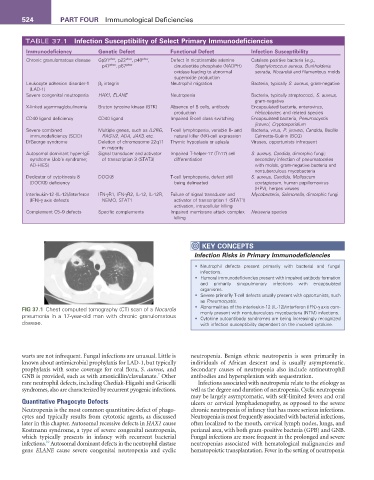
        fIG 37.1  Chest computed tomography (CT) scan of a Nocardia   •  Abnormalities of the interleukin-12 (IL-12)/interferon (IFN)-γ axis com-
                                                                   monly present with nontuberculous mycobacteria (NTM) infections.
        pneumonia in a 17-year-old man with chronic granulomatous   •  Cytokine autoantibody syndromes are being increasingly recognized
        disease.                                                   with infection susceptibility dependent on the involved cytokine.


        warts are not infrequent. Fungal infections are unusual. Little is   neutropenia.  Benign  ethnic  neutropenia  is  seen  primarily  in
        known about antimicrobial prophylaxis for LAD-1, but typically   individuals of  African descent and is usually asymptomatic.
        prophylaxis with some coverage for oral flora, S. aureus, and   Secondary  causes  of  neutropenia  also  include antineutrophil
                                                     7
        GNB is provided, such as with amoxicillin/clavulanate.  Other   antibodies and hypersplenism with sequestration.
        rare neutrophil defects, including Chediak-Higashi and Griscelli   Infections associated with neutropenia relate to the etiology as
        syndromes, also are characterized by recurrent pyogenic infections.  well as the degree and duration of neutropenia. Cyclic neutropenia
                                                               may be largely asymptomatic, with self-limited fevers and oral
        Quantitative Phagocyte Defects                         ulcers or cervical lymphadenopathy, as opposed to the severe
        Neutropenia is the most common quantitative defect of phago-  chronic neutropenia of infancy that has more serious infections.
        cytes and typically results from cytotoxic agents, as discussed   Neutropenia is most frequently associated with bacterial infections,
        later in this chapter. Autosomal recessive defects in HAX1 cause   often localized to the mouth, cervical lymph nodes, lungs, and
        Kostmann syndrome, a type of severe congenital neutropenia,   perianal area, with both gram-positive bacteria (GPB) and GNB.
        which typically presents in infancy with recurrent bacterial   Fungal infections are more frequent in the prolonged and severe
                10
        infections.  Autosomal dominant defects in the neutrophil elastase   neutropenias associated with hematological malignancies and
        gene  ELANE cause severe congenital  neutropenia and cyclic   hematopoietic transplantation. Fever in the setting of neutropenia

