


Page 550 - Clinical Immunology_ Principles and Practice ( PDFDrive )
P. 550
528          Part four  Immunological Deficiencies


        Mycophenolate Mofetil                                  Tumor Necrosis Factor-α Inhibitors
        Mycophenolate mofetil (MMF) is a prodrug of mycophenolic   TNF-α is a cytokine that plays a central role in macrophage and
        acid, which inhibits inosine monophosphate dehydrogenase, a   phagosome activation, differentiation of monocytes into mac-
        key enzyme in purine synthesis. It is a cytotoxic drug with   rophages, recruitment of neutrophils and macrophages, and
                                                33
        antiproliferative effect on T and B lymphocytes.  In addition   granuloma formation and maintenance. Blockade results in an
        to its potential myelosuppressive effect, it has been associated   increased risk of infection, particularly in the first few months
        in SOT to a higher risk of CMV infection. 32           after treatment. 37,38  Infections characterized by granulomas have
                                                               been described most frequently, in particular TB and NTM
        Antithymocyte Globulin                                 infections, but also disseminated histoplasmosis and coccidioi-
                                                                        39
        Antithymocyte globulin (ATG) is a polyclonal Ig prepared by   domycosis.  Other notable infections are listeriosis, legionellosis,
        immunizing  horses  or  rabbits  with  human  thymocytes  and   salmonellosis, recurrent or relapsing leishmaniasis, overwhelming
        harvesting the IgG. These antibodies produce a profound lym-  Plasmodium falciparum infection, and invasive mold infections
        phopenia that can last well beyond 1 year. Used for induction or   (i.e.,  aspergillosis  and  mucormycosis).  Risk  of  certain  viral
        rejection therapy in transplantations, their use has been associated   infections also appears to be increased, particularly VZV infection.
        consistently with a greater risk of CMV and posttransplantation   Several cases of severe hepatitis B virus (HBV) reactivation in
                                       36
        lymphoproliferative disease (PTLD).  CMV prophylaxis or   patients with positive surface antigen at the start of treatment
        preemptive therapy is recommended in transplant recipients that   have been reported, many of whom developed hepatic failure.
        receive ATG. Because these are foreign proteins, serum sickness   Patients receiving anti–TNF-α therapy should be screened for
        can also develop between 1 and 2 weeks after treatment.  TB (latent or active), HBV, and HCV before starting treatment,
                                                                                  38
                                                               and treated accordingly.  Patients with latent TB should receive
        Monoclonal Antibodies and Small Molecules              isoniazid for 6–9 months. Ideally, patients would have received
        Monoclonal antibodies (mAbs) and small molecules target specific   at least 3 weeks of isoniazid before therapy with biologicals;
        cellular steps, making it possible to manipulate disease pathways   however, in truly urgent cases, this can be done simultaneously.
        for previously untreatable illnesses. Many of these biological   In patients that are hepatitis B surface antigen (HbsAg) positive,
        agents interfere with specific aspects of the immune system.   baseline HBV DNA levels should be obtained and antiviral
        Highlighted below are those that have a key infection susceptibility   prophylaxis or treatment offered. All HBV-seronegative patients
        pattern. Others with more subtle increases in infections are also   should be vaccinated against hepatitis B and seroconversion
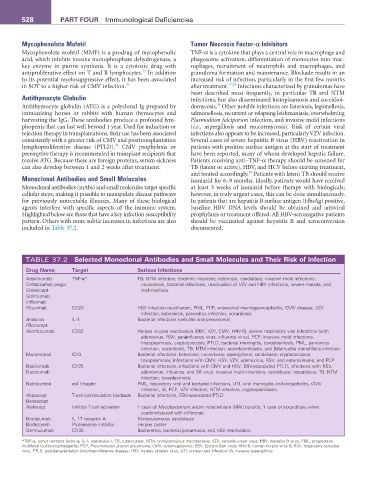
        included in Table 37.2.                                documented.


         TABLE 37.2  Selected Monoclonal antibodies and Small Molecules and their risk of Infection
          Drug Name      target               Serious Infections
          Adalimumab     TNF-α*               TB, NTM infection, endemic mycoses, listeriosis, candidiasis, invasive mold infections,
          Certolizumab pegol                   nocardiosis, bacterial infections, reactivation of VZV and HBV infections, severe malaria, and
          Etanercept                           leishmaniasis
          Golimumab
          Infliximab
          Rituximab      CD20                 HBV infection reactivation, PML, PCP, enteroviral meningoencephalitis, CMV disease, VZV
                                               infection, babesiosis, parvovirus infection, nocardiosis
          Anakinra       IL-1                 Bacterial infections (cellulitis and pneumonia)
          Rilonacept
          Alemtuzumab    CD52                 Herpes viruses reactivation (EBV, VZV, CMV, HHV-6), severe respiratory viral infections (with
                                               adenovirus, RSV, parainfluenza virus, influenza virus), PCP, invasive mold infections,
                                               histoplasmosis, cryptococcosis, PTLD, bacterial meningitis, toxoplasmosis, PML, parvovirus
                                               infection, nocardiosis, TB, NTM infection, acanthamebiasis, and Balamuthia mandrillaris infection
          Muromonab      CD3                  Bacterial infections; listeriosis; nocardiosis; aspergillosis; candidiasis; cryptococcosis;
                                               toxoplasmosis; infections with CMV, HSV, VZV, adenovirus, RSV, and enteroviruses; and PCP
          Basiliximab    CD25                 Bacterial infections; infections with CMV and HSV; EBV-associated PTLD; infections with RSV,
          Daclizumab                           adenovirus, influenza, and BK virus; invasive mold infections; candidiasis; nocardiosis; TB; NTM
                                               infection; toxoplasmosis
          Natalizumab    α-4 Integrin         PML, respiratory viral and bacterial infections, UTI, viral meningitis and encephalitis, CMV
                                               infection, IA, PCP, VZV infection, NTM infection, cryptosporidiosis
          Abatacept      T-cell costimulation blockade  Bacterial infections, EBV-associated PTLD
          Belatacept
          Alefacept      Inhibits T-cell activation  1 case of Mycobacterium avium intracellulare (MAI) bursitis, 1 case of nocardiosis when
                                               coadministered with infliximab
          Brodalumab     IL 17 receptor A     Mucocutaneous candidiasis
          Bortezomib     Proteasome inhibitor  Herpes zoster
          Gemtuzumab     CD33                 Bacteremia, bacterial pneumonia, and HSV reactivation.
        *TNF-α, tumor necrosis factor-α; IL-1, interleukin-1; TB, tuberculosis; NTM, nontuberculous mycobacteria; VZV, varicella-zoster virus; HBV, hepatitis B virus; PML, progressive
        multifocal leukoencephalopathy; PCP, Pneumocystis jiroveci pneumonia; CMV, cytomegalovirus; EBV, Epstein-Barr virus; HHV-6, human herpes virus 6; RSV, respiratory syncytial
        virus; PTLD, posttransplantation lymphoproliferative disease; HSV, herpes simplex virus; UTI, urinary tract infection; IA, invasive aspergillosis.

