


Page 55 - Clinical Immunology_ Principles and Practice ( PDFDrive )
P. 55
40 ParT ONE Principles of Immune Response
Influenza viruses and respiratory syncytial virus replicate in BPI is a ~55-kilodalton (kDa) cationic and hydrophobic
airway epithelial cells, leading to cell death and inflammation. protein with high affinity for the lipid A region of lipopolysac-
The impaired barrier function of the airways can lead to increased charide (endotoxin). It is found in neutrophil primary (azuro-
susceptibility to secondary invasive bacterial infections by philic) granules and is also inducible in epithelial cells. BPI inhibits
Streptococcus pneumoniae and other pyogenic bacteria. Inflam- gram-negative bacteria by its endotoxin neutralizing and
9
matory bowel diseases also result in impaired barrier functions microbicidal and opsonic properties. Neutralization of endotoxin
of the small and large intestines, which can be associated with may also help limit inflammatory responses to gram-negative
increased translocation of bacteria across gut mucosa, potentially bacteria.
leading to serious infection. Some APPs, such as lysozyme (Lz), have enzymatic activities,
which cleaves peptidoglycans found in bacterial cell walls. Other
CLINICaL PEarLS APPs bind to and compete for nutrients, a form of so-called
Innate Immunity Barriers nutritional immunity. Lactoferrin (Lf), for example, binds iron,
9
a nutrient essential to bacterial survival.
• Innate immune barriers consist of epithelial layers, including those of Defensins are classified by the linking pattern of cysteines
skin and the gastrointestinal, respiratory, and genitourinary tracts. and their sizes. α-defensins are expressed in neutrophils and
• Barrier function is an underappreciated component of the innate immune Paneth cells of the small intestine, whereas β-defensins are
system. expressed by mucosal surface epithelia, including those of skin,
• Defects of barrier function, such as epidermolysis bullosa and atopic eyes, and the oral, urogenital, and respiratory tracts. Defensins
10
dermatitis, increase the risk of infection.
• Production of antimicrobial peptides and proteins at barrier sites plays have a broad specificity of antimicrobial activities against bacteria,
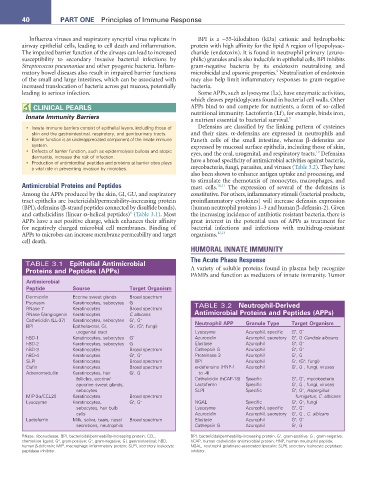
a vital role in preventing invasion by microbes. mycobacteria, fungi, parasites, and viruses (Table 3.2). They have
also been shown to enhance antigen uptake and processing, and
to stimulate the chemotaxis of monocytes, macrophages, and
Antimicrobial Proteins and Peptides mast cells. 10,11 The expression of several of the defensins is
Among the APPs produced by the skin, GI, GU, and respiratory constitutive. For others, inflammatory stimuli (bacterial products,
tract epithelia are bactericidal/permeability-increasing protein proinflammatory cytokines) will increase defensin expression
(BPI), defensins (β-strand peptides connected by disulfide bonds), (human neutrophil proteins 1–3 and human β-defensin-2). Given
8
and cathelicidins (linear α-helical peptides) (Table 3.1). Most the increasing incidence of antibiotic resistant bacteria, there is
APPs have a net positive charge, which enhances their affinity great interest in the potential uses of APPs as treatment for
for negatively charged microbial cell membranes. Binding of bacterial infections and infections with multidrug-resistant
APPs to microbes can increase membrane permeability and target organisms. 12,13
cell death.
HUMORAL INNATE IMMUNITY
The Acute Phase Response
TABLE 3.1 Epithelial antimicrobial
Proteins and Peptides (aPPs) A variety of soluble proteins found in plasma help recognize
PAMPs and function as mediators of innate immunity. Tumor
antimicrobial
Peptide Source Target Organism
Dermicidin Eccrine sweat glands Broad spectrum
Psoriasin Keratinocytes, sebocytes G − TABLE 3.2 Neutrophil-Derived
RNase 7 Keratinocytes Broad spectrum
RNase 5/angiogenin Keratinocytes C albicans antimicrobial Proteins and Peptides (aPPs)
+
Cathelicidin (LL-37) Keratinocytes, sebocytes G , G − Neutrophil aPP Granule Type Target Organism
BPI Epithelia-oral, GI, G , (G , fungi)
−
+
+
urogenital tract Lysozyme Azurophil, specific G , G −
−
+
hBD-1 Keratinocytes, sebocytes G − Azurocidin Azurophil, secretory G , G Candida albicans
+
hBD-2 Keratinocytes, sebocytes G − Elastase Azurophil G , G −
+
hBD-3 Keratinocytes Broad spectrum Cathepsin G Azurophil G , G −
+
hBD-4 Keratinocytes G , G − Proteinase 3 Azurophil G , G −
+
−
+
SLPI Keratinocytes Broad spectrum BPI Azurophil G , (G , fungi)
Elafin Keratinocytes Broad spectrum α-defensins (HNP-1 Azurophil G , G , fungi, viruses
+
−
+
Adrenomedullin Keratinocytes, hair G , G − to -4)
+
−
follicles, eccrine/ Cathelicidin (hCAP-18) Specific G , G , mycobacteria
+
−
apocrine sweat glands, Lactoferrin Specific G , G , fungi, viruses
sebocytes SLPI Specific G , G , Aspergillus
+
−
MIP-3α/CCL20 Keratinocytes Broad spectrum fumigatus, C. albicans
+
−
+
Lysozyme Keratinocytes, G , G − NGAL Specific G , G , fungi
+
sebocytes, hair bulb Lysozyme Azurophil, specific G , G −
+
cells Azurocidin Azurophil, secretory G , G , C. albicans
−
+
Lactoferrin Milk, saliva, tears, nasal Broad spectrum Elastase Azurophil G , G −
secretions, neutrophils Cathepsin G Azurophil G , G −
+
+
−
RNase, ribonuclease; BPI, bactericidal/permeability-increasing protein; CCL, BPI, bactericidal/permeability-increasing protein; G , gram-positive; G , gram-negative;
−
+
chemokine ligand; G , gram-positive; G , gram-negative; GI, gastrointestinal; hBD, hCAP, human cathelicidin antimicrobial protein; HNP, human neutrophil peptide;
human β-defensin; MIP, macrophage inflammatory protein; SLPI, secretory leukocyte NGAL, neutrophil gelatinase-associated lipocalin; SLPI, secretory leukocyte peptidase
peptidase inhibitor. inhibitor.

