


Page 59 - Clinical Immunology_ Principles and Practice ( PDFDrive )
P. 59
44           ParT ONE  Principles of Immune Response


        and represent the majority of NK cells in peripheral lymphoid   sites for the activation of other protein tyrosine kinases, such as
        organs. NK cells are a major source of IFN-γ, which augments   Syk and ZAP-70, which activate downstream effector molecules
        the microbicidal functions of macrophages. Conversely, NK cells   in a signaling cascade. Infection of host cells with some viruses
        are primed by IL-15 derived from DCs and IL-12 or IL-18 derived   can lead to reduced MHC class I expression, thereby reducing
        from macrophages, demonstrating the regulatory interactions   viral antigen presentation to T cells. Concomitantly, ligands for
        that occur between NK cells and other cells of the immune   activating receptors are expressed by the infected cell, leading
        system.                                                to NK-cell activation and killing of the infected cell.
           NK-cell function is regulated by a delicate balance between   NK cells play an important role in immunosurveillance against
                                                      32
                                                                      33
        signals generated by inhibitory and activating receptors.  NK   tumors.  In humans, NK cell receptors that mediate tumor
        cells possess the ability to recognize and kill infected or malig-  recognition include NKp46, NKp30, NKp44, DNAM-1 (DNAX
        nantly transformed cells, while leaving healthy host cells   accessory molecule-1), and NKG2D. Ligands expressed on target
        unharmed. Inhibitory receptors on NK cells recognize class I   cells include MHC I-related chain (MIC)-A, MICB, unique long
        major histocompatibility complex (MHC) molecules expressed   16-binding  proteins  (ULBP),  poliovirus  receptor  (PVR),  and
        on most healthy cells in the body.                     Nectin-2. DNAM-1 specific ligands include PVR and Nectin-2,
           NK inhibitory receptors include three families of receptors:   which are expressed in cell lines that include carcinomas, mela-
        heterodimers composed of CD94 and NKG2A, the Ig-like   nomas, and neuroblastomas. Nectin expression is not specific
        transcripts (i.e., ILT-2), and the killer cell Ig-like receptor (KIR)   to tumors, since nectins are expressed on normal cells. DNAM-
        family. The immunoreceptor tyrosine-based inhibition motifs   1-nectin interactions on normal cells do not result in NK cell
        (ITIMs)  in  their  cytoplasmic  tails  recruit  phosphatases  (Src   lysis because normal cells are protected by MHC class I expression.
        homology  region  2  [SH2]  domain-containing  phosphatase-1   Conditions favoring NK cell–mediated lysis include tumors in
        [SHP-1], SHP-2, and SHIP [SH2-containing inositol polyphos-  which nectins are overexpressed and/or MHC class I expression
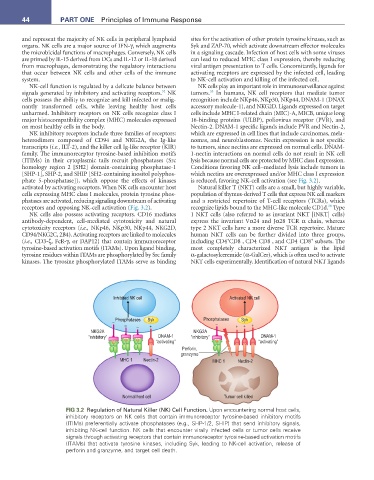
        phate 5-phosphatase]), which oppose the effects of kinases   is reduced, favoring NK-cell activation (see Fig. 3.2).
        activated by activating receptors. When NK cells encounter host   Natural killer T (NKT) cells are a small, but highly variable,
        cells expressing MHC class I molecules, protein tyrosine phos-  population of thymus-derived T cells that express NK cell markers
        phatases are activated, reducing signaling downstream of activating   and a restricted repertoire of T-cell receptors (TCRs), which
                                                                                                            34
        receptors and opposing NK-cell activation (Fig. 3.2).  recognize lipids bound to the MHC-like molecule CD1d.  Type
           NK cells also possess activating receptors. CD16 mediates   1 NKT cells (also referred to as invariant NKT [iNKT] cells)
        antibody-dependent, cell-mediated cytotoxicity and natural   express the invariant Vα24 and Jα28 TCR  α chain, whereas
        cytotoxicity receptors (i.e., NKp46, NKp30, NKp44, NKG2D,   type 2 NKT cells have a more diverse TCR repertoire. Mature
        CD94/NKG2C, 2B4). Activating receptors are linked to molecules   human NKT cells can be further divided into three groups,
                                                                                     −
                                                                                −
                                                                           +
                                                                                                       +
                                                                                                  −
                                                                                         −
        (i.e., CD3-ζ, FcR-γ, or DAP12) that contain immunoreceptor   including CD4 CD8 , CD4 CD8 , and CD4 CD8  subsets. The
        tyrosine-based activation motifs (ITAMs). Upon ligand binding,   most completely characterized NKT antigen is the lipid
        tyrosine residues within ITAMs are phosphorylated by Src family   α-galactosylceremide (α-GalCer), which is often used to activate
        kinases. The tyrosine phosphorylated ITAMs serve as binding   NKT cells experimentally. Identification of natural NKT ligands

                                      Inhibited NK cell                     Activated NK cell


                                       Phosphatases  Syk            Phosphatases  Syk
                                      –
                                          –   –   +                     –     +  +  +
                               NKG2A                            NKG2A
                              “inhibitory”           DNAM-1    “inhibitory”           DNAM-1
                                                    “activating”                      “activating”
                                                             Perforin,
                                                            granzyme
                                        MHC 1   Nectin-2               MHC 1   Nectin-2


                                         Normal host cell                 Tumor cell killed

                       FIG 3.2  Regulation of Natural Killer (NK) Cell Function. Upon encountering normal host cells,
                       inhibitory receptors on NK cells that contain immunoreceptor tyrosine-based inhibitory motifs
                       (ITIMs) preferentially activate phosphatases (e.g., SHP-1/2, SHIP) that send inhibitory signals,
                       inhibiting NK-cell function. NK cells that encounter virally infected cells or tumor cells receive
                       signals through activating receptors that contain immunoreceptor tyrosine-based activation motifs
                       (ITAMs) that activate tyrosine kinases, including Syk, leading to NK-cell activation, release of
                       perforin and granzyme, and target cell death.

