


Page 552 - Clinical Immunology_ Principles and Practice ( PDFDrive )
P. 552
530          Part four  Immunological Deficiencies


        with myeloma treated with bortezomib is around 13–22% and   intervention are similar among those undergoing SOT. This
        in relapsed/refractory mantle cell lymphoma around 10.3%, with   predictable temporal pattern has enabled the institution of specific
        age ≥65 years as the only predictive factor. 44        prophylactic strategies and in the development of an infection
                                                               differential diagnosis. 45
        INFECTIONS IN SOLID ORGAN TRANSPLANTATION
                                                                   CLINICaL PEarLS

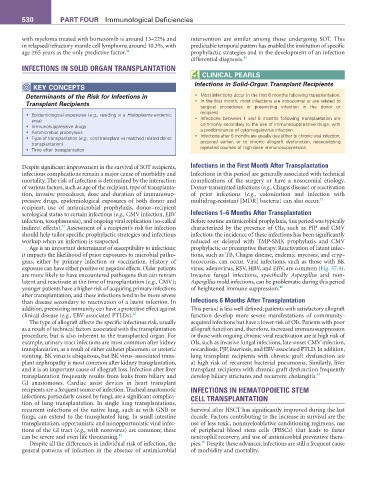
            KEY CoNCEPtS                                         Infections in Solid-Organ Transplant Recipients
         Determinants of the Risk for Infections in              •  Most infections occur in the first 6 months following transplantation.
         Transplant Recipients                                   •  In the first month, most infections are nosocomial or are related to
                                                                   surgical  procedures or  preexisting  infection in  the donor  or
                                                                   recipient.
          •  Epidemiological exposures (e.g., residing in a Histoplasma endemic
           area)                                                 •  Infections between 1 and 6 months following transplantation are
          •  Immunosuppressive drugs                               commonly secondary to the use of immunosuppressive drugs, with
          •  Antimicrobial prophylaxis                             a predominance of cytomegalovirus infection.
          •  Type of transplantation (e.g., cord transplant vs matched related donor   •  Infections after 6 months are usually due either to chronic viral infection,
           transplantation)                                        acquired earlier, or to chronic allograft dysfunction, necessitating
          •  Time after transplantation                            repeated courses of high-dose immunosuppression.


        Despite significant improvement in the survival of SOT recipients,   Infections in the First Month After Transplantation
        infectious complications remain a major cause of morbidity and   Infections in this period are generally associated with technical
        mortality. The risk of infection is determined by the interaction   complications of the surgery or have a nosocomial etiology.
        of various factors, such as age of the recipient, type of transplanta-  Donor-transmitted infections (e.g., Chagas disease) or reactivation
        tion, invasive procedures, dose and duration of immunosup-  of prior infections (e.g., colonization and infection with
        pressive drugs, epidemiological exposures of both donor and   multidrug-resistant [MDR] bacteria) can also occur. 45
        recipient, use of antimicrobial prophylaxis, donor–recipient
        serological status to certain infections (e.g., CMV infection, EBV   Infections 1–6 Months After Transplantation
        infection, toxoplasmosis), and ongoing viral replication (so-called   Before routine antimicrobial prophylaxis, this period was typically
                     45
        indirect effects).  Assessment of a recipient’s risk for infection   characterized by the presence of OIs, such as PJP and CMV
        should help tailor specific prophylactic strategies and infectious   infection; the incidence of these infections has been significantly
        workup when an infection is suspected.                 reduced or delayed with TMP-SMX prophylaxis and CMV
           Age is an important determinant of susceptibility to infections;   prophylactic or preemptive therapy. Reactivation of latent infec-
        it impacts the likelihood of prior exposures to microbial patho-  tions, such as TB, Chagas disease, endemic mycoses, and cryp-
        gens, either by primary infection or vaccination. History of   tococcosis, can occur. Viral infections, such as those with BK
        exposure can have either positive or negative effects. Older patients   virus, adenovirus, RSV, HBV, and EBV, are common (Fig. 37.4).
        are more likely to have encountered pathogens that can remain   Invasive fungal infections, specifically  Aspergillus and non-
        latent and reactivate at the time of transplantation (e.g., CMV);   Aspergillus mold infections, can be problematic during this period
        younger patients have a higher risk of acquiring primary infections   of heightened immune suppression. 45
        after transplantation, and these infections tend to be more severe
        than disease secondary to reactivation of a latent infection. In   Infections 6 Months After Transplantation
        addition, preexisting immunity can have a protective effect against   This period is less well defined; patients with satisfactory allograft
        clinical disease (e.g., EBV-associated PTLDs). 45      function develop more severe manifestations of community-
           The type of allograft affects the specific infectious risk, usually   acquired infections but have a lower risk of OIs. Patients with poor
        as a result of technical factors associated with the transplantation   allograft function and, therefore, increased immunosuppression
        procedure, but is also inherent to the transplanted organ. For   or those with ongoing chronic viral reactivation are at high risk of
        example, urinary tract infections are most common after kidney   OIs, such as invasive fungal infections, late-onset CMV infection,
        transplantation, as a result of either catheter placement or ureteric   nocardiosis, PJP, listeriosis, and EBV-associated PTLD. In addition,
        stenting. BK virus is ubiquitous, but BK virus–associated trans-  lung transplant recipients with chronic graft dysfunction are
        plant nephropathy is most common after kidney transplantation,   at high risk of recurrent bacterial pneumonia. Similarly, liver
        and it is an important cause of allograft loss. Infection after liver   transplant recipients with chronic graft dysfunction frequently
        transplantation frequently results from leaks from biliary and   develop biliary strictures and recurrent cholangitis. 45
        GI anastomoses. Cardiac assist devices in heart transplant
        recipients are a frequent source of infection. Tracheal anastomotic   INFECTIONS IN HEMATOPOIETIC STEM
        infections, particularly caused by fungi, are a significant complica-  CELL TRANSPLANTATION
        tion  of  lung  transplantation.  In  single  lung  transplantations,
        recurrent infections of the native lung, such as with GNB or   Survival after HSCT has significantly improved during the last
        fungi, can extend to the transplanted lung. In small intestine   decade. Factors contributing to the increase in survival are the
        transplantation, opportunistic and nonopportunistic viral infec-  use of less toxic, nonmyeloablative conditioning regimens, use
        tions of the GI tract (e.g., with norovirus) are common; these   of peripheral blood stem cells (PBSCs) that leads to faster
        can be severe and even life threatening. 45            neutrophil recovery, and use of antimicrobial preventive thera-
                                                                   46
           Despite all the differences in individual risk of infection, the   pies.  Despite these advances, infections are still a frequent cause
        general patterns of infection in the absence of antimicrobial   of morbidity and mortality.

