


Page 569 - Clinical Immunology_ Principles and Practice ( PDFDrive )
P. 569
546          ParT fOur  Immunological Deficiencies


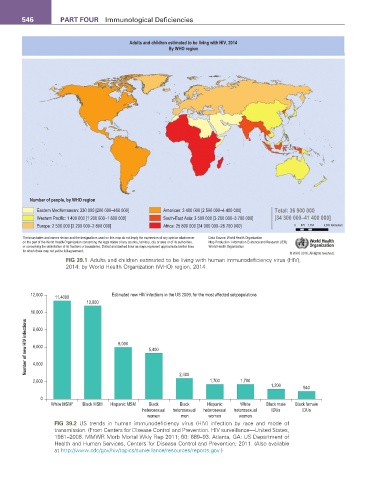
                                           Adults and children estimated to be living with HIV, 2014
                                                        By WHO region


           Number of people, by WHO region
             Eastern Mediterranean: 330 000 [200 000–460 000]  Americas: 3 400 000 [2 500 000–4 400 000]  Total: 36 900 000
             Western Pacific: 1 400 000 [1 200 000–1 800 000]  South-East Asia: 3 500 000 [3 200 000–3 700 000]  [34 300 000–41 400 000]
             Europe: 2 500 000 [2 200 000–2 800 000]  Africa: 25 800 000 [24 000 000–28 700 000]  0  875 1,750  3,500 Kilometers
        The boundaries and names shown and the designations used on this map do not imply the expression of any opinion whatsoever  Data Source: World Health Organization
        on the part of the World Health Organization concerning the legal states of any country, territory, city or area or of its authorities,  Map Production: Information Evidence and Research (IER)
        or concerning the delimitation of its frontiers or boundaries, Dotted and dashed lines on maps represent approximate border lines  World Health Organization
        for which there may not yet be full agreement.
                                                                                                © WHO 2016. All rights reserved.
                       fIG 39.1  Adults and children estimated to be living with human immunodeficiency virus (HIV),
                       2014: by World Health Organization (WHO) region, 2014.


           12,000                     Estimated new HIV infections in the US 2009, for the most affected subpopulations
                   11,4000
                             10,800
           10,000
          Number of new HIV infections  8,000  6,000  5,400


            6,000


            4,000

            2,000                                           2,400     1,700     1,700
                                                                                          1,200
                                                                                                    940
              0
                  White MSM*  Black MSM  Hispanic MSM  Black  Black  Hispanic   White   Black male  Black female
                                                heterosexual  heterosexual   heterosexual  heterosexual  IDUs  IDUs
                                                 women      men      women     women
                   fIG 39.2  US trends in human immunodeficiency virus (HIV) infection by race and mode of
                   transmission. (From Centers for Disease Control and Prevention. HIV surveillance—United States,
                   1981–2008. MMWR Morb Mortal Wkly Rep 2011; 60: 689–93. Atlanta, GA: US Department of
                   Health and Human Services, Centers for Disease Control and Prevention; 2011. (Also available
                   at http://www.cdc/gov/hiv/topics/surveillance/resources/reports.gov.)

