


Page 565 - Clinical Immunology_ Principles and Practice ( PDFDrive )
P. 565
542          Part four  Immunological Deficiencies


        infecting young children, is not uncommon. Immune competence   that includes antigen-receptor specificities to respond to vaccina-
        to chronic infections is also compromised with age. The best   tion. Repertoire contraction resulting from thymic involution or
        example here is the reactivation of VZV manifesting as shingles.  memory inflation appears to be less severe than originally thought,
                                                               and currently explored interventions to restore thymic activity
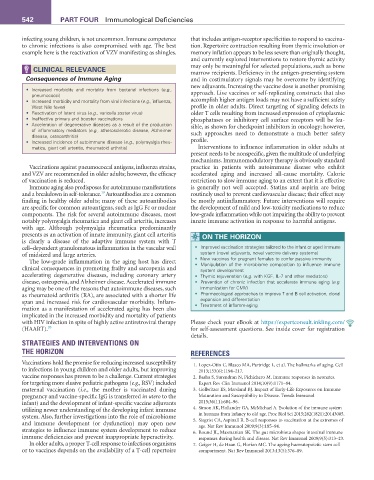
            CLINICaL rELEVaNCE                                 may only be meaningful for selected populations, such as bone
                                                               marrow recipients. Deficiency in the antigen-presenting system
         Consequences of Immune Aging                          and in costimulatory signals may be overcome by identifying
                                                               new adjuvants. Increasing the vaccine dose is another promising
          •  Increased  morbidity  and  mortality  from  bacterial  infections  (e.g.,
           pneumococci)                                        approach. Live vaccines or self-replicating constructs that also
          •  Increased morbidity and mortality from viral infections (e.g., influenza,   accomplish higher antigen loads may not have a sufficient safety
           West Nile fever)                                    profile in older adults. Direct targeting of signaling defects in
          •  Reactivation of latent virus (e.g., varicella zoster virus)  older T cells resulting from increased expression of cytoplasmic
          •  Ineffective primary and booster vaccinations      phosphatases or inhibitory cell surface receptors will be fea-
          •  Acceleration of degenerative diseases as a result of the production   sible, as shown for checkpoint inhibitors in oncology; however,
           of inflammatory mediators (e.g., atherosclerotic disease, Alzheimer   such approaches need to demonstrate a much better safety
           disease, osteoarthritis)
          •  Increased incidence of autoimmune disease (e.g., polymyalgia rheu-  profile.
           matica, giant cell arteritis, rheumatoid arthritis)    Interventions to influence inflammation in older adults at
                                                               present needs to be nonspecific, given the multitude of underlying
                                                               mechanisms. Immunomodulatory therapy is obviously standard
           Vaccinations against pneumococcal antigens, influenza strains,   practice in patients with autoimmune disease who exhibit
        and VZV are recommended in older adults; however, the efficacy   accelerated aging and increased all-cause mortality. Calorie
        of vaccination is reduced.                             restriction to slow immune aging to an extent that it is effective
           Immune aging also predisposes for autoimmune manifestations   is generally not well accepted. Statins and  aspirin are being
                                  19
        and a breakdown in self-tolerance.  Autoantibodies are a common   routinely used to prevent cardiovascular disease; their effect may
        finding in healthy older adults; many of these autoantibodies   be mostly antiinflammatory. Future interventions will require
        are specific for common autoantigens, such as IgG Fc or nuclear   the development of mild and low-toxicity medications to reduce
        components. The risk for several autoimmune diseases, most   low-grade inflammation while not impairing the ability to prevent
        notably polymyalgia rheumatica and giant cell arteritis, increases   innate immune activation in response to harmful antigens.
        with age.  Although polymyalgia rheumatica predominantly
        presents as an activation of innate immunity, giant cell arteritis    oN tHE HorIZoN
        is clearly a disease of the adaptive immune system with T
        cell–dependent granulomatous inflammation in the vascular wall   •  Improved vaccination strategies tailored to the infant or aged immune
        of midsized and large arteries.                            system (novel adjuvants, novel vaccine delivery systems)
           The low-grade inflammation in the aging host has direct   •  New vaccines for pregnant females to confer passive immunity
                                                                 •  Manipulation of the microbiome composition to influence immune
        clinical consequences in promoting frailty and sarcopenia and   system development
        accelerating  degenerative  diseases,  including  coronary  artery   •  Thymic rejuvenation (e.g. with KGF, IL-7 and other mediators)
        disease, osteopenia, and Alzheimer disease. Accelerated immune   •  Prevention of chronic infection that accelerate immune aging (e.g.
        aging may be one of the reasons that autoimmune diseases, such   immunization for CMV)
        as rheumatoid arthritis (RA), are associated with a shorter life   •  Pharmacological approaches to improve T and B cell activation, clonal
                                                                   expansion and differentiation
        span and increased risk for cardiovascular morbidity. Inflam-  •  Treatment of inflamm-aging
        mation as a manifestation of accelerated aging has been also
        implicated in the increased morbidity and mortality of patients
        with HIV infection in spite of highly active antiretroviral therapy   Please check your eBook at https://expertconsult.inkling.com/
        (HAART). 20                                            for self-assessment questions. See inside cover for registration
                                                               details.
        STRATEGIES AND INTERVENTIONS ON
        THE HORIZON                                            REFERENCES
        Vaccinations hold the promise for reducing increased susceptibility   1.  Lopez-Otin C, Blasco MA, Partridge L, et al. The hallmarks of aging. Cell
        to infections in young children and older adults, but improving   2013;153(6):1194–217.
        vaccine responses has proven to be a challenge. Current strategies   2.  Basha S, Surendran N, Pichichero M. Immune responses in neonates.
        for targeting more elusive pediatric pathogens (e.g., RSV) included   Expert Rev Clin Immunol 2014;10(9):1171–84.
        maternal vaccination (i.e., the mother is vaccinated during   3.  Gollwitzer ES, Marsland BJ. Impact of Early-Life Exposures on Immune
        pregnancy and vaccine-specific IgG is transferred in utero to the   Maturation and Susceptibility to Disease. Trends Immunol
        infant) and the development of infant-specific vaccine adjuvants   2015;36(11):684–96.
        utilizing newer understanding of the developing infant immune   4.  Simon AK, Hollander GA, McMichael A. Evolution of the immune system
        system. Also, further investigations into the role of microbiome   in humans from infancy to old age. Proc Biol Sci 2015;282(1821):20143085.
        and immune development (or dysfunction) may open new    5.  Siegrist CA, Aspinall R. B-cell responses to vaccination at the extremes of
                                                                  age. Nat Rev Immunol 2009;9(3):185–94.
        strategies to influence immune system development to reduce   6.  Round JL, Mazmanian SK. The gut microbiota shapes intestinal immune
        immune deficiencies and prevent inappropriate hyperactivity.   responses during health and disease. Nat Rev Immunol 2009;9(5):313–23.
           In older adults, a proper T-cell response to infectious organisms   7.  Geiger H, de Haan G, Florian MC. The ageing haematopoietic stem cell
        or to vaccines depends on the availability of a T-cell repertoire   compartment. Nat Rev Immunol 2013;13(5):376–89.

